


TL;DR Summary
Comprehensive background screening for rental properties in 2026 combines modern credit analysis, criminal background checks, employment and income verification, rental and eviction history review, identity authentication, and AI-powered fraud detection. With 93.3% of property managers facing application fraud, eviction costs averaging $2,540–$7,700, and bad debt write-offs reaching $4.2 million annually for some operators, using professional providers like SmartScreen is essential to stop losses, maintain FCRA and Fair Housing compliance, and select quality tenants who pay on time.
Why Background Screening Matters More Than Ever in 2026
Background screening for rental properties is no longer optional—it is the landlord’s primary defense against financial devastation, legal exposure, and operational chaos in an era of sophisticated fraud.
Financial Stakes: Eviction and Bad Debt Costs
Eviction costs average $2,540–$7,700 per case when factoring in lost rental income (2–3 months), legal fees ($500–$1,000), court costs ($50–$400), and property turnover expenses ($150–$1,750). Critically, only 17% of eviction judgments result in any financial recovery, meaning landlords write off the vast majority of these losses.
According to the National Multifamily Housing Council’s 2024 Pulse Survey, nearly 24% of all eviction filings in the prior three years stemmed from fraudulent applications and subsequent failure to pay rent. Furthermore, the average survey respondent was forced to write off nearly $4.2 million in bad debt over the previous 12 months, with approximately 25% of that bad debt directly attributable to nonpayment due to fraudulent applications.
The 2026 Rental Fraud Crisis
Rental application fraud has reached epidemic levels, driven by pandemic-era digitization, AI-powered forgery tools, and deteriorating economic conditions.
Key 2026 fraud statistics:
93.3% of property managers and owners report experiencing some form of fraud in the past 12 months.
84.3% have encountered applicants who falsified or fabricated pay stubs, employment references, or other income documentation.
80% observed prospective renters misrepresenting information on applications.
70% reported identity theft, fraudulent ID documents, or use of another individual’s personal information.
67.1% experienced unauthorized cohabitants, illegal subletting, or other forms of evasion.
62.9% reported fraudulent checks or other payment methods.
Moreover, 70.7% of respondents reported an increase in fraudulent applications and payments over the past 12 months, with those reporting increases averaging a 40.4% increase.
Atlanta: Ground Zero for Rental Fraud
The Wall Street Journal’s investigation, widely cited across industry sources, identifies the Atlanta metro area as the national epicenter of rental application fraud. Greystar, America’s largest apartment landlord, reports that fraudulent applications now account for as much as 50% of all submissions at some Atlanta properties, particularly in midtown, downtown, and Buckhead.
Other high-fraud markets include Houston, Los Angeles, South Florida, Washington D.C., Durham-Chapel Hill, Salt Lake City, Portland, Charleston, and Boston.
Legal Compliance: FCRA and Fair Housing Requirements
HUD’s 2024 Fair Housing guidance and the federal Fair Credit Reporting Act (FCRA) require transparent, fair, and consistent screening for all applicants. Landlords who fail to comply face discrimination claims, regulatory penalties, and costly litigation.
For comprehensive FCRA compliance guidance, review the Federal Trade Commission’s FCRA resources and SmartScreen’s overview of tenant screening laws.
Competitive Advantage Through Professional Screening
Landlords who invest in professional background screening solutions report up to 80% fewer rental disputes, 25% lower turnover, and dramatically lower eviction rates than those using informal or incomplete vetting. Professional screening not only protects income but also supports better tenant relationships and property reputation.
Background Screening Components & Risk Reduction
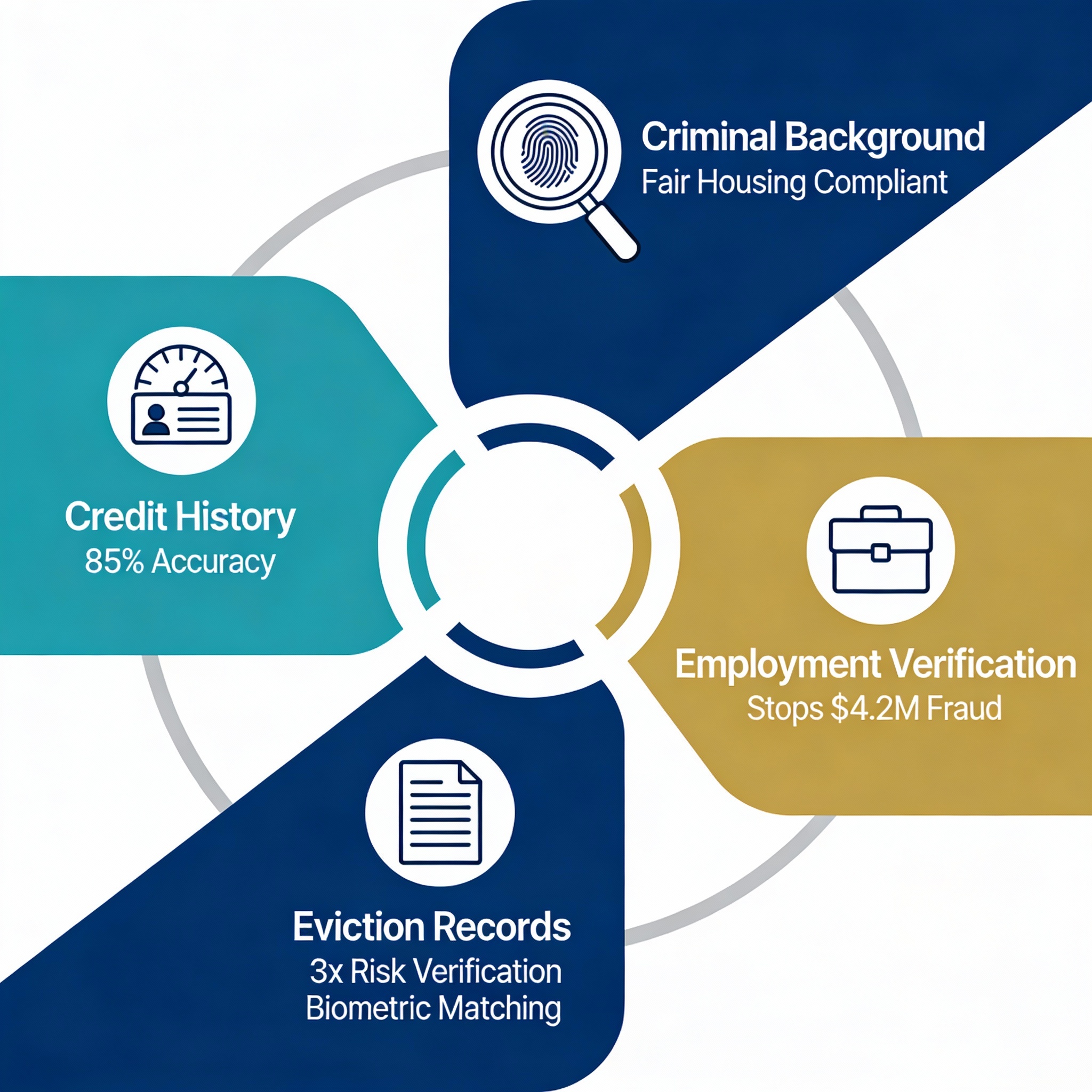
The SmartScreen 5-Step Tenant Screening Process
SmartScreen’s tenant screening platform provides landlords with a systematic, compliant, and highly accurate screening framework that addresses every major fraud vector.
Step 1: Application Review and Automated Document Analysis
SmartScreen instantly flags inconsistencies in rental applications using automated document analysis that detects common forgery patterns, metadata anomalies, and mismatched records. This first layer of defense catches template-generated pay stubs, digitally altered bank statements, and documents sourced from “fraud farms” that mass-produce fake paperwork.
Step 2: Employment and Income Verification
Employment fraud is a $4.2 million crisis for landlords in 2026. SmartScreen eliminates document manipulation by conducting direct employer verification through independently researched contact channels, then cross-checking reported income against pay stubs, tax returns, and—where applicable—bank deposit patterns for gig workers.
Red flags SmartScreen catches:
Pay stubs showing perfectly round figures, with unrealistic tax withholdings or deductions.
Employment verification contacts who immediately confirm details without asking for the caller’s identity or credentials.
Bank statements showing suspiciously regular, identical deposit amounts rather than the natural variation of real paychecks.
Step 3: Comprehensive Multi-Database Background Check
SmartScreen searches national credit bureaus, criminal databases, and eviction records across multiple jurisdictions to build a complete risk profile. This includes:
Credit history: Beyond traditional FICO scores, SmartScreen evaluates ResidentScore models that predict rental payment reliability 15% better than standard credit scores.
Criminal background: Searches national and state databases using multiple identifiers (name, DOB, SSN) while ensuring compliance with HUD’s 2024 guidance requiring individualized assessment rather than blanket bans.
Eviction records: Tenants with prior evictions are 3x more likely to face eviction again, making this one of the most predictive screening factors.
For more on credit-specific screening, see SmartScreen’s tenant credit check resources.
Step 4: Identity Authentication and Biometric Matching
Identity theft and Credit Profile Number (CPN) fraud are among the fastest-growing threats. SmartScreen uses biometric matching and document verification technology to confirm applicants are who they claim to be, stopping third-party identity fraud before lease signing.
CPN alert: The Wall Street Journal investigation confirms that using Credit Profile Numbers instead of legitimate Social Security Numbers on rental applications constitutes fraud and is illegal. SmartScreen flags CPN use automatically.
Step 5: AI-Powered Risk Assessment and Recommendation
SmartScreen generates a detailed risk score and recommendation using 30+ data points, including payment history, employment stability, rental references, and fraud detection signals. This final risk assessment helps landlords make confident, defensible decisions backed by comprehensive data.
Real-world result: A Charlotte property management firm using SmartScreen avoided $22,500 in potential losses by catching three fake applications in a single month.
Key Background Screening Components Explained
1. Credit History and Financial Analysis
What matters beyond FICO: Modern screening platforms like SmartScreen evaluate ResidentScore and other rental-specific credit models that predict rental payment reliability 15% better than traditional FICO scores. These models weigh factors like debt-to-income ratio, recent credit inquiries, payment patterns, and account delinquencies to estimate risk with approximately 85% accuracy.
For rental-specific credit insights, consult TransUnion SmartMove’s ResidentScore documentation and SmartScreen’s credit analysis tools.
2. Criminal Background Verification with Fair Housing Compliance
HUD’s 2024 update requirements: Landlords must evaluate offense severity, time elapsed, and relevance to tenancy on an individualized basis—blanket criminal history bans are prohibited under Fair Housing law.
How SmartScreen complies: Searches national and state databases using multiple identifiers (name variations, date of birth, Social Security Number) and cross-references results, then provides landlords with guidance on applying individualized assessments that comply with HUD’s criminal background guidance.
3. Employment and Income Verification
Why it is critical: Employment fraud accounted for 84.3% of all fraud cases reported in the NMHC survey, with bad debt from fraudulent tenants reaching $4.2 million annually for some operators.
SmartScreen’s verification system:
Eliminates document manipulation by contacting employers directly through independently verified phone numbers (never using applicant-provided contacts).
Cross-checks pay stubs and tax returns for internal consistency and realistic withholding patterns.
Analyzes bank deposit patterns for gig workers and self-employed applicants to verify income stability.
4. Rental History and Eviction Records
Predictive power: Tenants with prior evictions are 3x more likely to face eviction again, making this one of the most predictive screening data points. Additionally, nearly 24% of all eviction filings over the past three years were tied to fraudulent applications and related rent nonpayment.
What SmartScreen checks:
Payment patterns and on-time rent history from previous landlords.
Lease compliance, property care, and any reported violations or disputes.
Court eviction records across multiple jurisdictions to catch applicants with hidden eviction histories.
Ensuring Legal Compliance: FCRA and Fair Housing Requirements
FCRA Compliance Checklist for Landlords
Federal law requires landlords to follow specific procedures when conducting background screening. Failure to comply can result in lawsuits, fines, and damages.
☑ Written consent: Always obtain written authorization before running credit, criminal, or background checks.
☑ Adverse action notice: If you deny an application based on screening results, provide a written “adverse action” letter explaining the decision and including the screening company’s contact information.
☑ Disclosure of rights: Give applicants their rights under the FCRA, including how to dispute inaccurate information.
☑ Secure data storage and disposal: Safely store screening records and dispose of them securely to protect applicant privacy.
For complete FCRA compliance guidance, review the FTC’s FCRA requirements for landlords.
HUD 2024 Fair Housing Guidance
HUD’s 2024 Fair Housing guidance emphasizes three critical principles for background screening:
Algorithmic transparency: Minimize bias by employing transparent, documented decision-making processes and regularly auditing screening algorithms for disparate impact.
Protected class consistency: Apply the same screening criteria to all applicants regardless of race, color, religion, national origin, sex, disability, or familial status.
Clear adverse action: Provide clear, written reasons for denials, including instructions for disputing inaccurate information.
SmartScreen’s built-in compliance features ensure landlords meet these requirements automatically.
Technology and Trends: The 2026 Tenant Screening Market
Market Growth and AI Adoption
The global tenant screening market was valued at approximately $110 billion in 2023 and is projected to reach $195 billion by 2030, driven by rising fraud rates and landlord demand for better protection.
Currently, 78% of screening platforms use machine learning and AI to detect sophisticated document fraud and predict tenant reliability. These tools analyze metadata, image manipulation patterns, and cross-database inconsistencies that human reviewers cannot catch.
Alternative Data for Financial Inclusion
Modern screening platforms are incorporating alternative data—such as rent payment history, utility payment patterns, and bank account behavior—to evaluate applicants who may lack traditional credit histories. This approach supports Fair Housing goals by expanding access for underbanked renters while still maintaining strong risk assessment.
Fraud Detection and Prevention Strategies for 2026
The Rising Sophistication of Document Fraud
Document fraud has evolved from simple Photoshop alterations to sophisticated AI-generated forgeries that evade manual detection. According to Snappt’s analysis of 2.9 million documents in 2025, approximately 25,000 were deemed the product of “template farms” that mass-produce fake documents, while another 21,540 were flagged as the work of “advanced fraud rings” that tamper with underlying document code.
Social media platforms and the dark web have democratized access to these fraud tools, with TikTok personalities advertising comprehensive fraud packages—including fake pay stubs, CPN numbers, and altered bank statements—for $250 to $1,250.
SmartScreen’s Multi-Layer Fraud Defense
SmartScreen uses AI-powered fraud detection to identify:
Digital forgeries through metadata analysis and pixel-level image inspection.
Template-generated documents by comparing submitted files against known fraud farm patterns.
Mismatched records by cross-referencing employment, income, and credit data across multiple independent databases.
Additionally, SmartScreen verifies all employment independently through direct employer contact, bypassing applicant-provided references that may be part of the fraud scheme.
Red Flags Every Landlord Should Know
Even without professional tools, landlords can watch for these warning signs:
Perfect-looking documents: Pay stubs with perfectly round numbers, no tax withholdings, or no realistic deductions.
Verification resistance: Applicants who push back against routine checks or offer to pay multiple months upfront to “skip” screening.
Employment verification anomalies: Contacts who confirm details immediately without asking for your identity or credentials.
Credit Profile Numbers: Any applicant using a CPN instead of a Social Security Number is committing fraud.
Implausibly perfect applications: Applicants with flawless credit, high income, excellent references, and immediate availability who somehow can’t secure housing elsewhere.
Real-World Success: Case Studies from SmartScreen Clients
Denver Multi-Family Portfolio (450 Units)
A Denver property management company implemented SmartScreen’s comprehensive background screening platform and achieved:
Turnover reduction from 18% to 8% annually.
Fraud losses dropped to zero within 90 days of implementation.
Average tenant quality scores improved by 35%.
Atlanta Single-Family Portfolio
An Atlanta landlord managing 12 single-family rentals adopted SmartScreen after losing $15,000 to a fraudulent tenant and achieved:
Screening time reduced from 5–7 days to 24 hours.
Zero problematic tenants since implementation (18 months).
Estimated $15,000+ in avoided losses.
Phoenix Property Management Firm
A Phoenix firm managing 200+ units integrated SmartScreen with their property management software and reported:
25% faster lease-ups due to streamlined screening.
15% better tenant retention through improved tenant quality.
$50,000 in annual operational savings from automation and reduced evictions.
FAQ: Background Screening for Rental Properties
What does comprehensive background screening cover?
Background screening includes credit history analysis, criminal background checks, eviction records, employment and income verification, rental history from previous landlords, and identity authentication using biometric matching and document verification.
Who pays for tenant screening fees?
Typically, applicants pay nonrefundable screening fees ranging from $35–$75 to cover the cost of reports, though some landlords include screening as part of their services to attract higher-quality applicants.
Is it legal to deny tenants based on background screening results?
Yes, landlords can legally deny applications based on screening results, provided that decisions comply with Fair Housing laws (no discrimination based on protected characteristics) and FCRA requirements (a written adverse action notice with dispute instructions).
How can landlords avoid Fair Housing violations during screening?
Apply the same written criteria to all applicants, avoid blanket bans (especially for criminal history), conduct individualized assessments, document all decisions thoroughly, and provide written adverse action notices with clear reasons and dispute instructions.
What makes SmartScreen different from other screening providers?
SmartScreen offers industry-leading AI-powered fraud detection, direct employer verification (not reliant on applicant-provided contacts), Fair Housing compliance expertise built into every report, biometric identity authentication, and a proven 22+ year track record of protecting landlords.
How much does rental application fraud cost landlords annually?
The average NMHC survey respondent wrote off nearly $4.2 million in bad debt over 12 months, with approximately 25% directly attributable to fraudulent applications and nonpayment. Individual evictions cost $2,540–$7,700 on average.
Conclusion: Protecting Your Rental Investment in 2026
Background screening for rental properties is no longer optional—it is the essential first line of defense against fraud, eviction losses, and legal liability in an era of unprecedented application fraud and economic uncertainty. Professional, multi-layer verification through services like SmartScreen delivers better tenants, fewer disputes, and substantial cost savings while ensuring full FCRA and Fair Housing compliance.
For 2026 and beyond, investing in comprehensive background screening is the best way to protect both your property and your peace of mind.