


Quick Takeaways
Use a standardized checklist to evaluate all applicants fairly and consistently.
Pre-screen candidates before investing time in full background checks
Income-to-rent ratio should typically be 3:1 (tenant earns 3x monthly rent)
Credit scores below 650 indicate higher default risk
Eviction history is the strongest predictor of future non-payment
Contact previous landlords directly—don’t rely on applicant references alone
SmartScreen automates most screening steps, reducing time by 60-80%
Fair Housing compliance is non-negotiable throughout the entire process
Why Every Landlord Needs a Tenant Screening Checklist
Last month, I consulted with a landlord who skipped proper screening to fill a vacancy quickly. The applicant seemed nice, dressed professionally, and gave a convincing story about needing immediate housing. Three months later, that landlord was staring at $18,000 in losses: $6,800 in unpaid rent, $4,200 in eviction costs and legal fees, $5,500 in property repairs (holes in walls, broken appliances, damaged flooring), and two months of lost rent during turnover. The tenant had three prior evictions—all easily discoverable with basic screening.
This scenario repeats daily across the country. According to industry data, landlords using professional screening services experience default rates 67% lower than those relying on informal processes. Eviction rates drop by half among professionally screened tenants.
A comprehensive tenant screening checklist prevents these costly scenarios by creating a systematic, defensible evaluation process. Rather than relying on intuition or first impressions, you gather objective data across multiple criteria, compare applicants fairly, and document everything for legal protection.
Beyond financial protection, a checklist ensures Fair Housing compliance by applying identical criteria to all applicants regardless of race, color, religion, sex, national origin, disability, or familial status. This consistency protects landlords from discrimination claims while ensuring systematic, unbiased decision-making.
The U.S. Department of Housing and Urban Development (HUD) issued updated guidance in April 2024 emphasizing that housing providers remain legally responsible for discriminatory screening decisions even when using third-party screening companies. HUD made clear that the Fair Housing Act “applies to housing decisions regardless of what technology is used,” including artificial intelligence and machine learning tools.
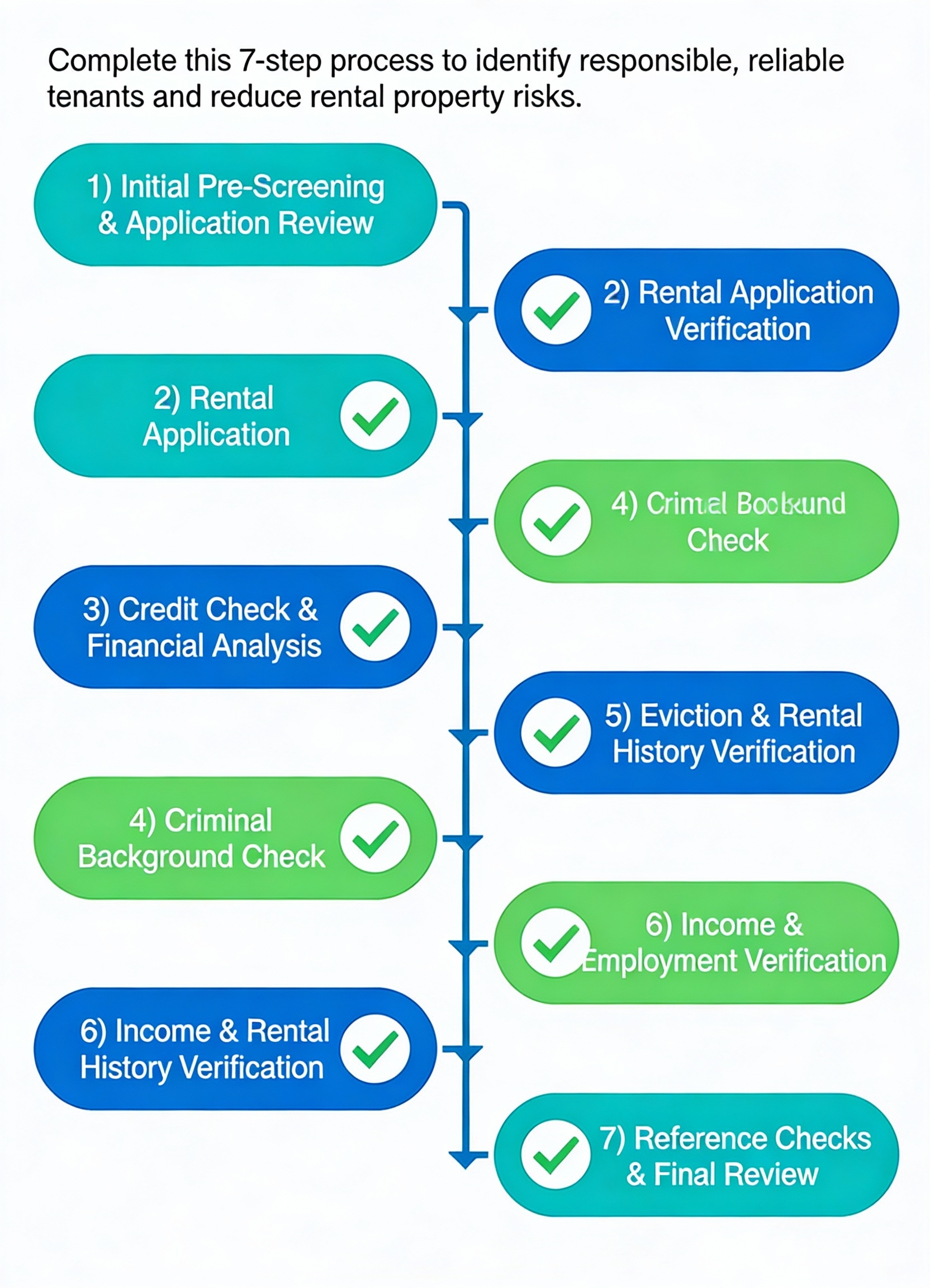
The 7-Step Tenant Screening Checklist
Step 1: Pre-Screen Applicants With Initial Questions
Before scheduling property showings or conducting formal background checks, pre-screen candidates with fundamental questions that quickly identify unsuitable applicants. This initial filtering saves time and effort while setting expectations.
Last week, I pre-screened twelve inquiries about a rental property. Seven failed basic qualifying questions (insufficient income, immediate eviction on record, unwilling to consent to screening). By identifying these disqualified applicants upfront, I avoided wasting $350 on unnecessary background checks and hours scheduling unproductive showings.
Key pre-screening questions include:
When do you plan to move in? Ensures alignment with your availability and timeline
What’s your monthly gross income? Filters applicants who can’t afford the rent (typically should be 3x monthly rent or higher)
Are you currently employed, or do you have a stable income? Confirms ongoing income source and stability
Do you have pets? Identifies potential policy conflicts before investing in screening costs
Why are you moving from your current residence? Reveals red flags like evictions, job loss, or conflicts with previous landlords
Will you consent to background and credit checks? Gauges transparency and willingness to cooperate
Do you smoke? Clarifies compliance with no-smoking policies if applicable
How many people will be living in the unit? Confirms lease terms match your property capacity and local occupancy codes
Applicants unwilling to answer basic questions or those providing evasive answers deserve closer scrutiny during formal screening. Hesitation around background check consent often signals something to hide.
Step 2: Collect a Completed Rental Application
A written rental application creates an official record, signals serious intent from applicants, and provides information for verification. Never proceed without a completed application—it’s your foundational document for the entire screening process.
I learned this lesson the hard way years ago when I accepted a verbal application from a friend-of-a-friend. Without written documentation of employment, previous addresses, or landlord contacts, I had nothing to verify. That tenant lasted four months before defaulting on rent. Since then, every applicant completes a full written application without exception.
Your rental application must include:
Full legal name, date of birth, driver’s license number, and social security number
Current address and phone number, with how long they’ve lived there
Employment information: current employer, position, supervisor contact, annual salary, employment duration
Previous addresses for the past 5+ years with landlord contact information
Reason for leaving each previous residence
List of personal and professional references
Bank account information for electronic payments
Written consent for background checks and credit verification under the Fair Credit Reporting Act (FCRA)
Disclosure questions: evictions, bankruptcies, criminal history, lease violations
Signature and date acknowledging information accuracy
Pet information, if applicable, including breed, weight, and veterinary records
Incomplete applications should be returned with a request for full completion. This weeds out disorganized or dishonest applicants early while establishing a professional tone. Applicants who can’t complete basic paperwork rarely make reliable tenants.
Step 3: Conduct a Comprehensive Credit Check
A credit check reveals financial responsibility, payment patterns, and creditworthiness—directly indicating the ability to pay rent consistently. This step is non-negotiable in any professional screening process.
Two years ago, I almost approved an applicant with excellent references and steady employment. Something made me look closer at the credit report. Despite a 680 credit score, the applicant had seven collections totaling $12,000—all from the past year. Further investigation revealed a gambling problem that had derailed their finances. That credit check saved me from a tenant who statistically would have defaulted within months.
What to evaluate in credit reports:
Credit score: Scores above 700 indicate excellent credit and low risk. 650-700 suggests acceptable creditworthiness. Below 600 raises significant concerns. However, scores aren’t absolute—consider context before rejecting applicants with lower scores due to medical debt, job loss, or identity theft. HUD’s 2024 guidance emphasizes that credit score thresholds can have a disparate impact on protected classes and should be applied thoughtfully with individualized assessment.
Payment history: Review the past 7 years for late payments, collections, charge-offs, and defaults. One or two late payments from years ago might be excusable; consistent patterns of 30+ day late payments or recent delinquencies are concerning. Look at the trend—is credit improving or deteriorating?
Outstanding debts: Calculate the debt-to-income ratio by dividing total monthly debt payments by gross monthly income. Ratios above 45% indicate the applicant is highly leveraged and may struggle with additional rent obligations. Someone paying $2,000 in monthly debt with $4,500 income (44% ratio) is financially stretched.
Eviction history: Evictions appearing on credit reports are red flags indicating previous landlord disputes and non-payment. Any eviction should trigger a deeper investigation into the circumstances. However, the Fair Credit Reporting Act generally prohibits reporting civil judgments older than seven years.
Bankruptcies: Discharged bankruptcies from 5+ years ago may be less concerning; recent bankruptcies (within 2-3 years) indicate ongoing financial stress and higher default risk. Chapter 7 bankruptcies remain on credit reports for 10 years; Chapter 13 for 7 years.
Collections and charge-offs: These indicate that the applicant stopped making payments and defaulted. Numerous collections suggest financial irresponsibility and future rent payment risk. Pay attention to recency and amounts—a $50 medical collection from five years ago differs from $5,000 in credit card defaults from last month.
Use SmartScreen’s credit check services to access comprehensive credit reports from all three major bureaus—Equifax, Experian, and TransUnion—rather than relying on applicant-provided credit scores, which may be inaccurate or outdated.
Step 4: Run a Criminal Background Check
Criminal background checks assess potential safety risks and protect your property, other tenants, and your legal liability. Modern screening includes county, state, and federal records as well as sex offender registry searches.
Here’s the critical distinction many landlords miss: HUD guidelines explicitly prohibit blanket policies that automatically reject all applicants with any criminal history. Such policies have been found to have disparate impact on protected classes, particularly based on race and national origin, and violate the Fair Housing Act.
Instead, you must conduct individualized assessments considering:
Nature and severity of the criminal conduct
Time elapsed since the criminal conduct occurred
Evidence of rehabilitation and good tenant history since the conduct
The nature of the housing and whether the criminal conduct directly relates to tenant safety
A felony conviction from 20 years ago with no subsequent issues should be evaluated differently from a recent domestic violence charge. Always document your reasoning for any denial based on criminal history.
What to investigate:
Violent crimes: Assault, battery, domestic violence, weapons charges, or threats indicate safety concerns. Recent violent offenses typically warrant serious consideration, though older offenses may not, depending on rehabilitation evidence.
Property crimes: Theft, burglary, arson, and vandalism suggest risk of property damage. Previous property crime convictions raise legitimate concerns about rental property safety, particularly if recent.
Drug-related offenses: Possession, distribution, or manufacturing charges indicate potential illegal activity on your property and possible tenant community issues. However, marijuana possession convictions are increasingly viewed differently as legalization expands.
Sex offender status: Registered sex offenders warrant careful review. Some jurisdictions restrict where sex offenders can live, particularly near schools or childcare facilities. However, blanket bans may still violate Fair Housing laws—consult legal counsel.
Under the Fair Credit Reporting Act, consumer reporting agencies generally cannot report arrests, criminal charges, or other non-conviction criminal records older than seven years. Convictions can be reported regardless of age.
Use SmartScreen’s criminal background checks to access comprehensive national, state, and county records rather than conducting manual searches that may miss critical information.
Step 5: Verify Eviction and Rental History
Eviction history is the single strongest predictor of future non-payment and lease violations. This step reveals how applicants actually behaved with previous landlords—the most reliable indicator of future behavior.
Three months ago, an applicant presented impeccable credit (750 score) and excellent employment (six years as a software engineer earning $95,000). Everything looked perfect—until I checked eviction records—two evictions in three years, both for non-payment despite the applicant’s high income. When I contacted previous landlords, a pattern emerged: chronic late payments, constant excuses, and ultimate default despite financial ability to pay. That rental history check prevented what would have been a costly mistake.
What to verify:
Court records: Formal eviction filings, judgments, and case outcomes document disputes and non-payment
Payment history: Did the applicant pay rent on time, or were consistent late payments the pattern even without a formal eviction?
Property condition: How did the applicant maintain the unit? Were there damage complaints or lease violations documented?
Lease violations: Was any eviction due to non-payment, unauthorized occupants, noise complaints, pets, smoking, or other lease breaches?
Duration of tenancy: Long tenancies (2+ years) suggest stability; frequent moves every 6-12 months indicate instability or conflicts
Contact previous landlords directly by phone using numbers you independently verify—not contact information applicants provide. When I first started, I used applicant-provided landlord numbers. Later, I discovered several applicants had listed friends who posed as landlords providing glowing (fake) references. Now I independently verify landlord identities through property records or management company websites.
Ask specific questions:
“Did this tenant pay rent on time each month?”
“How long did they live there?”
“What condition was the unit left in when they moved out?”
“Were there any complaints from neighbors about noise, conflicts, or other issues?”
“Would you rent to this person again without hesitation?”
“Why did they leave your property?”
“Did they provide proper notice, or did they break the lease early?”
Landlords are typically candid when speaking confidentially; their responses reveal far more than generic written references. Pay attention to hesitation, vague answers, or unwillingness to give a firm recommendation—these signal problems.
HUD’s guidance notes that eviction records can have a disparate impact on protected classes, as eviction filings disproportionately affect certain groups. The guidance recommends considering circumstances around evictions (such as domestic violence, medical emergencies, or temporary job loss) and giving applicants the opportunity to explain before making final decisions.
Use SmartScreen’s eviction history reports to search nationwide databases covering court records, eviction filings, and judgment history across multiple states—far more comprehensive than manual courthouse searches.
Step 6: Verify Income and Employment
Income verification confirms the applicant can afford the rent and indicates financial stability. Standard practice requires income to be at least 3x monthly rent, though some markets use 2.5x or 3.5x ratios.
Last year, an applicant claimed $6,500 monthly income from self-employment, well above my 3x requirement for the $1,800 rent. When I requested tax returns, the applicant provided heavily redacted documents with inconsistencies. Upon contacting the applicant’s accountant (whose contact information I independently verified), I learned actual income averaged $3,200 monthly—barely half what was claimed. That verification saved me from approving an applicant who couldn’t genuinely afford the rent.
Verification methods:
Pay stubs: Request 2-3 recent pay stubs showing consistent income, employer name, position, and tax withholdings. Current pay stubs prove ongoing employment; outdated stubs suggest job changes or termination. Look for consistency—income should match across multiple pay periods.
Tax returns: For self-employed applicants or those with variable income, you require 1-2 years of personal tax returns (Form 1040). Tax returns reveal actual annual income more accurately than verbal claims. Schedule C shows business income/losses; Schedule E shows rental income. Calculate the average monthly income by dividing the annual totals by 12.
Offer letters: For newly employed applicants, offer letters confirming job title, start date, and salary provide proof of future income. However, verify employment actually started by contacting HR after the stated start date.
Employer verification: Contact the applicant’s employer directly using independently verified phone numbers (from company websites, not applicant-provided contacts) to confirm:
Current employment status and start date
Job title and position
Annual salary or hourly rate with average hours worked
Employment duration and likelihood of continued employment
Supervisor name matches the application
Most employers confirm employment details for background checks, though some only verify through third-party services such as The Work Number.
Bank statements: Request 2-3 months of bank statements showing deposit patterns matching reported income. Large one-time deposits should be explained and verified (inheritance, sale of assets, tax refunds). Look for consistent deposits that match pay schedules—bi-weekly, semi-monthly, or monthly—aligning with the claimed employment.
Apply the income-to-rent ratio consistently: If your rent is $1,500 monthly, you require a minimum $4,500 monthly gross income ($54,000 annually). Some landlords require 2.5x for higher-income applicants; others use 3.5x for competitive markets. Be consistent across all applicants to avoid Fair Housing violations.
HUD guidance notes that income source discrimination—rejecting applicants solely because income comes from Housing Choice Vouchers (Section 8), disability benefits, Social Security, or other legal sources—may violate Fair Housing laws in many jurisdictions. Focus on income sufficiency and stability rather than source.
Use SmartScreen’s employment and income verification services to independently verify employment details, avoiding reliance on applicant-provided documents that may be falsified.
Step 7: Check References and Conduct Final Review
Reference checks complete your due diligence by gathering additional perspective on the applicant’s reliability, character, and suitability.
The most valuable reference is always the current or most recent landlord, followed by earlier landlords. Why? Because current landlords might give glowing recommendations to get rid of problem tenants, while previous landlords have no incentive to lie once the tenant has already left. I’ve caught this scenario three times—current landlords praising applicants whom the previous landlord described as nightmares.
Contact verification sources:
Previous landlords (multiple contacts): Beyond the most recent landlord, contact 1-2 earlier landlords to gauge consistency and behavior patterns across multiple tenancies. Ask the same questions of each landlord and compare responses for patterns.
Employers or supervisors: Inquire about work performance, reliability, punctuality, and overall character as an employee—traits correlating with rental responsibility. Someone who shows up late constantly and misses work likely handles financial obligations similarly.
Personal references: While less reliable than landlord or employer references, personal references can reveal character and interpersonal skills. Ask about reliability, trustworthiness, and how long they’ve known the applicant.
Professional references: Attorneys, accountants, or other professionals can speak to someone’s reliability and professionalism.
Final review questions before approval:
Does the applicant meet or exceed your minimum income requirements? (3x rent minimum or your established ratio)
Is the credit score acceptable to you? (650+ generally acceptable, 600-650 borderline)
Are there unexplained negative items in credit or background reports that weren’t addressed?
Does rental history reveal patterns of stability or constant movement every few months?
Do eviction or court records show non-payment or lease violations?
Have all income and employment claims been independently verified with documentation?
Did previous landlords confirm on-time payment and property care?
Does the applicant’s behavior during the screening process demonstrate reliability and honesty?
Are any concerns explainable with supporting evidence, or do they suggest inherent risk?
Does accepting this applicant align with my screening criteria applied to all other applicants?
Document your decision and reasoning for every application—approved and rejected. This documentation protects you legally if applicants challenge your decisions and ensures consistent application of criteria across all candidates.
The Fair Credit Reporting Act requires that if you reject an applicant based on information in a consumer report, you must provide an adverse action notice explaining:
That you took adverse action based on information in a consumer report
The name, address, and phone number of the consumer reporting agency that provided the report
That the consumer reporting agency didn’t make the decision, and can’t explain why it was made
That the applicant has the right to dispute the accuracy of information in the report
The applicant has the right to request a free copy of the report within 60 days
SmartScreen’s Automated Tenant Screening Solution
Conducting each screening step manually is time-consuming, error-prone, and often misses critical information. SmartScreen’s comprehensive tenant screening services automate most of this process while maintaining accuracy and legal compliance.
I switched to SmartScreen three years ago after manually conducting screening for fifteen years. What previously took 5-7 days per applicant now completes in 24-48 hours. More importantly, the comprehensive reports catch details I previously missed—like out-of-state evictions or criminal records in counties I didn’t know to search.
What SmartScreen provides:
Integrated applications: Collect rental applications with consent forms and FCRA disclosures built in, ensuring legal compliance from the start
Instant credit reports: Access reports from all three bureaus covering scores, payment history, collections, and bankruptcies in one comprehensive view
Criminal background checks: National, state, and county record searches covering felonies, misdemeanors, and sex offender registry verification
Eviction history reports: Nationwide court record searches identifying past evictions, judgments, and rental disputes across multiple jurisdictions.
Employment verification: Direct employer contact confirmation of employment status, position, and salary
Income verification: Document collection, analysis, and income-to-rent ratio calculation
Rental history verification: Landlord contact and previous tenancy verification
Identity verification: SSN validation, address verification, and fraud detection
By using SmartScreen, landlords complete in hours what manual screening requires days or weeks. The automated process reduces human error, ensures consistent application of criteria, and generates detailed reports supporting your decisions while maintaining Fair Housing compliance.
Red Flags: When to Reject Applications
Specific findings should typically result in application rejection. However, Fair Housing compliance requires individualized assessments rather than automatic disqualifications based on blanket policies.
Common red flags:
Recent evictions (within 1-2 years) for non-payment: Especially multiple evictions, indicate immediate risk of future non-payment. However, consider circumstances—eviction due to domestic violence, medical emergency, or temporary job loss during COVID-19 may warrant a different evaluation than chronic non-payment.
Credit scores below 550 with no explanation: Suggest poor financial management; may warrant additional documentation, co-signer requirement, or higher security deposit rather than automatic rejection
Consistent late rent payments across multiple properties: Pattern of 30+ day late payments across multiple tenancies indicates likely future non-payment regardless of credit score
Unverifiable income: Applicant cannot or won’t document income; information inconsistent with claimed employment; employer doesn’t confirm employment
Multiple recent collections or charge-offs: Indicates applicant defaulted on obligations to other creditors; recent collections are more concerning than older ones
Recent violent crime convictions: May pose legitimate safety risks to other residents depending on nature, severity, and evidence of rehabilitation
Income-to-rent ratio below 2.5x: Applicant is financially stretched and at higher risk of default; ratios below 3x require scrutiny
Dishonesty or inconsistencies: Application facts don’t align with verified information (employment dates, addresses, income); suggests fraud risk and untrustworthiness
Evasion or refusal: Applicant unwilling to authorize background checks, provide requested documents, answer questions, or cooperate with verification process raises trust concerns
When rejecting an application based on information in a consumer report, provide a written adverse action notice as required by the Fair Credit Reporting Act. If rejecting based on other factors, document your objective, non-discriminatory reasons thoroughly.
HUD’s guidance emphasizes that housing providers should allow applicants to provide additional information or explanation regarding negative details before making final denial decisions. This practice demonstrates a reasonable faith effort at individualized assessment and may reveal mitigating circumstances.
Fair Housing Compliance Throughout Your Screening Process
Fair Housing laws prohibit discrimination based on protected characteristics: race, color, religion, sex (including sexual orientation and gender identity), national origin, disability, and familial status (presence of children under 18). Many state and local laws protect additional characteristics, such as marital status, military status, source of income, and gender identity.
To maintain compliance:
Apply identical criteria to all applicants: Use the same income requirements, credit score minimums, and screening questions for everyone. Don’t adjust standards based on protected characteristics or gut feelings about specific applicants.
Document your decisions thoroughly: Record which criteria each applicant did or didn’t meet to demonstrate consistent, objective evaluation. Documentation is your best defense against discrimination claims.
Be cautious with criminal history: Conduct individualized assessments rather than automatically rejecting all applicants with any criminal history. Courts have found blanket criminal history policies discriminatory under disparate impact theory.
Don’t make assumptions: Never assume someone’s reliability, income, or character based on protected characteristics like race, national origin, religion, or familial status.
Provide written rejection reasons: When denying applications, explain the specific, objective reasons for rejection. Under the FCRA, rejections based on consumer reports require adverse action notices.
Maintain comprehensive records: Keep all screening reports, application forms, verification documentation, landlord reference notes, and decision records for 3+ years. These records prove consistent application of the criteria if challenged.
Give applicants the opportunity to explain: Before making final denial decisions, allow applicants to provide context or corrections regarding negative information. This demonstrates a good-faith, individualized assessment.
Train anyone involved in screening: Ensure all staff, partners, or family members involved in tenant selection understand Fair Housing laws and your consistent screening criteria.
HUD can impose civil penalties up to $25,597 for first-time Fair Housing violations, with penalties increasing for repeat violations. Beyond fines, discrimination lawsuits can result in significant legal fees, settlements, and reputational damage.
Consult with a Fair Housing attorney when establishing your screening criteria to ensure legal compliance while protecting your investment. For more information on Fair Housing requirements, visit HUD’s Fair Housing website.
Download Your Free Printable Screening Checklist
Applicant Name:___________ Property Address:___________ Date Received:___________
Pre-Screening
Initial pre-screening questions answered satisfactorily
Applicant appears to meet basic criteria (income 3x rent, move-in date aligns, willing to consent to screening)
No immediate disqualifications identified
Rental Application Review
Application complete with all fields filled out
Personal information provided (name, DOB, SSN, driver’s license)
Current address documented with move-in date
Employment history listed covering the past 5+ years if available
Previous addresses listed (minimum 3 years) with landlord contact information
Reason for leaving each previous residence documented
References provided (landlord and employment contacts)
Bank account information provided
FCRA disclosure and authorization forms signed and dated
Disclosure questions answered (evictions, bankruptcies, criminal history)
Pet information disclosed if applicable
Credit Check
Credit report ordered and received from a consumer reporting agency
Credit score: _________ (meets threshold: [ ] Yes [ ] No)
Payment history reviewed: Late payments in past 7 years: [ ] None [ ] Explain: _______________
Collections, charge-offs, or judgments: [ ] None [ ] Number:_____ Total amount:$_____ Details: _______________
Bankruptcies: [ ] None [ ] Chapter___ Filed:_____ Discharged:_____ Explain: _____________________
Evictions or landlord judgments on credit report: [ ] None [ ] Explain: _____________________
Debt-to-income ratio calculated: % (Total monthly debts $ ÷ Monthly income $__ = ___%)
Credit concerns identified and documented: _______________
Criminal Background Check
Background report ordered and received
Criminal history: [ ] None found [ ] Records found – details below
Convictions: _______________________________ Date:_______ Sentence:_______
Nature and severity assessed: [ ] Violent [ ] Property [ ] Drug [ ] Other:_______
Time elapsed since conviction: _______ years
Evidence of rehabilitation considered: _______________
Individualized assessment documented: _______________
Sex offender registry check: [ ] Clear [ ] Registered – Level:_______
Decision regarding criminal history: [ ] Accept [ ] Reject [ ] Need more information
Reasoning documented for Fair Housing compliance: _______________
Eviction and Rental History
Eviction history report completed (nationwide search)
Eviction filings found: [ ] None [ ] Number:_____ Courts:_____________ Outcomes: _______________
Previous landlord #1: _______________ Phone:_______________ Dates lived:_______
Contact made: [ ] Yes [ ] No Interview notes: _______________
On-time payment: [ ] Yes [ ] Often late [ ] Chronic issues
Would re-rent: [ ] Yes [ ] No [ ] With reservationsPrevious landlord #2: _______________ Phone:_______________ Dates lived:_______
Contact made: [ ] Yes [ ] No Interview notes: _______________
On-time payment: [ ] Yes [ ] Often late [ ] Chronic issues
Would re-rent: [ ] Yes [ ] No [ ] With reservationsPrevious landlord #3: _______________ Phone:_______________ Dates lived:_______
Contact made: [ ] Yes [ ] No Interview notes: _______________
On-time payment: [ ] Yes [ ] Often late [ ] Chronic issues
Would re-rent: [ ] Yes [ ] No [ ] With reservationsRental payment pattern identified: [ ] Consistently on-time [ ] Occasional lates [ ] Chronic late payments
Property maintenance: [ ] Excellent [ ] Good [ ] Fair [ ] Poor
Lease violations documented: [ ] None [ ] Details: _______________
Circumstances of any evictions explained by applicant: _______________
Income and Employment Verification
Current pay stubs provided (dates:) showing gross monthly income: $
Pay stubs verified as authentic (checked employer name, address, pay period, tax withholdings)
Employer contacted: _______________ Phone:_______________ Date contacted:_______
Employment status confirmed: [ ] Full-time [ ] Part-time [ ] Self-employed [ ] Contract [ ] Other:_______
Job title confirmed: _______________ Start date confirmed: _______
Annual income verified: $_______________ (Gross monthly: $_______)
Income-to-rent ratio: :1 (Monthly income $ ÷ Monthly rent $_____ = _____)
Meets 3:1 minimum: [ ] Yes [ ] NoTax returns provided (if self-employed or variable income): Years:_______ Annual income:$_______
Bank statements provided showing deposits: Months:_______ Deposits match claimed income: [ ] Yes [ ] No
Income source: [ ] Employment [ ] Self-employment [ ] Benefits [ ] Other:_______
Income stability assessed: [ ] Stable [ ] Variable [ ] Concerns:_______________
References and Final Review
Current/recent employer reference contacted: _______________
Summary: _______________Personal reference #1 contacted: _______________
Summary: _______________Personal reference #2 contacted: _______________
Summary: _______________All red flags or concerns addressed and applicant given opportunity to explain: _______________
Applicant explanations considered and documented: _______________
Overall assessment notes: _______________
Decision
APPROVED – Applicant meets all screening criteria
APPROVED WITH CONDITIONS – Conditions: _______________ (e.g., higher deposit, co-signer)
REJECTED – Primary reason(s): _______________
[ ] Adverse action notice sent (if based on consumer report)
[ ] Written rejection notice sent explaining objective reasons
[ ] Fair Housing compliance verified (consistent with criteria applied to all applicants)
Documentation and Compliance
All documentation collected and filed securely
FCRA adverse action notice sent if applicable (includes CRA name, address, phone; applicant rights)
Decision reasoning documented to show consistent application of criteria
Applicant notification completed: Date sent:_______
Lease prepared if approved OR rejection notice sent if denied
Application records will be retained for 3+ years per legal requirements
File contains: [ ] Application [ ] Consent forms [ ] Credit report [ ] Background check [ ] Eviction report [ ] Income verification [ ] Landlord reference notes [ ] Decision documentation
Screening completed by:_______________ Date:_______________ Signature:_______________
Frequently Asked Questions
What is a tenant screening checklist, and why is it essential?
A tenant screening checklist is a standardized evaluation tool listing all criteria, documents, and verification steps landlords should complete before approving tenants. It’s essential because it ensures consistent, fair evaluation of all applicants; reduces financial risk by identifying problematic tenants early (studies show 67% lower default rates with professional screening); maintains Fair Housing compliance by applying identical criteria to all candidates; and creates documented evidence of objective decision-making that protects landlords legally if decisions are challenged.
How long should the tenant screening process typically take?
Manual screening typically requires 5-10 business days as landlords contact employers and previous landlords and gather verification documents. SmartScreen’s automated services complete most screening within 24-48 hours, reducing the process from over a week to 1-2 days while improving accuracy and ensuring nothing gets missed.
What income-to-rent ratio should I require from applicants?
Industry standard is 3:1—meaning monthly gross income should be at least 3x monthly rent. If your rent is $1,500, you require a minimum $4,500 monthly gross income ($54,000 annually). Some landlords use 2.5x in competitive markets where higher ratios limit applicant pools; others use 3.5x for an additional safety margin. Whatever ratio you select, apply it consistently to all applicants to avoid Fair Housing violations. HUD guidance warns that income requirements that significantly exceed 3x the rent may have discriminatory effects in some markets.
Can I reject applicants based solely on credit score?
While you can consider credit scores as one factor, HUD’s 2024 guidance cautions that rigid credit score cutoffs can have a disparate impact on protected classes and may violate Fair Housing laws. Instead, conduct individualized assessments that evaluate credit scores in the context of the overall financial profile, employment stability, rental history, and any explanations for negative items (medical debt, identity theft, temporary job loss, divorce). An applicant with a 620 credit score, stable employment, and excellent rental history might be lower risk than an applicant with a 680 credit score but multiple recent collections and eviction history.
What credit score is generally acceptable for tenants?
Scores above 700 indicate excellent credit and low risk. A credit score of 650-700 is considered acceptable creditworthiness for most landlords. 600-650 is borderline and might warrant additional documentation, a higher security deposit, or a co-signer requirement. Below 600 typically indicates significant financial stress, though some landlords accept scores in the 550-600 range with compensating factors like extremely high income, excellent rental history, or significant security deposits. Always apply standards consistently and allow for individual circumstances rather than automatic rejections.
Should I contact the landlords on my applicant lists as references?
Yes, but don’t stop there and don’t use applicant-provided contact information without verification. Applicants typically list only favorable references—sometimes fake references (friends posing as landlords). Instead, independently verify landlord identities and phone numbers through property tax records, management company websites, or online property databases. Contact both the current landlord AND 1-2 previous landlords for comparison. Previous landlords often provide more honest assessments since they have no motivation to lie once the tenant has left. In contrast, current landlords might exaggerate positives to get rid of problem tenants.
What should I do if an applicant has a criminal record?
Don’t automatically reject applicants with a criminal history—HUD explicitly states that blanket policies prohibiting anyone with any criminal record violate Fair Housing laws through disparate impact. Instead, conduct individualized assessments considering: (1) nature and severity of the criminal conduct, (2) time elapsed since the conduct occurred, (3) evidence of rehabilitation and good tenant history since, and (4) whether the conduct directly relates to tenant safety and property protection. A 15-year-old non-violent conviction with no subsequent issues should be evaluated very differently from a recent violent assault charge. Always document your reasoning thoroughly.
How do I ensure Fair Housing compliance throughout the screening process?
Apply identical criteria to all applicants regardless of race, color, religion, sex, national origin, disability, or familial status; document all decisions explaining objective reasons for approval or rejection; avoid subjective assessments or assumptions based on protected characteristics; don’t ask questions that would reveal protected information (plans for children, religious affiliation, disability status); provide written adverse action notices when rejecting based on consumer reports; give applicants opportunity to explain negative information before final decisions; and maintain comprehensive records for 3+ years proving consistent application of criteria. For specific guidance, visit HUD’s Fair Housing page.
Can I use SmartScreen for my tenant screening needs?
Yes. SmartScreen offers comprehensive tenant screening services, including credit checks from all three bureaus, criminal background verification covering national/state/county records, eviction history reports searching nationwide court databases, employment verification, income verification, and rental history checks. Their automated process reduces screening time by 60-80% (from 5-10 days to 24-48 hours) while ensuring FCRA compliance, Fair Housing compliance, and accuracy. You can select screening packages that match your specific needs and budget, from basic credit checks to comprehensive reports that include all verification components.
What documentation should I keep after screening tenants?
Maintain all screening reports (credit, background, eviction history), rental applications, consent and authorization forms, employment verification documents, income verification documents (pay stubs, tax returns, bank statements), landlord reference conversation notes, decision documentation explaining approval or rejection reasoning, adverse action notices if applicable, and any applicant correspondence. Keep these records securely (encrypted digital or locked physical files) for a minimum of 3 years, though 7 years is recommended. These records prove consistent application of criteria and protect you legally if applicants file discrimination claims or other challenges.
How can I speed up screening without compromising quality?
Use SmartScreen’s automated screening services to access integrated credit reports, background checks, eviction histories, and employment verification simultaneously rather than contacting multiple vendors sequentially. This reduces processing time from 5-10 business days to 24-48 hours and improves accuracy, as automated systems search more comprehensive databases than manual research. The time savings allow you to focus on evaluating results and making informed decisions rather than spending days gathering information. Additionally, pre-screen applicants thoroughly before ordering paid reports to avoid wasting money screening clearly unqualified candidates.
Conclusion: Use Your Checklist to Protect Your Investment
A tenant screening checklist transforms the selection process from risky guesswork into a systematic, objective evaluation, protecting your investment. By following these seven steps—pre-screening, application verification, credit checks, criminal background verification, eviction history review, income verification, and reference checks—you dramatically reduce the risk of problematic tenants while improving your chances of securing reliable renters who pay consistently and maintain your property.
After eighteen years of managing rental properties, I’ve learned that corners cut during screening always come back to haunt you. That applicant you approved without checking references because you had a good feeling about them? They defaulted in month four. The person you didn’t contact previous landlords about because you were in a hurry? Eviction in month six. The applicant whose employment you didn’t verify? Income was fabricated—default in month three. Every shortcut costs far more than the time and expense it saves.
The most successful property managers don’t skip steps or rush decisions. Instead, they invest time upfront in thorough screening, knowing that proper due diligence prevents far more costly problems later. One thorough screening process takes a few hours and costs $30-75; one eviction costs 3-6 months of rent ($4,500-$9,000 for a $1,500/month unit), legal fees ($1,500-$5,000), property repairs ($2,000-$8,000), and immeasurable stress.
Use technology to streamline screening without sacrificing thoroughness. SmartScreen’s automated services handle credit checks, background verification, eviction histories, and employment verification simultaneously—completing in 24-48 hours what manual screening requires 5-10 days. This efficiency allows you to process applications quickly while maintaining rigorous evaluation standards and ensuring Fair Housing compliance.
Remember that consistency and documentation protect you legally. Apply identical criteria to all applicants, document your decisions explaining objective reasons, give applicants the opportunity to explain negative information before final determinations, and maintain comprehensive records for 3+ years. This approach ensures Fair Housing compliance while demonstrating that you made thoughtful, defensible tenant selection decisions based on legitimate business criteria.
Start with the checklist provided in this guide, customize the criteria to match your property requirements and local market conditions, and commit to following the complete process for every single application. Your investment deserves nothing less than systematic protection through professional screening.
For additional Fair Housing guidance and legal requirements, visit the U.S. Department of Housing and Urban Development.
Author Bio: Robert Chen, CPM, is a Certified Property Manager with 18+ years of experience managing residential rental portfolios exceeding 500 units across multiple states. He specializes in tenant screening best practices, Fair Housing compliance, and risk reduction strategies for landlords and property managers. Robert is a frequent speaker at property management conferences and landlord association meetings nationwide, focusing on effective screening that balances thorough evaluation with legal compliance. He holds the Certified Property Manager (CPM) designation from the Institute of Real Estate Management and is licensed in seven states.