


The 5 Most Expensive Fair Housing Mistakes Landlords Make
Mistake #1: Applying Different Criteria to Different Applicants
What It Looks Like:
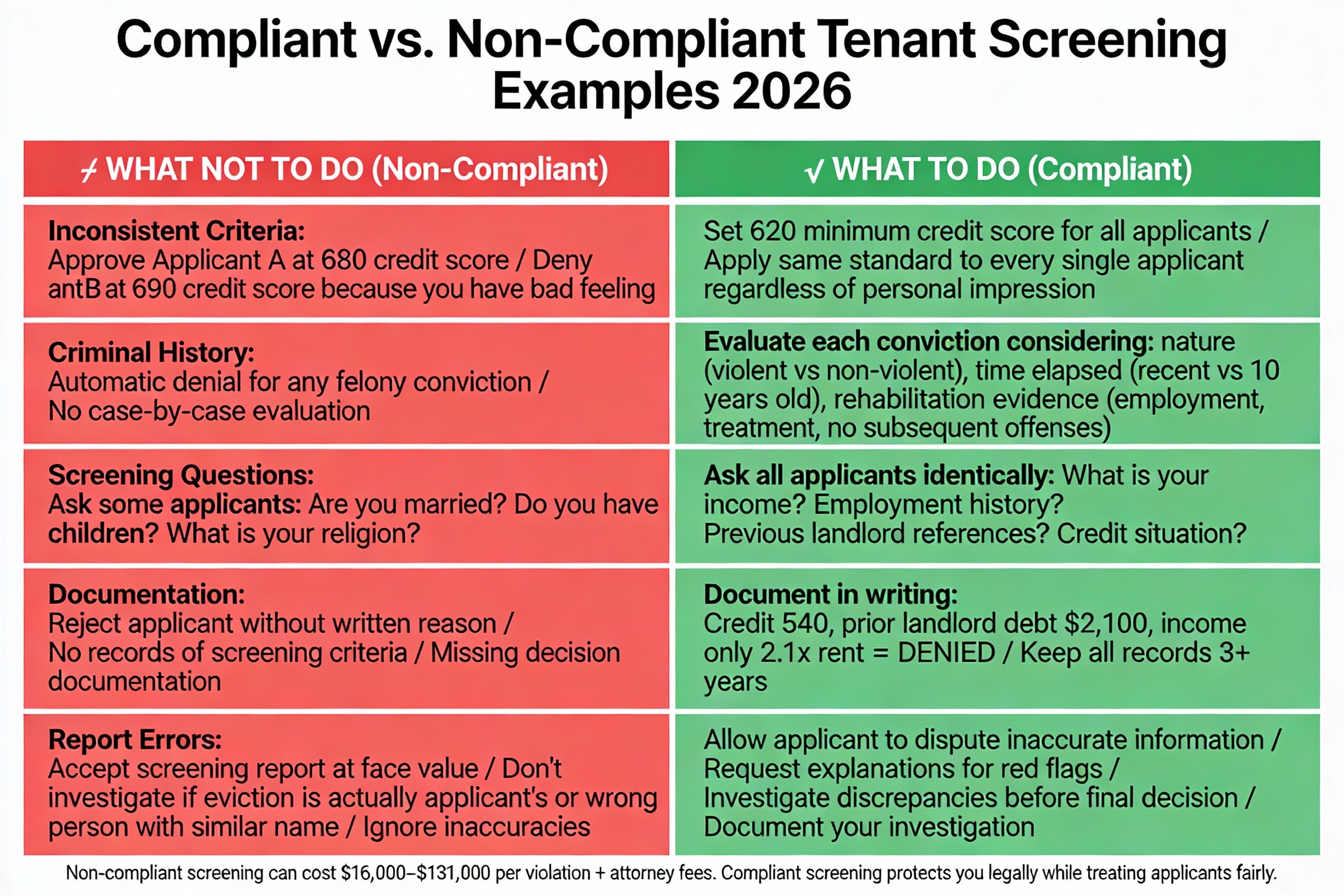
You approve Applicant A with a 680 credit score, but deny Applicant B with a 690 credit score because you have a “bad feeling” about them. You waive the income requirement for one applicant but strictly enforce it for another. You ask about family status from some applicants but not others.
Why It’s Illegal:
Inconsistent application triggers disparate treatment claims—a direct Fair Housing violation. Even if you didn’t intend discrimination, courts examine whether protected classes (race, color, religion, sex, disability, familial status, national origin) were treated differently. Pattern evidence is extremely damaging.
The Cost:
Civil penalties of $10,000–$65,653 for first violations; $25,000–$131,000 for repeat violations. Plus attorney fees (often $5,000–$15,000+), compensatory damages covering applicants’ relocation costs, and punitive damages for intentional discrimination.
How to Avoid It:
Write your screening criteria before posting the listing. Use the same standards for every applicant. Document every decision with specific reasons referencing your criteria. If you approve Applicant A at a 680 credit score, approve all similar applicants at that score level. Period.
Mistake #2: Using Blanket Criminal History Exclusions
What It Looks Like:
Your screening policy states: “Automatic denial for any felony conviction.” Or: “No drug convictions under any circumstances.” Or: “Any criminal record = rejection.”
Why It’s Illegal:
HUD 2024 guidance requires an individualized assessment for criminal history. Blanket exclusions create disparate impact—disproportionately excluding Black and Latino applicants, given well-documented racial disparities in the criminal justice system. Courts view these as prima facie evidence of discrimination.
The Cost:
Class action lawsuits settling for $2–$5 million (SafeRent paid $2.3 million in 2025; other platforms are facing similar claims). Individual cases: $25,000–$150,000 in civil penalties plus massive attorney fees and compensatory damages for the entire class.
How to Avoid It:
For each criminal conviction, evaluate: (1) Nature and severity (violent crime vs. non-violent?), (2) Time elapsed (1 year ago vs. 10 years?), (3) Rehabilitation evidence (steady employment? Treatment completion? No subsequent offenses?). Document your analysis for each applicant. “Denied due to armed robbery conviction 2 years ago—no recent employment history” is defensible. “Denied due to felony conviction” is not.
Mistake #3: Asking Screening Questions About Protected Classes
What It Looks Like:
You ask applicants: “Are you married?” “Do you have children?” “What religion are you?” “Where were you born?” “Are you able to climb stairs?” “Do you have a disability?” You ask these questions to some applicants but not others.
Why It’s Illegal:
These questions directly probe protected characteristics. Asking some applicants but not others creates evidence of discrimination. Answers can’t legally factor into screening decisions—only job-related accommodation requests matter.
The Cost:
Easy discrimination claims. Questions themselves constitute violations—courts don’t need to prove you actually acted on the information. $16,000–$65,000 per violation, stacking if you ask multiple applicants.
How to Avoid It:
Ask only job-related questions: employment, income, rental history, credit, criminal record, and identity verification. Don’t ask about family status, disability, religion, national origin, marital status, sexual orientation, or gender identity. Focus on: “Can you afford this?” “Will you follow the lease terms?” “Are you who you claim?” Nothing else.
Mistake #4: Not Documenting Your Screening Decisions
What It Looks Like:
You reject an applicant but don’t provide a reason. You approve one applicant and deny another with similar profiles, but you have no documentation of your decision-making process. You don’t maintain any records of screening criteria or how you applied them.
Why It’s Illegal:
Without documentation, discrimination claims become he-said-she-said. Judges assume the worst. You can’t prove you applied the criteria consistently. Lack of records itself implies discrimination—”if you weren’t discriminating, why hide the process?”
The Cost:
Weak legal defense. More exposure to punitive damages for “willful” violations. Juries interpret missing documentation as bad faith. An estimated additional $10,000–$25,000 in damages and settlements.
How to Avoid It:
Document everything:
Write screening criteria before accepting applications
Save copies of policies showing applicants what standards apply
Keep rental applications from all applicants (not just approved ones)
Record screening reports (credit, background, eviction, employment)
Write specific denial reasons: “Credit score 540, income only 2.2x rent, prior landlord debt $3,200” (not “didn’t qualify”)
Store adverse action notices showing you provided the required disclosures
Maintain records for a minimum 3 years (5–7 years recommended)
Invest 15 minutes per applicant in documenting decisions. It’s the difference between defensible compliance and defenseless liability.
Mistake #5: Ignoring Errors in Screening Reports
What It Looks Like:
The screening report shows an eviction from 1998. You reject the applicant without verifying if it’s actually their eviction or someone else’s with a similar name. The report indicates a misdemeanor conviction, but you don’t request any explanation or context. You accept the report at face value without investigation.
Why It’s Illegal:
Under the Fair Credit Reporting Act (FCRA), applicants have the right to dispute inaccurate information, and you must allow correction before making final decisions. Ignoring disputes or acting on potentially false information violates FCRA and creates Fair Housing liability. Screening report errors disproportionately affect minorities.
The Cost:
FCRA violations: up to $1,000 per violation plus actual damages. Applicants can sue for emotional distress, lost wages, and legal fees. Class action risk if your process systematically denies minorities due to reporting errors.
How to Avoid It:
When screening reports, flag issues:
Contact applicant immediately: “Your report shows [specific issue]. Can you explain?”
Allow written response and documentation (court records, verification letters)
Investigate discrepancies (verify name matches, check if similar name confused records)
Request updated information from the screening company if the records seem outdated
Document your investigation in writing
Don’t make a final decision until the applicant has the opportunity to dispute
This protects you legally while treating applicants fairly.
The 5 Critical Screening Standards You Must Document
1. Income Verification (3x Monthly Rent Minimum)
Require applicants prove gross income equals 3x proposed rent. Acceptable verification: recent pay stubs (2–3 months), employer letter confirming salary, bank statements showing regular deposits. For self-employed: 2 years’ tax returns plus the current profit/loss statement.
Why it matters: Strong predictor of rent payment ability. Applicants with 3x income have substantially lower default probability than those with 2x income.
Fair Housing note: Accept all lawful income sources equally—employment, Social Security, disability, child support, housing vouchers. Don’t discriminate by source; focus only on verification and reliability.
2. Credit Score Minimum (620–650 Recommended)
Check for minimum credit score, payment history patterns, prior landlord debt, collections, and debt-to-income ratio. Prior landlord debt (evictions resulting in unpaid judgments) is the strongest default predictor; many landlords require zero prior landlord debt regardless of other factors.
Why it matters: Credit reflects financial reliability and rent payment discipline. Prior landlord debt indicates applicant previously failed to pay rent—4–8x higher default probability.
Fair Housing note: The same minimum applies to all applicants. Don’t lower standards for some applicants based on protected characteristics.
3. Rental History (No Evictions 5–7 Years)
Verify previous landlord references. Ask: “Did the applicant pay rent on time?” “Any property damage?” “Lease violations?” “Would you rent to them again?” Contact at least 2 previous landlords; 3 is stronger.
Why it matters: Most predictive of future behavior. Prior evictions indicate a 4–8x higher probability of eviction. Payment reliability, property care, and neighbor relations all emerge from landlord references.
Fair Housing note: Ask identical questions to all applicants. Don’t skip reference checks for some applicants based on “vibes.”
4. Employment Stability (6+ Months Current Position)
Verify current employment through employer contact (HR/payroll, not applicant-provided phone). Confirm title, tenure, and likelihood of continued employment. For self-employed: 2 years of business operation minimum.
Why it matters: Employment stability predicts income reliability. Recent or frequent job changes indicate income instability. Being self-employed for less than 2 years indicates unproven business viability.
Fair Housing note: Verify employment for all applicants using identical procedures. Don’t skip verification for applicants who “look” employed.
5. Criminal History (Individualized Assessment Only)
Document your assessment process for criminal convictions, evaluating nature/severity, time elapsed, and rehabilitation. Different conduct warrants different decisions—violent felony vs. nonviolent misdemeanor.
Why it matters: Safety assessment. But overly broad criteria create illegal disparate impact.
Fair Housing note: Never use blanket exclusions. Each case requires documented analysis. This is legally non-negotiable per HUD guidance.
What SmartScreen Does: Consistency Through Automation
SmartScreen handles critical compliance work automatically:
Credit Reports: Delivers standardized tri-merge credit analysis (Equifax, Experian, TransUnion), ensuring identical evaluation metrics for all applicants. No subjective “credit looks good” vs. “credit looks bad.”
Criminal Background Checks: Comprehensive 370+ million record database searches. Reports present information identically for every applicant, enabling consistent evaluation rather than cherry-picking concerning details.
Eviction History: Multi-state database showing exact reason (non-payment vs. lease violation), judgment amounts, dates—enabling documented individualized assessment rather than blanket exclusions.
Employment Verification: Automated verification confirming employment, title, tenure through direct employer contact. Consistent for every applicant—no manual verification shortcuts.
Rental History Verification: Systematized previous landlord contact collecting identical information (payment history, property care, would rent again) from consistent interviews.
Automated Compliance Documentation: SmartScreen generates FCRA authorization forms before reports are ordered, produces adverse action notices within required timelines, and maintains audit trails proving consistent criteria application. Removes human error that creates liability.
This automation doesn’t eliminate landlord judgment—you still evaluate reports and make final decisions. But it ensures consistency, documentation, and reduced bias.
The 5-Step Screening Process That Protects You
Step 1: Establish Written Criteria (Before Listing Property)
Write down: minimum credit score, income requirement, employment tenure, rental history standard, and criminal history evaluation process. Share publicly on listing—”This property requires 620+ credit score, 3x monthly rent income, no evictions past 5 years.” No surprises. No subjective decisions. Applicants know exactly what matters.
Step 2: Use the Identical Application Form
Same form for all applicants. Asks about income, employment, rental history, references, and criminal history—nothing about family status, disability, religion, or national origin. Identical questions enable consistent comparison.
Step 3: Order Standardized Reports
SmartScreen comprehensive screening delivers credit, criminal, eviction, employment, and rental verification in a standardized format. Every applicant receives identical report types—no cherry-picking different screening levels for different applicants based on “gut feelings.”
Step 4: Document Decisions in Writing
For every applicant—approved and denied—write: “Approved: Credit 720, income $7,500 (3.75x rent), employment 5 years, no evictions, positive references.” Or: “Denied: Credit 580, prior landlord debt $2,100, income only 2.1x rent.” Specific. Objective. Documented.
This 5-minute effort per applicant prevents lawsuits for $25,000–$150,000.
Step 5: Send Required Notices Within 5–7 Days
If denied based on report information, provide adverse action notice within 5–7 business days, including: (1) specific reasons for denial, (2) name and contact of screening company, (3) applicant’s right to dispute inaccurate information. This FCRA requirement demonstrates compliance and gives applicants fair notice.
Red Flags That Signal Discrimination Risk
In Your Screening:
The same criteria are applied differently to different applicants
Blanket criminal history exclusions
Questions about protected characteristics
No written documentation of decisions
Different screening levels (credit-only vs. full background)
Allowing exceptions/waivers for some applicants but not others
In Your Tenant Pool:
Significant racial/ethnic imbalance compared to the local population
Women or families with children are consistently denied
Applicants with disabilities are systematically rejected
Source-of-income (Housing Choice Voucher) applicants are disproportionately denied
In Your Process:
Inconsistent adverse action notice provision
Missing documentation of decision-making
No maintenance of applicant records
Applicants are unaware of the screening criteria beforehand
If you recognize patterns, audit your process. Consult Fair Housing attorney. Risk exposure grows with each discriminatory decision.
FAQ: Common Screening Questions
Q: Can I ask about criminal history during the interview?
A: Yes—criminal history is a legitimate screening factor. But ask every applicant consistently. And conduct individualized assessment considering nature, recency, and rehabilitation. Document your analysis. Don’t ask: “Have you ever been arrested?” (arrests ≠ , convictions, harder to defend). Better: “Have you been convicted of any felony or misdemeanor?” Then evaluate specific convictions with context.
Q: What if two applicants are identical except for race?
A: This scenario tests Fair Housing compliance directly. Choose whichever you prefer based on documented criteria (income strength, rental history, employment tenure, references). Document your choice reasoning specifically: “Selected Applicant A due to 3-year employment stability vs. Applicant B’s 6-month tenure, despite similar credit.” Anything suggesting a race-based decision creates liability.
Q: How long do I keep screening records?
A: Minimum 3 years (Fair Housing discrimination statute of limitations). Many attorneys recommend 5–7 years for additional protection. Keep: criteria, applications, reports, verification documentation, decisions, adverse action notices, disputes/corrections. Protect with secure storage (encryption, locked files, limited access).
Q: Are screening software algorithms safe from Fair Housing violations?
A: No. Algorithms trained on biased historical data perpetuate discrimination—even when designed “neutrally.” SafeRent settled $2.3 million, claiming its algorithm discriminated against Black and Latino applicants. You remain liable for algorithmic bias even if third-party software created it. Verify algorithm isn’t using protected characteristic proxies; review outputs for disparate impact; make independent final decisions rather than automatically accepting scores.
Q: Can I require a co-signer instead of approving an applicant below my income requirement?
A: Yes—if you apply this option consistently to all applicants failing to meet the income requirement (not selectively). Waiving the income requirement for protected-class applicants while requiring a co-signer for others constitutes discrimination. Document that every applicant below 3x income received the co-signer option equally.
TL;DR: The Checklist
✅ Write screening criteria before listing property; post publicly
✅ Use an identical application form for all applicants
✅ Ask only job-related questions (income, employment, rental history, credit, criminal, identity)
✅ Never ask about family status, disability, religion, national origin, marital status, or sexual orientation
✅ Order standardized reports from SmartScreen or a similar FCRA-compliant provider
✅ Document every decision, specifically referencing your criteria
✅ For criminal history: individualized assessment (nature, recency, rehabilitation)—no blanket exclusions
✅ Allow applicants to dispute inaccurate report information before the final decision
✅ Send adverse action notices within 5–7 days when denying based on reports
✅ Keep all records for a minimum of 3 years (5–7 recommended)
✅ Apply identical standards to all applicants without exception
✅ If you’re unsure, consult a Fair Housing attorney
Bottom Line
Fair Housing compliance isn’t complex—it requires consistency, documentation, and discipline. One inconsistent screening decision can cost $25,000–$150,000. One blanket criminal exclusion can trigger class action exposure. One missing adverse action notice violates FCRA.
Protect your rental income through smart tenant selection and legal protection. Use SmartScreen’s comprehensive screening to ensure consistency across all applicants. Document your decisions thoroughly. Consult legal counsel when uncertain.
The cost of compliance ($70–$150 per applicant for professional screening) is trivial compared with exposure to discrimination lawsuits (minimum $16,000–$131,000 per violation, plus attorneys’ fees, damages, and punitive damages).
Screen smart. Document completely. Rent legally.