


Why Tenant Screening is Critical for Real Estate Agents and Property Owners
Tenant screening is a vital step in the rental process, protecting both real estate agents’ professional reputations and property owners’ financial investments. Comprehensive screening reduces the risk of renting to financially unreliable applicants (credit scores below 600, showing 300–400% higher default probability), applicants with criminal histories that raise safety concerns, or applicants with prior evictions, which indicate 4–8× higher future eviction likelihood.
Key Benefits of Professional Tenant Screening:
Protects Property Owner Investments: Screening prevents renting to high-risk tenants who default on rent (averaging $2,500–$5,000 lost income per eviction case), damage properties (repair costs averaging $1,500–$3,500), or require costly legal eviction proceedings (attorney fees $1,500–$3,000 plus court costs).
Preserves Agent Professional Reputation: Quality tenant placements through thorough screening demonstrate professional competence, generating client referrals and repeat business. Conversely, problematic tenant placements damage agent credibility and risk losing property management contracts.
Ensures Compliance with Fair Housing Laws: Professional screening services like SmartScreen maintain Fair Housing Act compliance by applying consistent, documented criteria to all applicants—protecting agents from discrimination claims that can carry penalties averaging $16,000–$131,000, plus attorney fees.
Reduces Vacancy Periods: Efficient screening processes accelerate the identification of qualified tenants, reducing property vacancy losses of $1,500–$3,000 per month for median-priced rentals that remain empty during prolonged tenant searches.
Improves Long-Term Tenant Retention: Quality screening identifies responsible tenants who pay rent consistently, maintain properties properly, and renew leases—avoiding turnover costs averaging $3,000–$5,000 per vacancy, including cleaning, repairs, marketing, and lost rent.
Effective tenant screening transforms rental property management from reactive problem-solving to proactive risk prevention—enabling agents to focus on portfolio growth rather than tenant conflicts.
What is SmartScreen and How Does it Work for Real Estate Agents?
SmartScreen is a cutting-edge tenant screening service designed to revolutionize how real estate agents assess rental applicants on behalf of property owners. Using advanced technology, comprehensive databases (370+ million criminal records, tri-merge credit reports from TransUnion, nationwide eviction searches), and industry expertise, SmartScreen offers agents a complete screening solution streamlining tenant evaluation while maintaining full Fair Housing Act compliance.
SmartScreen Platform Advantages for Real Estate Agents
Time Efficiency: Reports delivered within 24–48 hours enable rapid tenant selection, reducing vacancy periods and accelerating lease execution. Automated report generation eliminates manual verification tasks that can consume 5–10 hours per applicant with traditional methods.
Comprehensive Verification: A single platform provides credit analysis, criminal background checks, eviction history, employment verification, and rental references—eliminating the need for multiple vendor relationships and fragmented information sources.
Fair Housing Compliance Automation: SmartScreen generates required FCRA authorization forms, produces adverse action notices for rejected applicants, and maintains audit trails documenting consistent application of criteria—protecting agents from discrimination liability.
Client Confidence: Detailed, professional reports enable data-driven tenant-selection discussions with property owners, demonstrating thorough due diligence and risk assessment that support informed investment decisions.
Scalable Operations: Whether screening a single tenant or managing multiple properties, SmartScreen’s platform scales to varying workloads without requiring additional administrative staff or infrastructure investment.
Through its innovative approach, SmartScreen streamlines the tenant screening process, saving agents time while ensuring property owners receive thoroughly vetted candidates—protecting investments and fostering successful long-term tenancies.
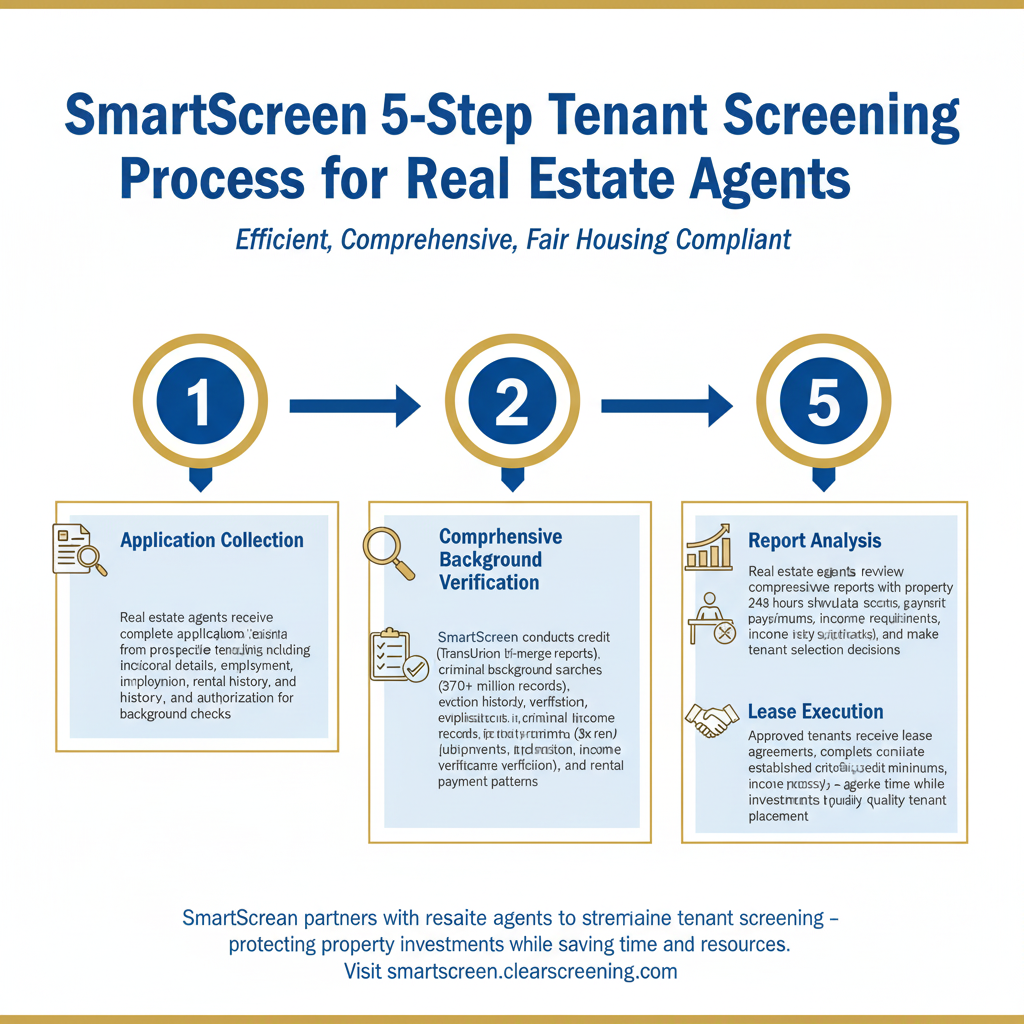
This five-step process shows how SmartScreen partners with real estate agents for efficient, comprehensive, Fair Housing compliant tenant screening: (1) Application collection where agents receive complete rental applications including personal details, employment information, rental history, and background check authorization, (2) Comprehensive background verification where SmartScreen conducts credit checks via TransUnion tri-merge reports, criminal searches across 370+ million records, eviction history verification, employment/income confirmation requiring 3x rent minimum, and previous landlord references, (3) Report analysis delivering detailed screening reports within 24–48 hours showing credit scores, payment history, criminal records, eviction judgments, employment tenure, income verification, and rental payment patterns, (4) Agent review and decision where agents review reports with property owners, evaluate applicants against established criteria, and make informed selection decisions, (5) Lease execution where approved tenants receive agreements, complete move-in procedures, and begin tenancy while agents save time protecting client investments.
Comprehensive Tenant Background Check Components
A thorough tenant background check comprises key elements that provide real estate agents with a complete view of rental applicants’ backgrounds, enabling informed decisions and protecting property owners’ investments.
Credit Score and Payment History Analysis
Credit reports provide valuable insights into applicants’ financial responsibility and past payment behaviors—the strongest predictor of future rent payment reliability. SmartScreen partners with TransUnion, delivering tri-merge credit reports (data from Equifax, Experian, TransUnion), ensuring comprehensive credit evaluation.
Critical Credit Factors:
Credit Score: A minimum score of 620 is recommended for rental approval; scores below 600 indicate a 300–400% higher rent default probability. Premium properties often require scores of 680–700+, attracting financially stable tenants.
Payment History: Review late payments, collections accounts, charge-offs, and payment patterns over the past 24–36 months. Chronic late payments (30+ days past due) indicate potential rent payment issues.
Prior Landlord Debt: Unpaid rent from previous landlords (showing as collections) is the #1 red flag, indicating a 400% higher probability of future default.
Debt-to-Income Ratio: Calculate existing debt obligations (credit cards, auto loans, student loans) relative to income. A maximum debt-to-income ratio of 40% is recommended; higher ratios leave insufficient income for rent.
Bankruptcies and Foreclosures: Recent bankruptcies (within 2–3 years) or foreclosures indicate financial instability and warrant additional scrutiny. Non-discharged bankruptcies in which the debt remains active pose a higher risk.
Credit Inquiries: Multiple recent credit inquiries suggest the applicant is seeking significant new debt, potentially reducing rent affordability. Hard inquiries (loan applications) matter more than soft inquiries (background checks, employment verification).
Understanding applicants’ creditworthiness through comprehensive credit analysis enables real estate agents to assess financial stability and predict rent payment reliability, thereby protecting property owners from default losses.
Criminal Background Verification
Thorough criminal history checks protect property owners, existing tenants, and surrounding communities by identifying applicants with criminal histories that warrant further review. SmartScreen criminal background checks search 370+ million records across nationwide databases, county court records, sex offender registries, and terrorism watchlists.
Important Compliance Note: HUD Fair Housing guidance prohibits blanket criminal history exclusions and requires an individualized assessment considering the nature of the offense, the time elapsed, and evidence of rehabilitation. Automatic rejections based solely on criminal records create illegal disparate impact discrimination.
Criminal History Evaluation Framework:
Nature and Severity: Violent felonies (assault, armed robbery, sexual offenses) raise greater safety concerns than non-violent misdemeanors (minor theft, trespassing). Property-related crimes (arson, vandalism) directly affect landlords’ risk assessments.
Time Elapsed: Recent convictions (within 1–2 years) indicate current risk; older convictions (5–10+ years ago) with clean subsequent records demonstrate rehabilitation. Recency matters significantly in risk evaluation.
Rehabilitation Evidence: Stable employment since conviction, completion of a treatment program, community involvement, positive character references, and an absence of subsequent offenses demonstrate rehabilitation and support approval consideration.
Pending Charges: Arrests without convictions cannot legally serve as the sole basis for rejection (innocent until proven guilty). However, serious charges may warrant additional investigation or delayed decisions until the case is resolved.
Sex Offender Registry Status: The presence of a sex offender registry requires disclosure to property owners. Many jurisdictions restrict registered sex offenders from living near schools, parks, or daycare centers—affecting property eligibility.
Criminal background checks balance safety concerns with Fair Housing compliance—requiring documented, individualized assessment rather than blanket exclusions, protecting agents from discrimination liability.
Eviction History Search
Eviction history verification identifies applicants with prior rental evictions—the strongest predictor of future eviction risk, with prior evictions indicating 4–8× higher probability of future eviction compared to applicants with clean rental records.
Eviction Record Analysis:
Filing vs. Judgment Distinction: Eviction case filings (landlord-initiated eviction proceedings) differ from eviction judgments (court-ordered tenant removal). Filings may settle before judgment through payment arrangements; judgments represent completed evictions with stronger negative implications.
Eviction Reasons: Non-payment evictions (the most common, accounting for 80–90% of cases) directly indicate rent payment reliability. Lease-violation evictions (property damage, unauthorized occupants, illegal activities) raise distinct concerns that require separate evaluation.
Timeframe Consideration: Recent evictions (within 1–2 years) pose a higher risk than older evictions (5–7+ years ago). Multiple evictions indicate chronic rental problems regardless of the timeframe.
Unpaid Judgments: Eviction judgments with unpaid balances owed to prior landlords create an ongoing financial liability, reducing rent affordability for current tenants. Prior landlord debt should be the primary disqualification factor.
Mitigating Circumstances: Evaluate context—evictions during documented hardships (medical crisis, temporary job loss since resolved, domestic violence situations) with strong subsequent rental performance may warrant consideration. Document analysis thoroughly.
Eviction history provides concrete evidence of past rental performance, enabling real estate agents to predict future tenancy reliability and protect property owners from repeat evictions.
Employment and Income Verification
Employment and income verification confirms applicants’ financial capacity to afford rent, with a standard requirement of 3× monthly rent in verified gross income (4× for premium properties or competitive markets, ensuring a stronger financial buffer).
Verification Components:
Current Employment Status: Confirm applicant is actively employed through direct employer contact (HR/payroll departments, not supervisor phone numbers provided by applicants, which may be fraudulent). Verify position title, hire date, employment type (full-time, part-time, contract), and continued employment likelihood.
Income Documentation: Require 2–3 recent pay stubs showing gross income, pay frequency, and year-to-date earnings. For self-employed applicants: 2 years tax returns (Form 1040 with Schedule C), current profit/loss statements, and bank statements showing consistent deposits.
Employment Tenure: A minimum of 6–12 months of current employment indicates job stability; frequent job changes (3+ jobs within 12 months) suggest income instability. Self-employed applicants should demonstrate 2+ years of business operation with consistent profitability.
Income Calculation: Calculate gross monthly income: (Annual salary ÷ 12) or (Hourly rate × Hours per week × 52 weeks ÷ 12). Compare to monthly rent: Income ÷ Rent should equal 3.0+ (e.g., $5,000 income ÷ $1,500 rent = 3.33×).
Alternative Income Sources: Accept all lawful income sources per Fair Housing requirements: employment wages, Social Security benefits, disability payments, retirement income, child support, alimony, investment income, housing vouchers (Section 8). Source discrimination violates Fair Housing laws in many jurisdictions.
Income Verification Red Flags: Pay stubs with unusual formatting or fonts suggesting forgery, income amounts not aligning with position/industry standards, employer phone numbers going to personal cell phones rather than company lines, bank deposits not matching stated income, gaps in employment not explained.
Employment and income verification protects property owners by ensuring tenants possess financial capacity to fulfill rent obligations throughout the lease term—reducing default risk substantially.
Rental History and Previous Landlord
Rental history verification provides firsthand insights into applicants’ behavior as tenants through direct contact with previous landlords—revealing payment patterns, property care, lease compliance, and renewal decisions that are unavailable through automated reports.
Previous Landlord Reference Questions:
Payment Reliability: “Did the tenant pay rent on time consistently? Any late payments or NSF checks? How frequently?” Chronic late payments predict future rent payment problems.
Property Care: “Did the tenant maintain the property in good condition? Any excessive damage beyond normal wear-and-tear? Cleanliness standards?” Property damage history indicates potential future damage risk.
Lease Compliance: “Did the tenant follow lease terms? Any violations (unauthorized occupants, pets, subletting, noise complaints)? How were violations addressed?” Lease violation patterns suggest future non-compliance.
Notice Compliance: “Did the tenant provide proper move-out notice per lease terms? Condition of property at move-out? Security deposit disposition?” Sudden departures without notice raise red flags.
Renewal Decision: “Would you rent to this tenant again? Why or why not?” Most revealing question—previous landlords’ reluctance to re-rent signals significant concerns worth investigating.
Best Practices for Reference Verification:
Contact Multiple Landlords: Verify at least 2 previous landlords (current and prior); 3 provides stronger evidence of a pattern. Current landlords may provide positive references simply to facilitate the departure of difficult tenants.
Verify Landlord Identity: Confirm phone numbers are legitimate landlord/property management companies (not friends posing as landlords). Search property records, reverse phone lookups, or request alternative contact methods.
Document Conversations: Maintain written records of landlord conversations, including dates, names, phone numbers, questions asked, and responses received—supporting screening decisions if challenged.
Rental history verification reveals applicants’ actual tenant behavior, providing predictive insights unavailable from credit scores or criminal records alone.
Why SmartScreen is the Trusted Partner for Real Estate Agent Tenant Screening
SmartScreen has earned its reputation as the trusted partner for real estate agents conducting tenant screening due to its commitment to providing reliable, efficient, comprehensive, and compliant screening services, enabling agents to protect client investments while streamlining property management operations.
Extensive and Accurate Database Access
SmartScreen’s strength lies in its extensive database partnerships, providing agents with access to comprehensive, current information crucial for evaluating rental applicants:
Credit Data: TransUnion tri-merge credit reports combining data from all three major credit bureaus (Equifax, Experian, TransUnion), ensuring complete credit history coverage rather than single-bureau gaps.
Criminal Records: 370+ million criminal records across nationwide databases, county courts (2,500+ jurisdictions), federal courts, sex offender registries (all 50 states), and terrorism watch lists, providing thorough criminal background verification.
Eviction Records: Multi-state eviction database searches that identify case filings, judgments, disposition status, judgment amounts, and eviction reasons across jurisdictions, enabling comprehensive assessment of eviction history.
Public Records: Bankruptcies, liens, civil judgments, foreclosures, and other public records affecting financial standing and tenant suitability.
Having robust, up-to-date databases ensures real estate agents receive accurate, complete information to support informed tenant selection—minimizing the risk of renting to problematic applicants due to incomplete screening.
Fast and Efficient Screening Process
SmartScreen’s streamlined screening process delivers comprehensive reports within 24–48 hours—significantly faster than traditional methods that require 5–7 days for manual verification, enabling agents to expedite the selection of qualified tenants and reduce costly vacancy periods.
Efficiency Benefits:
Reduced Vacancy Costs: Fast screening accelerates lease execution, minimizing lost rent during property vacancy. Each week saved through efficient screening generates $400–$ 800 in additional income for median-priced rentals.
Competitive Advantage: Quick response times attract quality applicants who may receive multiple offers—enabling agents to secure the best tenants before competitors complete slower screening processes.
Time Savings: Automated report generation eliminates manual verification tasks (calling employers, previous landlords, credit bureaus), consuming 5–10 hours per applicant—freeing agents for client acquisition and property management activities.
Applicant Experience: Professional, efficient screening processes improve applicant satisfaction regardless of outcome—enhancing agent reputation for organized, responsive property management.
Efficient screening processes benefit agents (time savings and reduced vacancies), property owners (faster lease execution and minimized income loss), and applicants (prompt decisions that enable housing planning)—creating positive experiences that support long-term business relationships.
Fair Housing Law Compliance Automation
SmartScreen ensures compliance with Fair Housing Act requirements and Fair Credit Reporting Act (FCRA) regulations—safeguarding real estate agents against potential discrimination claims, which can carry penalties averaging $16,000–$131,000, plus attorney fees and reputational damage.
Compliance Features:
Consistent Criteria Application: Standardized reporting formats ensure identical information presentation for all applicants—preventing selective disclosure or cherry-picking data supporting biased decisions.
FCRA Authorization Forms: Automated generation of required disclosure and authorization forms before ordering consumer reports, ensuring legal compliance with consent requirements.
Adverse Action Notices: Automatic production of adverse action notices for rejected applicants, including specific rejection reasons, screening company contact information, and applicant rights to dispute inaccurate information—fulfilling FCRA obligations within the required 5–7 day timeframe.
Audit Trail Documentation: Comprehensive record-keeping of screening criteria, reports ordered, decision rationale, and applicant communications—providing legal defense if discrimination claims arise, demonstrating consistent, non-discriminatory evaluation processes.
Regular Compliance Updates: SmartScreen monitors evolving Fair Housing regulations, FCRA requirements, and state/local screening laws, updating platform procedures to ensure continuous compliance as regulations change.
Compliance automation protects real estate agents from costly legal violations while demonstrating professional standards and ethical practices to clients and applicants.
How Real Estate Agents Benefit from SmartScreen Tenant Screening
Real estate agents leveraging SmartScreen’s advanced tenant screening services gain significant competitive advantages through streamlined rental processes, enhanced client protection, and improved professional reputation supporting business growth and client retention.
Save Time and Operational Resources
Real estate agents save 5–10 hours per applicant by using SmartScreen’s automated screening services, compared with manual verification processes, enabling portfolio scaling without proportional increases in administrative staff.
Time Savings Breakdown:
Manual Credit Verification: Traditional methods require contacting credit bureaus, requesting reports, waiting 3–5 business days for delivery, and interpreting raw credit data (2–3 hours per applicant). SmartScreen delivers a formatted credit analysis within 24–48 hours automatically.
Employment Verification: Calling employers, navigating HR departments, leaving messages, waiting for callbacks, and documenting conversations consumes 1–2 hours per applicant. SmartScreen’s automated employment verification streamlines this process to minutes.
Tracking down multiple previous landlords, scheduling calls, conducting reference interviews, and documenting responses take 2–3 hours per applicant. SmartScreen’s systematic rental history verification handles this efficiently.
Criminal Background Research: Manual county court searches across multiple jurisdictions where applicants previously resided can take 3–5 hours per applicant. SmartScreen’s database of 370+ million records provides instant nationwide criminal searches.
Report Compilation: Organizing disparate information sources (credit, criminal, eviction, employment, references) into coherent screening documentation requires 1–2 hours per applicant. SmartScreen delivers comprehensive, formatted reports ready for client presentation.
Total Time Investment: Manual screening: 10–15 hours per applicant. SmartScreen automated screening: 30–60 minutes reviewing formatted reports. Time savings: 9–14 hours per applicant, enabling agents to evaluate 10× more applicants with the same time investment.
Time efficiency enables agents to manage larger property portfolios, respond more quickly to inquiries, and focus on revenue-generating activities (client acquisition, property showings, lease negotiations) rather than administrative screening.
Protect Client Investments and Minimize Risk Exposure
Real estate agents safeguard property owner investments by partnering with SmartScreen to conduct thorough tenant screenings—preventing financially unstable, high-risk tenants from accessing properties and reducing potential losses averaging $5,000–$10,000 per problematic tenant placement.
Risk Mitigation Benefits:
Rent Default Prevention: Comprehensive credit and income verification identifies applicants who meet the 3× income requirement and have a positive payment history—reducing rent default probability by 70–80% compared to minimal screening.
Property Damage Reduction: Rental history verification reveals applicants’ property care patterns, criminal background checks identify property-related convictions (arson, vandalism), and eviction searches show property damage disputes—enabling rejection of high property-damage-risk applicants, saving $1,500–$3,500 average repair costs.
Eviction Avoidance: Eviction history verification identifies applicants with 4–8× higher future eviction risk—preventing problematic placements that require costly eviction proceedings averaging $3,500–$7,000 (attorney fees $1,500–$3,000, court costs $500–$1,000, lost rent $2,000–$4,000, post-eviction repairs $1,000–$2,500).
Legal Liability Protection: Fair Housing-compliant screening protects property owners from discrimination lawsuits. SmartScreen’s documented, consistent screening processes provide legal defense demonstrating non-discriminatory tenant selection.
Client Confidence: Thorough screening demonstrates professional due diligence, supporting client trust in the agent’s judgment and generating referrals from satisfied property owners with successful, problem-free tenancies.
Protecting client investments through quality tenant screening preserves agent-client relationships, prevents contract cancellations due to tenant problems, and builds a reputation for reliable property management.
Improve Professional Reputation and Client Satisfaction
Real estate agents partnering with SmartScreen enhance their professional reputation as trusted advisors who prioritize client protection, tenant quality, and risk management—leading to increased client satisfaction, contract renewals, and referral business supporting practice growth.
Reputation Benefits:
Demonstrated Expertise: Utilizing professional screening services signals competence and commitment to best practices, differentiating agents from competitors using minimal screening or subjective “gut feeling” tenant selection.
Reduced Client Problems: Quality tenant placements minimize owner complaints about late rent, property damage, lease violations, or eviction proceedings—preserving positive agent-client relationships and reducing management headaches.
Professional Documentation: Comprehensive screening reports provide tangible evidence of due diligence, supporting tenant selection recommendations with data rather than opinion, building client confidence in the agent’s judgment.
Efficient Service Delivery: Fast screening turnaround (24–48 hours) demonstrates responsiveness and organizational competence, improving client satisfaction with agent performance and communication.
Referral Generation: Satisfied clients experiencing successful, problem-free tenancies become enthusiastic referral sources, recommending agents to other property owners and expanding business through word-of-mouth marketing.
Professional reputation built through quality tenant screening creates a sustainable competitive advantage—attracting premium clients, commanding higher management fees, and generating consistent referral business supporting long-term practice success.
Real-World Tenant Screening Scenario: Agent Success Story
Situation: Atlanta real estate agent Sarah Martinez managed 15 rental properties for various owners. She received applications from two prospective tenants for a $1,800/month single-family home—both appearing qualified based on initial application review and property showing impressions.
Applicant A: Credit score 720, annual income $85,000 (4.7× rent), stable employment 6 years, professional appearance, excellent communication during showing, provided a glowing reference letter from current landlord.
Applicant B: Credit score 655, annual income $68,000 (3.15× rent), employment 18 months, casual appearance, average communication, no reference letters, but provided previous landlord contact information.
Initial Impression: Applicant A appeared significantly stronger—higher credit, higher income, longer employment, better presentation, proactive reference provision.
SmartScreen Comprehensive Screening Results:
Applicant A Discovery: Credit report showed $2,100 prior landlord debt in collections from a 2023 eviction (unpaid final month rent plus damages). A criminal background check revealed a 2022 misdemeanor conviction for check fraud. Previous landlord reference verification revealed the current landlord was a family member (father)—not independent verification. Employment verification showed income $62,000 (not $85,000 claimed)—pay stubs were forged.
Applicant B Discovery: Credit report confirmed a 655 score with a clean payment history—lower score due to limited credit history (recent immigrant, only 3 years of US credit history). Income verification confirmed a $68,000 salary through direct contact with the employer. Previous landlord references (2 independent landlords) provided excellent feedback: consistent on-time rent payments, property maintained immaculately, quiet, responsible tenant, both would “absolutely rent again.” No criminal record, no evictions, no public records issues.
Agent Decision: Despite initial impressions favoring Applicant A, SmartScreen comprehensive screening revealed Applicant A was high-risk (prior eviction, fraudulent income documentation, check fraud conviction, prior landlord debt) while Applicant B was actually a lower-risk quality tenant (clean rental history, verified income sufficient for rent, excellent landlord references, no evictions/criminal issues).
Outcome: Sarah recommended Applicant B to the property owner with a detailed screening report supporting the rationale. Applicant B proved to be an excellent tenant—perfect rent payment record over 2+ years, renewed lease twice, maintained property beautifully, zero maintenance issues or complaints. The property owner remained a satisfied client, referred 3 additional property owners to Sarah’s services.
Alternative Scenario: If Sarah had screened minimally (basic credit check only) or relied on initial impressions without comprehensive verification, she likely would have selected Applicant A, resulting in a probable eviction, $3,500–$7,000 in owner losses, damage to the agent’s reputation, potential contract cancellation, and lost referrals.
Key Lesson: Comprehensive professional screening through SmartScreen revealed critical information unavailable through a surface-level evaluation—protecting property owners’ investments, preserving agents’ reputations, and enabling successful long-term tenancies.
Frequently Asked Questions: Tenant Screening for Real Estate Agents
Q: What is rental applicant screening for tenants by real estate agents?
A: Rental applicant screening for tenants by real estate agents is the systematic evaluation and verification of prospective tenants’ backgrounds on behalf of property owners—including credit history assessment (TransUnion tri-merge reports), criminal background checks (370+ million records), eviction history searches, employment and income verification (3× rent minimum), and rental history references from previous landlords. This comprehensive process enables agents to identify reliable, financially stable tenants while protecting property owner investments from high-risk applicants who may default on rent, damage properties, or require costly evictions.
Q: Why is rental applicant screening important for property owners?
A: Rental applicant screening is critical for property owners because it minimizes risks of renting to financially unreliable tenants (resulting in rent defaults averaging $2,500–$5,000 per case), applicants with criminal histories raising safety concerns, or tenants with prior evictions indicating 4–8× higher future eviction probability. Comprehensive screening also ensures Fair Housing Act compliance, protecting owners from discrimination lawsuits averaging $16,000–$131,000 penalties, verifies tenant affordability through income confirmation (3× rent minimum reducing default risk 70–80%), and identifies applicants likely to maintain properties properly and fulfill lease terms—ultimately protecting property values and generating consistent rental income supporting investment returns.
Q: What information is typically included in a rental applicant screening report?
A: Comprehensive rental applicant screening reports include: (1) Credit analysis showing credit scores (620+ recommended), payment history, collections accounts, prior landlord debt (automatic disqualification factor), bankruptcies, debt-to-income ratios, and financial judgments, (2) Criminal background checks covering felony/misdemeanor convictions, sex offender registry status, terrorism watch lists, and pending charges across 370+ million records, (3) Eviction history identifying case filings, court judgments, eviction reasons (non-payment vs. lease violations), unpaid judgment amounts, and timeframes, (4) Employment verification confirming current employment status, position title, hire date, employment type, income amounts, and job stability, (5) Income documentation through pay stubs, tax returns (self-employed), bank statements validating 3× rent minimum, (6) Rental history references from 2–3 previous landlords covering payment reliability, property care, lease compliance, and renewal recommendations, (7) Identity verification through government ID, Social Security number validation, address history confirmation.
Q: Who is responsible for conducting rental applicant screening?
A: Real estate agents managing properties on behalf of landlords/property owners are typically responsible for conducting rental applicant screening as part of their property management services. Agents leverage professional screening platforms like SmartScreen, which provide access to comprehensive databases (credit bureaus, criminal records, eviction histories, employment verification services), automated report generation, FCRA compliance documentation, and Fair Housing Act adherence—enabling thorough, efficient tenant screening while maintaining legal compliance. While agents conduct screenings, final tenant selection decisions involve property owner input based on the screening report findings and agent recommendations.
Q: What are the benefits of using real estate agents for rental applicant screening?
A: Real estate agents provide significant value in rental applicant screening through: (1) Local market expertise understanding rental market trends, competitive rental rates, and typical tenant qualifications enabling optimal tenant selection, (2) Access to professional screening tools like SmartScreen comprehensive verification providing credit, criminal, eviction, employment, and rental history data unavailable to individual property owners, (3) Fair Housing compliance through documented, consistent screening criteria application protecting owners from discrimination claims averaging $16,000–$131,000 penalties, (4) Time efficiency handling screening administration (application collection, report ordering, reference verification, documentation) saving owners 10–15 hours per applicant, (5) Objective evaluation removing emotional decision-making through data-driven tenant assessment reducing placement errors, (6) Legal knowledge navigating complex landlord-tenant laws, FCRA requirements, and state/local screening regulations preventing compliance violations.
Q: How can SmartScreen assist with rental applicant screening for real estate agents?
A: SmartScreen is a trusted partner for real estate agents providing: (1) Comprehensive screening packages including credit reports (TransUnion tri-merge), criminal background checks (370+ million records), eviction history (nationwide database searches), employment verification, income confirmation, and rental references—all customized to property owner requirements, (2) Fast turnaround delivering complete screening reports within 24–48 hours accelerating lease execution and reducing vacancy costs, (3) Fair Housing compliance automation through standardized reporting, FCRA authorization forms, adverse action notices, and audit trail documentation protecting agents from discrimination liability, (4) Time savings eliminating manual verification tasks (5–10 hours per applicant) through automated report generation freeing agents for revenue-generating activities, (5) Professional presentation delivering formatted, comprehensive reports supporting data-driven tenant selection discussions with property owners demonstrating thorough due diligence and risk assessment.
Q: How much does tenant screening cost?
A: Tenant screening costs vary by comprehensiveness: Basic credit checks cost $15–$40, Comprehensive credit reports $25–$50, Criminal background checks $15–$40, Eviction history searches $5–$20, and Complete screening packages (credit + criminal + eviction + employment + references) range $35–$75 per applicant. Many screening services like SmartScreen offer applicant-paid screening where prospective tenants pay screening fees directly, eliminating landlord/agent costs while maintaining comprehensive verification. This approach is common practice and legally permissible, provided fees reflect actual screening costs (not profit centers) and are applied consistently to all applicants per Fair Housing requirements.
TL;DR: Essential Tenant Screening for Real Estate Agents
Comprehensive screening protects investments: Rental applicant screening through SmartScreen prevents high-risk tenants costing property owners $5,000–$10,000 through rent defaults, property damage, and evictions—requiring credit verification (620+ score, 3× income, no prior landlord debt), criminal background checks (individualized assessment per Fair Housing), eviction history (prior evictions = 4–8× higher future eviction risk), employment confirmation, and rental references from 2–3 previous landlords.
SmartScreen delivers fast, comprehensive reports: 24–48-hour turnaround with TransUnion tri-merge credit reports, 370+ million criminal record searches, nationwide eviction histories, automated employment verification, and rental reference documentation—saving agents 5–10 hours per applicant and enabling portfolio scaling without administrative staff increases.
Fair Housing compliance built-in: Automated FCRA authorization forms, adverse action notices, consistent application of criteria, and audit trail documentation protect agents from discrimination claims and associated penalties averaging $16,000–$131,000, while demonstrating professional standards to clients.
Agent benefits: Time savings (10× more applicants evaluated with same time investment), risk mitigation (70–80% rent default reduction through comprehensive verification), client protection (preventing $5,000–$10,000 problematic tenant losses), enhanced reputation (quality placements generating referrals), competitive advantage (24–48 hour screening vs. 5–7 days manual methods securing best tenants first).
Critical screening components: Credit score 620+ with payment history, debt-to-income ratio maximum 40%, no prior landlord debt, income 3× rent minimum through verified employment (6+ months tenure), clean eviction history (or mitigating circumstances documented), individualized criminal assessment (nature, recency, rehabilitation), and positive previous landlord references (payment reliability, property care, lease compliance).
Conclusion: Professional Tenant Screening Excellence for Real Estate Success
Rental applicant screening by real estate agents is the foundation of successful property management—protecting owners’ investments through comprehensive background verification while streamlining rental processes and enabling agents to scale their portfolios efficiently. SmartScreen partnership provides real estate agents with professional screening infrastructure (TransUnion credit data, 370+ million criminal records, nationwide eviction searches, employment verification, rental references), delivering complete reports within 24–48 hours while maintaining full compliance with the Fair Housing Act and the FCRA through automated documentation.
Strategic Implementation for Real Estate Agents:
Establish Clear Screening Criteria: Define minimum qualifications (credit score> 620, income> 3× rent, employment> 6 months, no recent evictions, individualized criminal assessment) before listing properties, communicate these standards to property owners, and apply them consistently to all applicants to demonstrate Fair Housing compliance.
Leverage SmartScreen Automation: Use SmartScreen’s comprehensive screening to eliminate manual verification tasks that consume 5–10 hours per applicant, enabling evaluation of 10× more candidates with the same time investment while maintaining thorough due diligence standards.
Conduct Individualized Assessments: Follow HUD Fair Housing guidance requiring case-by-case evaluation of criminal histories and rental problems—considering offense nature, time elapsed, rehabilitation evidence, and mitigating circumstances — rather than blanket exclusions that create illegal disparate impact, thereby protecting agents from discrimination liability.
Document Decisions Thoroughly: Maintain comprehensive records (screening criteria, reports, reference notes, decision rationale, adverse action notices) for a minimum of 3 years supporting legal defense if discrimination claims arise while demonstrating professional standards to property owners.
Communicate Transparently: Provide property owners with complete screening reports, explain findings, recommend tenant selection based on data analysis, and document decision-making processes, building client confidence in the agent’s expertise while preventing misunderstandings.
Professional tenant screening transforms real estate property management from reactive problem-solving to proactive risk prevention—enabling agents to focus on portfolio growth, client acquisition, and relationship-building rather than on tenant conflicts and eviction proceedings. SmartScreen’s partnership provides screening infrastructure that supports agent success through quality tenant placement, time efficiency, legal compliance, and client satisfaction, generating referrals and sustainable business growth.
Professional Resources & Authority
SmartScreen Screening Services:
Industry Screening Platforms:
Government Resources: