

What is a Landlord Credit Check with SmartScreen?
Comprehensive Financial Assessment for Tenant Evaluation
A landlord credit check is a process where property owners review a tenant’s financial history, credit report, and credit score through SmartScreen’s comprehensive screening services to gauge their financial reliability and ability to fulfill rental obligations, including consistent rent payments.
This evaluation helps landlords assess the risk of potential non-payment of rent or property damage, providing valuable insight into prospective tenants’ financial trustworthiness and payment patterns. By analyzing the credit report and score, landlords can determine if a tenant has a history of making timely payments and managing their finances responsibly.
Essential Credit Check Components:
Credit Score Analysis: Numerical representation (300-850 range) of creditworthiness
Payment History: Record of on-time vs. late payments across all accounts
Credit Utilization: Percentage of available credit currently used
Account Details: Open and closed accounts with payment patterns
Public Records: Bankruptcies, judgments, liens, and collections
Recent Inquiries: Hard pulls indicating credit-seeking behavior
This process allows landlords to make informed decisions when selecting tenants, ensuring a stable income stream and reducing the likelihood of rent-collection challenges.
Why is Tenant Screening Important for Landlords?Risk Mitigation Through Financial Verification
Tenant screening is crucial for landlords, as it helps evaluate potential tenants’ reliability, financial history, and adherence to rental agreements, reducing the risk of evictions averaging $3,500-$10,000 and property damage.
By conducting thorough screening processes, including credit checks, landlords can gain insights into tenants’ creditworthiness, past rental experiences, and overall suitability for rental properties. According to recent joint surveys of independent landlords and property managers, nearly half now cite background checks as the most critical element of tenant screening, surpassing credit checks alone, due to rising application fraud, including falsified IDs, altered pay stubs, and fake references.
Critical Screening Benefits:
Financial Risk Reduction: Identifying applicants with poor payment histories before lease signing
Eviction Prevention: Prior evictions remain one of the strongest indicators of future rental risk
Fraud Detection: More application fraud, including falsified document,s requires verification
Property Protection: Screening reduces damage risks and costly repairs
Legal Compliance: Systematic Fair Housing Act adherence prevents discrimination claims
Detailed scrutiny of tenants’ employment history and income provides landlords with confidence in tenants’ ability to make consistent rent payments. Performing a credit check helps assess financial responsibility and identify red flags that may pose risks to landlord property investments.
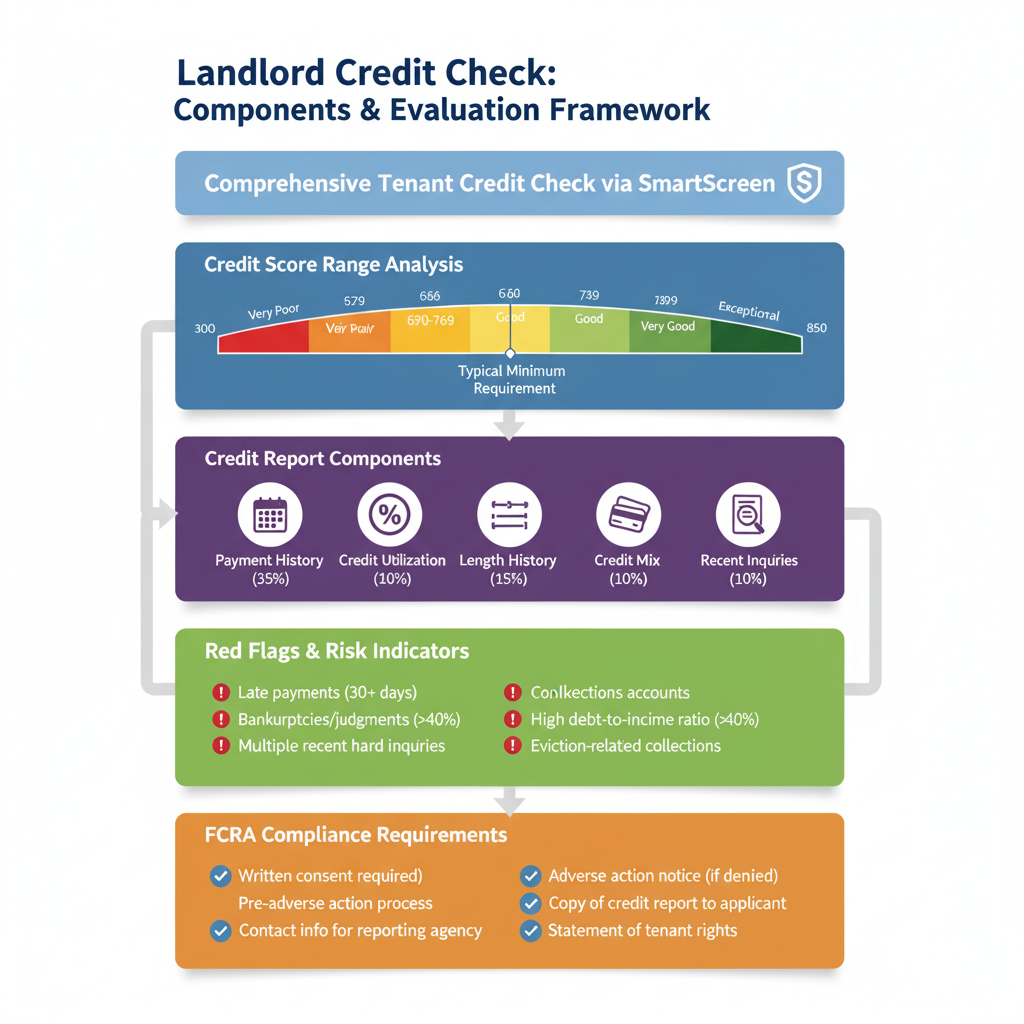
The Landlord Credit Check Process with SmartScreen
Step-by-Step Credit Evaluation Framework
The landlord credit check process through SmartScreen involves evaluating tenants’ financial behavior, credit scores, and rental history to determine their suitability for rental properties through FCRA-compliant reporting.
Step 1: Obtain Written Consent
Before running credit checks, landlords must obtain explicit written consent from applicants in accordance with FCRA requirements, with authorization separate from general application consent.
Consent Requirements:
Written signature specifically authorizing a credit check
Clear disclosure of what reports will be reviewed
Explanation of how information will be used in tenant selection
California ICRAA requires a more detailed notice than the federal FCRA
Consent forms should be standalone documents, not buried in applications
Step 2: Verify Applicant Identity
Landlords must verify the tenant’s full name, employment history, residential address, and Social Security number before accessing credit reports.
Identity Verification Information:
Full legal name matching government identification
Current and previous residential addresses
Social Security number for credit bureau matching
Date of birth for additional verification
Employment information for income confirmation
Step 3: Access Credit Report Through FCRA-Compliant Services
Landlords access credit reports through one of three major credit bureaus (Equifax, Experian, TransUnion) or through comprehensive services like SmartScreen, which offer bundled screening packages.
Credit Bureau Options:
Equifax, Experian, TransUnion: $25-$75 per applicant, depending on information requested
SmartScreen Comprehensive Screening: $35-$75, including credit, criminal, eviction, and employment verification
ResidentScore® Technology: Predicts eviction risk 15% better than traditional credit scores
Soft vs. Hard Pulls: Most tenant screening uses soft pulls that don’t negatively impact applicant credit scores
Step 4: Analyze Credit Report Components
A comprehensive credit report analysis examines payment history, credit utilization, account age, credit mix, and recent inquiries to assess a tenant’s financial responsibility.
Step 5: Apply Screening Criteria Consistently
Landlords must apply established screening criteria uniformly across all applicants to maintain Fair Housing compliance and avoid discrimination claims.
Step 6: Provide Adverse Action Notice if Denying
If denying applications based on credit reports, landlords must provide adverse action notices explaining rejection reasons and informing applicants of dispute rights.
What Information is Included in a Landlord Credit Check?
Comprehensive Financial History Components
A landlord credit check typically includes comprehensive information about rental applicants’ credit history, derogatory marks, previous rental agreements, and financial behavior patterns to assess creditworthiness.
1. Credit Score
The credit score is a numerical representation ranging from 300-850 that summarizes an applicant’s creditworthiness based on multiple financial factors.
Credit Score Ranges and Landlord Interpretation:
| Credit Score Range | Classification | Landlord Risk Assessment | Typical Action |
|---|---|---|---|
| 800-850 | Exceptional | Very low risk | Immediate approval likely |
| 740-799 | Very Good | Low risk | Strong candidate |
| 670-739 | Good | Acceptable risk | Generally approved |
| 620-669 | Fair | Moderate risk | Additional scrutiny, possible co-signer |
| 600-619 | Below Average | Higher risk | Co-signer likely required |
| 560-599 | Poor | Significant risk | Larger deposit, strong references needed |
| Below 560 | Very Poor | High risk | Often denied or requires guarantor |
Minimum Credit Score Standards:
Common Minimum: 620-650 for most rental properties
Competitive Markets: 670-700+ in high-demand urban areas
Luxury Properties: 700-740+ for upscale apartments
Average Renter Score: 638 according to recent research
Flexible Standards: Many landlords consider 560-850 range with additional verification
However, a credit score above 670 generally indicates good creditworthiness, though lower scores don’t automatically result in denial if applicants demonstrate current financial stability.
2. Payment History (35% of Credit Score)
Payment history comprises the largest component of credit scores, showing how consistently applicants meet monthly financial obligations across all accounts.
Payment History Analysis:
On-Time Payments: Green flags indicating financial responsibility
Late Payments: 30, 60, 90+ days late categorizations
Frequency and Recency: Recent late payments weigh more heavily
Account Types: Rent, credit cards, auto loans, student loans, mortgages
Severity: Collections accounts averaging $200-$5,000
3. Credit Utilization (30% of Credit Score)
Credit utilization measures the percentage of available credit currently used; ratios under 30% indicate responsible credit management.
Utilization Standards:
Under 30%: Excellent credit management
30-50%: Acceptable but approaching concern
50-75%: High utilization suggesting financial stress
Above 75%: Red flag indicating potential payment difficulties
4. Length of Credit History (15% of Credit Score)
Account age demonstrates financial maturity and long-term credit management capability, with established credit histories providing greater confidence.
5. Credit Mix (10% of Credit Score)
Diversity of credit types (credit cards, installment loans, mortgages) shows the ability to manage multiple financial obligations simultaneously.
6. Recent Hard Inquiries (10% of Credit Score)
Multiple recent hard inquiries within short timeframes suggest credit-shopping behavior or potential financial distress.
7. Public Records and Derogatory Marks
Public records, including bankruptcies, judgments, liens, and collections, provide critical insight into severe financial difficulties.
Common Public Records:
Bankruptcies: Chapter 7 or 13 filings indicating inability to pay debts
Judgments: Court-ordered debt payments
Tax Liens: Unpaid federal or state tax obligations
Collections Accounts: Debts sent to third-party collectors
Eviction-Related Collections: Unpaid rent predicting 3x higher default risk
Understanding Credit Score Requirements for Rental Properties
Market-Specific and Property-Type Variations
Credit score requirements vary significantly based on rental market competitiveness, property type, location, and landlord risk tolerance, with no universal legal minimum.
General Credit Score Guidelines:
Standard Rental Markets:
Most landlords accept credit scores of 600-650+ as acceptable, though requirements vary by property type and location. Research shows the average renter’s credit score is 638, suggesting many landlords accommodate scores in the 600-650 range.
Competitive Urban Markets:
In cities with high demand for apartments (New York, San Francisco, Seattle, Boston), landlords give preference to applicants with higher credit scores, often requiring scores of 670-700+ due to abundant applicant pools.
Property-Type Variations:
Luxury Buildings: 700-740+ scores preferred or required
Standard Apartments: 620-650 typical minimums
Private Rentals: More flexible, sometimes accepting 560-600
Student Housing: Lower requirements recognizing limited credit history
Alternative Acceptance Strategies:
Rather than setting absolute minimum credit scores, landlords should establish ranges reflecting target demographics and allow exceptions for:
Co-signers or Guarantors: Credit-worthy individuals guaranteeing lease obligations
Larger Security Deposits: Additional financial protection (where legally permitted)
Rent-in-Advance: Paying multiple months upfront demonstrates commitment
Strong References: Positive landlord recommendations offsetting lower scores
Income Documentation: Substantial income (3x+ monthly rent) compensating for credit concerns
Critical Red Flags in Landlord Credit Checks
High-Risk Indicators Requiring Additional Scrutiny
Certain credit report elements are strong predictors of tenant financial problems, prompting landlords to exercise caution or request additional verification.
Major Credit Red Flags:
1. Late Payment Patterns
Multiple late payments, especially recent ones exceeding 30+ days, indicate chronic payment difficulties and predict future rent payment problems.
Late Payment Severity:
30 Days Late: Minor concern if isolated
60 Days Late: Significant concern requiring explanation
90+ Days Late: Major red flag suggesting severe financial issues
Frequency: Multiple late payments are worse than isolated incidents
Recency: Recent late payments (last 12 months) are most concerning
2. Collections Accounts
Debts sent to collections averaging $200-$5,000 demonstrate an inability or unwillingness to pay obligations, particularly when rent-related.
3. Bankruptcies
Chapter 7 or 13 bankruptcies signal severe financial distress, though circumstances and time since filing matter significantly.
4. Eviction-Related Collections
Unpaid rent sent to collections predicts 3x higher future default risk than general collections, making it the strongest negative indicator.
5. High Debt-to-Income Ratio
Total debt obligations exceeding 40% of gross income leave little financial cushion for unexpected expenses, increasing rent payment vulnerability.
6. Multiple Recent Hard Inquiries
Numerous hard pulls within short periods suggest desperate credit-seeking behavior or potential fraud.
7. Judgments and Liens
Court-ordered payments or tax liens demonstrate unresolved financial obligations that compete with rent for limited resources.
FCRA Compliance Requirements for Landlord Credit Checks
Legal Obligations and Penalty Avoidance
The Fair Credit Reporting Act (FCRA) establishes strict requirements governing how landlords conduct credit checks, with violations resulting in fines exceeding $1,000 per violation plus potential lawsuits.
Mandatory FCRA Compliance Steps:
1. Obtain Written Consent Before Accessing Reports
Landlords must secure explicit written consent specifically authorizing credit checks, separate from general rental application authorization.
Consent Best Practices:
Standalone consent form with applicant signature
Clear disclosure of what specific reports will be reviewed
Explanation of how information influences tenant selection
California ICRAA requires more detailed notices than the federal FCRA
Keep signed consent forms for a minimum 2 years
2. Provide Pre-Adverse Action Notice
If considering denial based on credit report information, landlords must provide pre-adverse action notices giving applicants the opportunity to review reports and dispute inaccuracies.
3. Send Formal Adverse Action Notice if Denying
When denying rental applications based wholly or partly on credit report information, landlords must send formal adverse action notices within reasonable timeframes.
Adverse Action Notice Required Components:
Notice of Adverse Action: Clear statement that the application was denied
Specific Reasons: Credit score below minimum, late payment history, high utilization ratio
Credit Score Disclosure: Actual score used in the decision if available
Credit Bureau Information: Name, address, phone number of the reporting agency
Statement of Rights: Applicant’s right to dispute inaccuracies within 60 days
Agency Disclaimer: The credit bureau didn’t make a decision and cannot explain the denial
Adverse Action Timing:
Consumer report-based decisions: No specific timeframe, but “reasonable period.”
Third-party information-based decisions: Within a “reasonable period of time.”
Best practice: 3-7 business days after the decision
Adverse Action Triggers:
Denying the rental application outright
Requiring a co-signer based on credit information
Requiring a larger security deposit than standard
Charging higher rent than advertised
Denying lease renewal based on a new credit check
4. Provide a copy of the credit report to Applicant
If denying based on credit information, provide applicants with free copies of reports used in decision-making.
5. Apply Screening Criteria Consistently
Document objective screening criteria in writing before accepting applications and apply uniformly to avoid Fair Housing discrimination claims.
Soft vs. Hard Credit Pulls for Tenant Screening
Understanding Inquiry Types and Impacts
Landlords must choose between hard and soft credit inquiries when screening tenants, each with different implications for applicants and compliance requirements.
Hard Credit Inquiries (Hard Pulls)
Hard inquiries occur when landlords directly access credit reports in connection with credit applications, temporarily lowering applicants’ credit scores by a few points.
Hard Pull Characteristics:
Credit Score Impact: Temporary 2-5 point reduction lasting 12 months
Report Visibility: Remains on credit report for 2 years
Compliance Requirements: On-site business inspection for FCRA verification
Data Handling: Landlord handles sensitive information (SSN, address) directly
Common Use: Mortgage applications, auto loans, credit cards
Soft Credit Inquiries (Soft Pulls)
Soft inquiries access credit information without affecting applicants’ credit scores, which is standard practice in most tenant screening.
Soft Pull Characteristics:
Credit Score Impact: Zero – doesn’t affect credit scores at all
Report Visibility: Not shown to third parties reviewing credit
Compliance Simplicity: No on-site inspection required
Data Handling: Third-party services handle sensitive information
Tenant Screening Standard: Most landlord credit checks use soft pulls
SmartScreen’s Soft Pull Advantage:
SmartScreen tenant screening utilizes soft credit pulls, allowing landlords to evaluate tenant creditworthiness without damaging applicants’ credit records. This approach motivates more rental applications by eliminating concerns about credit scores while providing the same credit report details as hard pulls.
Consent Requirements for Both:
Even though tenant screening legally constitutes soft pulls, best practice requires landlords to obtain consent before conducting credit checks, ensuring compliance with the Fair Credit Reporting Act and safeguarding both consumer and landlord rights.
How to Conduct a Landlord Credit Check: Step-by-Step Guide
Practical Implementation for Property Owners
Conducting proper landlord credit checks through SmartScreen involves systematic processes ensuring legal compliance while obtaining comprehensive tenant financial information.
Step 1: Establish Written Screening Criteria
Before collecting applications, document objective screening criteria, including minimum credit scores, acceptable income thresholds, and background check requirements.
Recommended Criteria Documentation:
Minimum Credit Score: 620-650 or justifiable range based on property type
Income-to-Rent Ratio: 2.5-3x monthly rent gross income requirement
Rental History Standards: No prior evictions or good references
Criminal Background Criteria: Narrowly tailored and relevant standards
Pet Policy: Clearly stated allowances and restrictions
Step 2: Collect Complete Rental Applications
Require all applicants over age 18 to submit completed rental applications, including authorization for credit checks.
Step 3: Obtain Written Consent
Secure signed authorization forms explicitly permitting credit checks before accessing any credit information.
Step 4: Verify Applicant Identity
Confirm full legal name, employment history, residential address, and identification matching credit bureau records.
Step 5: Access Credit Reports Through SmartScreen
Utilize SmartScreen’s comprehensive tenant screening services, providing bundled credit, criminal, eviction, and employment verification for $35-$75 per applicant.
SmartScreen Screening Package Includes:
ResidentScore® eviction risk predictions (15% more accurate than traditional scores)
Criminal background checks across 370+ million records
Step 6: Analyze Credit Report Components
Review credit scores, payment history patterns, credit utilization ratios, account ages, public records, and recent inquiries to assess financial responsibility.
Step 7: Apply Screening Criteria Consistently
Evaluate all applicants using identical standards documented in Step 1, avoiding discriminatory application of criteria.
Step 8: Make Tenant Selection Decision
Approve or deny applications based on objective criteria, documenting specific reasons for all decisions.
Step 9: Provide Adverse Action Notices if Denying
If denying based wholly or partly on credit reports, send formal adverse action notices within 3-7 business days, including all mandatory FCRA components.
What Sets SmartScreen Apart from Other Tenant Screening Services?
Comprehensive Solutions for Landlord Success
SmartScreen distinguishes itself from other tenant screening services through comprehensive credit checks for renters’ backgrounds, advanced tenant background search capabilities, ResidentScore® technology, and landlord-centric compliance solutions.
SmartScreen’s Unique Advantages:
1. ResidentScore® Predictive Technology
SmartScreen’s proprietary ResidentScore® metric predicts future eviction risk 15% better than traditional credit scores alone, providing landlords a crucial predictive advantage for minimal additional cost.
2. Comprehensive Bundled Screening
Rather than piecemeal credit checks, SmartScreen offers complete tenant evaluation, including credit, criminal, eviction, employment, and rental history verification in single packages for $35-$75.
3. Soft Credit Pull Technology
SmartScreen uses soft pulls that don’t negatively impact applicants’ credit scores, encouraging more applications while providing the same information as hard inquiries.
4. Built-In FCRA Compliance
SmartScreen’s FCRA-compliant reporting ensures landlords meet Fair Credit Reporting Act requirements, obtain proper written consent, and provide compliant adverse action notices when denying applications—preventing fines up to $1,000+ per violation.
5. Fast Turnaround Times
SmartScreen delivers comprehensive screening reports within 48 hours in most cases, enabling faster tenant placement and reduced vacancy periods.
6. User-Friendly Dashboard
The platform’s intuitive interface allows landlords to easily navigate screening reports, compare multiple applicants, and make data-driven decisions efficiently.
7. Nationwide Database Access
SmartScreen searches 370+ million criminal records, comprehensive eviction databases, and all three major credit bureaus to provide a comprehensive tenant evaluation.
Frequently Asked Questions
What is a landlord credit check?
A landlord credit check is a process where property owners review tenants’ financial history, credit reports, and credit scores through SmartScreen’s comprehensive screening services to gauge financial reliability and rent payment ability, typically requiring written consent and minimum credit scores of 620-650 though acceptance ranges from 560-850 depending on property type.
Why is a landlord credit check important?
Landlord credit checks are important because they provide an understanding of potential tenants’ financial responsibility and rent payment capability, helping landlords avoid renting to high-risk tenants with histories of late/missed payments, collections averaging $200-$5,000, or eviction-related debts, predicting 3x higher future default risk that could result in eviction costs averaging $3,500-$10,000.
What information is included in a landlord credit check?
Landlord credit checks include credit scores (300-850 range), payment history (35% of score), credit utilization ratios (30% of score), length of credit history (15%), credit mix (10%), recent hard inquiries (10%), public records (bankruptcies, judgments, liens, collections), account details showing open/closed accounts, and derogatory marks like late payments or eviction-related collections.
How can I run a landlord credit check?
Landlords run credit checks by obtaining written consent from applicants, verifying identity information (name, SSN, address), accessing credit reports through SmartScreen’s comprehensive tenant screening services costing $35-$75 per applicant (or directly through Equifax, Experian, TransUnion for $25-$75), analyzing credit components, applying screening criteria consistently, and providing adverse action notices if denying based on credit information.
Is a landlord credit check legal?
Yes, landlord credit checks are legal as long as landlords have applicant consent and follow all relevant Fair Credit Reporting Act (FCRA) laws and regulations including obtaining written authorization before accessing reports, providing adverse action notices when denying applications based on credit information, supplying credit bureau contact details, and documenting tenant dispute rights—with violations resulting in fines exceeding $1,000 per violation.
Can a landlord credit check be used to discriminate against tenants?
No, landlord credit checks should never be used as discrimination tools against potential tenants but only as one of several objective factors in the tenant screening process, with landlords required to apply screening criteria consistently across all applicants regardless of race, color, religion, sex, national origin, familial status, or disability per Fair Housing Act requirements to avoid discrimination claims and disparate impact violations.
What credit score is needed to rent an apartment?
Most landlords require minimum credit scores of 620-650 for standard rental properties, though acceptance ranges vary from 560-850 depending on property type, with competitive urban markets requiring 670-700+, luxury buildings preferring 700-740+, and the average renter scoring 638, while landlords may accept lower scores with co-signers, larger security deposits, strong references, or substantial income (3x+ monthly rent).
What are adverse action notice requirements?
Adverse action notices are required when landlords deny rental applications, require co-signers, or mandate higher security deposits based wholly or partly on credit report information, with notices requiring specific components including reasons for denial, actual credit score if used, credit bureau contact information, applicant’s right to dispute inaccuracies within 60 days, and statement that bureau didn’t make decision—sent within reasonable timeframes (best practice 3-7 business days) to avoid FCRA violations and $1,000+ fines.
TL;DR: Landlord Credit Check Essentials
Minimum credit scores: 620-650, typical requirements, 560-850 acceptance range depending on property
Credit score components: Payment history (35%), utilization (30%), history length (15%), mix (10%), inquiries (10%)
Critical red flags: Late payments (30+ days), collections ($200-$5,000), eviction-related debts (3x higher risk)
FCRA compliance mandatory: Written consent, adverse action notices, credit bureau contact info, dispute rights
Soft vs. hard pulls: Tenant screening uses soft pulls with zero credit score impact
SmartScreen advantages: ResidentScore® 15% more accurate, comprehensive packages $35-$75, 48-hour turnaround
Adverse action timing: 3-7 business days best practice, “reasonable period” is legally required
Eviction cost prevention: Credit checks prevent $3,500-$10,000 average eviction expenses
Competitive markets: 670-700+ scores required in high-demand urban areas
Alternative acceptance: Co-signers, larger deposits, strong references, 3x+ rent income compensate for lower scores
Conclusion:
Mastering landlord credit checks through SmartScreen’s comprehensive tenant screening platform enables property owners to make data-driven tenant selection decisions by analyzing credit scores with typical minimum requirements of 620-650 (though acceptance ranges from 560-850 based on property type and market competitiveness), evaluating payment history comprising 35% of credit scores, reviewing credit utilization ratios under 30% indicating financial responsibility, examining account age and credit mix diversity, and identifying critical red flags including late payments exceeding 30 days, collections accounts averaging $200-$5,000, bankruptcies signaling severe financial distress, and eviction-related collections predicting 3x higher default risk—all while maintaining strict Fair Credit Reporting Act (FCRA) compliance through written consent requirements, adverse action notices sent within reasonable timeframes (best practice 3-7 business days) when denying applications based wholly or partly on credit information, providing applicants copies of reports and credit bureau contact details, documenting tenant dispute rights per federal regulations, and avoiding violations resulting in fines exceeding $1,000 per violation. By leveraging SmartScreen’s ResidentScore® technology that predicts eviction risk 15% better than traditional credit scores, utilizing soft credit pulls that don’t negatively impact applicant credit scores unlike hard inquiries causing temporary 2-5 point reductions, accessing comprehensive bundled screening packages for $35-$75 including credit analysis, criminal background checks across 370+ million records, eviction history verification, employment confirmation, and rental history validation, and receiving results within 48-hour turnaround times, landlords can prevent eviction costs averaging $3,500-$10,000 while protecting rental income through professional screening that applies objective criteria consistently across all applicants regardless of protected class status, ultimately ensuring Fair Housing compliance and selecting financially responsible tenants capable of consistent rent payment throughout lease terms.
Professional Resources: