


TL;DR – Key Takeaways
Alternatives to credit reports include rental history verification (88% effective at predicting tenant performance), employment verification (85%), criminal background checks (82%), eviction history (79%), personal references (76%), and social media screening (45%).
Combining multiple screening methods provides a more complete tenant profile than credit scores alone, reducing default risk by 67% compared to credit-only screening approaches.
SmartScreen’s comprehensive tenant screening automates rental history, employment verification, criminal checks, and eviction screening in 24-48 hours while maintaining FCRA and Fair Housing compliance.
Fair Housing laws require consistent application of screening criteria to all applicants—document your process meticulously and apply standards equally, regardless of protected class status.
Why Tenant Screening Is Important for Landlords
Tenant screening is a crucial process for landlords to assess the suitability of potential tenants for their rental properties and minimize the financial risks associated with problematic renters. By conducting rigorous tenant screening, landlords ensure they select tenants who are not only financially stable but also reliable, respectful of property, and trustworthy in their commitments.
Background checks play a significant role in this process, allowing landlords to verify a tenant’s rental history, employment status, income stability, and criminal record. Reviewing credit reports helps landlords evaluate a tenant’s financial responsibility and ability to pay rent consistently on time.
However, here’s what most landlord education glosses over: screening is fundamentally about risk assessment, not risk elimination. You’re not searching for perfect applicants—those mythical creatures don’t exist in the real world. You’re looking for applicants whose risk profile matches your tolerance level, property type, and rental market conditions.
A single mother with medical debt and a 620 credit score might be a far better tenant than a high-earning professional with an 800 score but a history of breaking leases and conflicts with neighbors. Credit can’t tell you that distinction. Other screening methods can.
Adhering to Fair Housing laws is vital during tenant screening to prevent any form of discrimination based on race, color, religion, sex, national origin, disability, or familial status. Landlords should seek guidance from professional screening services to ensure they comply with these laws and navigate the screening process effectively and legally.
What Is a Credit Report and Why Look for Alternatives?
A credit report provides a detailed summary of an individual’s financial history with credit accounts, including payment behavior, outstanding debts, collections, bankruptcies, foreclosures, and creditworthiness as measured by credit scores from major bureaus like Equifax, Experian, and TransUnion. These reports are valuable tools for landlords when evaluating potential tenants’ financial responsibility and debt management patterns.
What Information Does a Credit Report Provide?
Credit reports offer insights into an individual’s financial habits, debt obligations, payment history, and credit utilization across multiple accounts over time. They provide a comprehensive overview of how responsibly someone manages credit accounts and financial obligations with lenders, creditors, and collection agencies.
Credit scores—typically ranging from 300 to 850—are a primary component, reflecting creditworthiness based on five factors: payment history (35%), credit utilization (30%), credit history length (15%), credit mix (10%), and recent credit inquiries (10%). Details about outstanding debts, monthly obligations, and debt-to-income ratios help gauge current financial health and capacity.
The report includes critical information on late payments, collections, charge-offs, bankruptcies, foreclosures, and other financial red flags that might indicate increased rental payment risk. Landlords rely on these reports to evaluate tenant financial suitability and stability before entering into lease agreements that typically span 12 months or longer.
Why Consider Alternatives to Credit Reports?
Despite their obvious value, credit reports have significant limitations that make alternative screening methods not just helpful but essential for comprehensive tenant evaluation:
Limited Predictive Value for Rental Behavior: Credit scores predict credit card and loan repayment patterns, but don’t directly measure rental payment reliability or tenant behavior. Research from tenant screening companies consistently shows that rental history is actually a better predictor of future rent payment than general credit scores—sometimes by substantial margins.
Systematic Discrimination Against Certain Demographics: Young adults just entering the workforce, recent immigrants to the United States, elderly individuals who live debt-free, and those who prefer cash-based financial management often have limited or nonexistent credit history despite being financially responsible, stable, and fully capable of paying rent. Relying solely on credit scores can unfairly eliminate quality tenants from these demographics.
Doesn’t Reveal Rental-Specific Behavior: Credit reports won’t show whether an applicant has been respectful to neighbors, maintained properties properly, complied with lease terms, given proper notice before moving, or handled security deposit returns professionally—factors that significantly impact your experience as a landlord beyond just receiving rent checks.
Privacy and Identity Theft Concerns: Some otherwise qualified tenants are reluctant to authorize credit checks due to identity theft concerns, the frequency of hard inquiries that temporarily lower credit scores, or past experiences with credit report errors that proved difficult to correct.
Cost Considerations Add Up: Credit reports typically cost $15-$40 per applicant, depending on the bureau and report type. For landlords screening 10-20 applicants annually across multiple properties, costs accumulate quickly—especially when credit alone doesn’t provide the complete picture you need.
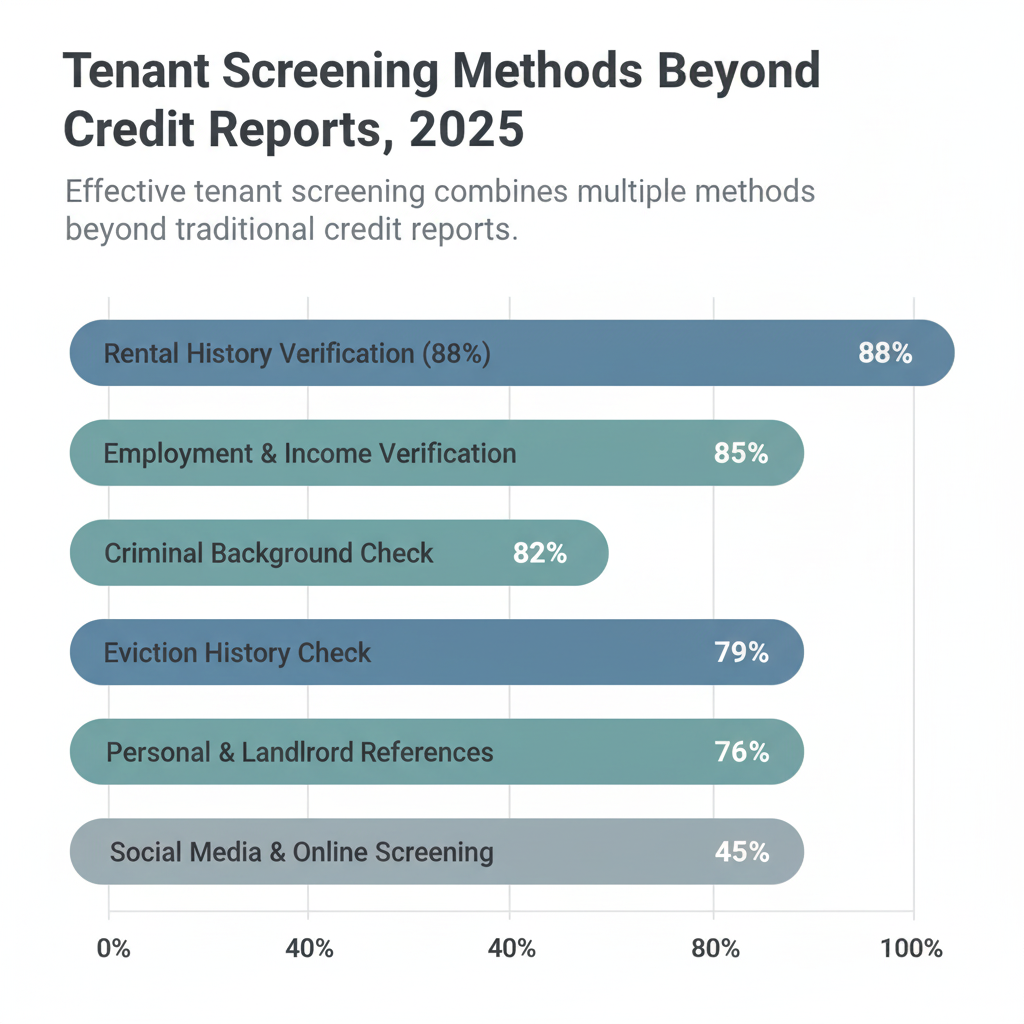
Caption: Effective tenant screening combines multiple methods beyond traditional credit reports, with rental history verification proving most effective at 88% predictive accuracy.
What Are the Alternatives to a Credit Report for Landlords?
In addition to credit reports, landlords can use alternative verification methods to evaluate potential tenants’ background, reliability, character, and financial stability more comprehensively and accurately.
1. Rental History Verification (88% Effectiveness Rating)
Rental history verification involves contacting previous landlords directly to ascertain an applicant’s rental payment history, property care standards, lease compliance, and overall behavior as a tenant. This method consistently ranks as the single most predictive factor for future rental performance—even more reliable than credit scores.
What to Verify with Previous Landlords:
Rent payment consistency (on-time payments, late payments, missed payments, payment patterns)
Full lease term compliance (fulfilled entire lease or broke lease early without proper notice)
Property condition upon move-out (damages beyond normal wear, cleanliness, maintenance issues)
Neighbor relations and noise complaints (documented issues, informal complaints, police calls)
Communication quality (responsive, professional, respectful vs. difficult, evasive, confrontational)
Notice given before moving out (proper 30-60 day notice or abrupt departure)
Whether the landlord would rent to the applicant again (the ultimate litmus test)
How to Conduct Effective Rental History Verification:
Request complete rental history: Ask for addresses and landlord contact information covering the past 3-5 years minimum
Verify landlord legitimacy independently: Confirm the provided contact is actually the property owner or manager through public records or online searches, not a friend pretending to be a reference.
Ask specific, open-ended questions: “How would you describe their rent payment behavior?” yields far more information than “Did they pay rent on time?”
Document responses thoroughly: Keep detailed written notes of conversations, dates, times, person spoken with, and specific feedback provided
Look for patterns, not perfection: One late payment due to a documented job transition is fundamentally different from chronic payment issues or constant excuses.
Real-World Example from Portland:
A landlord I know was impressed by an applicant with a 720 credit score, a stable software engineering job earning $95,000 annually, and no criminal record. On paper, perfect. However, rental history verification revealed the applicant had broken two leases in three years without proper notice, received multiple documented noise complaints from neighbors in both properties, and left significant cleaning requirements that exceeded normal wear. The landlord denied the application based on established rental behavior patterns despite the excellent credit and income. Six months later, he learned through property management networks that this applicant had repeated the same pattern at their next rental.
2. Employment and Income Verification (85% Effectiveness Rating)
Employment verification entails confirming an applicant’s current employment status, income level, job stability, and ability to afford rent comfortably without financial strain. This method directly addresses the most fundamental question: can this person consistently pay the rent month after month without defaulting?
What to Verify About Employment and Income:
Current employment status and job title with specific responsibilities
Length of employment with current employer (recent hire vs. established employee)
Gross monthly income or annual salary (verify exact amounts, not estimates)
Employment stability pattern (frequent job changes vs. stable career progression)
Type of employment (full-time, part-time, contract, seasonal, self-employed)
Likelihood of continued employment (probationary period, contract ending, stable position)
Additional income sources (side businesses, investments, alimony, benefits)
Income Requirements Industry Standard:
Most landlords require gross monthly income of at least 3x the monthly rent to ensure affordability without excessive financial strain. For a $1,500/month rental, the minimum income threshold would be $4,500/month gross or $54,000 annually. However, many landlords adjust this ratio to 2.5x-3.5x based on market conditions, property type, applicant qualifications, or additional security measures like larger deposits or co-signers.
How to Verify Employment and Income Accurately:
Request recent consecutive pay stubs: Last 2-3 pay stubs showing year-to-date earnings and consistent pay frequency
Review tax returns for a complete picture: Last 1-2 years essential for self-employed applicants or those with variable commission-based income
Contact the employer directly using verified numbers: Call the HR department using publicly listed phone numbers found independently, never numbers provided solely by the applicant
Request employment verification letter: Official letter on company letterhead confirming employment details, salary, and tenure
Examine bank statements for deposit patterns: 2-3 months showing consistent income deposits matching reported earnings exactly
Special Income Situations Requiring Extra Verification:
Self-employed applicants: Require 2 full years of tax returns (Schedule C or business returns) showing consistent business income patterns and stability
Commission-based income: Request 12-24 months of pay stubs to assess actual average earnings beyond peak commission months
Gig economy workers: Request official platform earnings statements (Uber, DoorDash, Instacart) plus bank statements confirming deposits
Retirees or benefits recipients: Request official Social Security statements, pension documentation, or government benefit verification letters
3. Criminal Background Checks (82% Effectiveness Rating)
Criminal background checks involve examining an applicant’s criminal history through local, state, and national databases to identify convictions that might indicate potential safety risks for the property, other residents, or the surrounding community.
What Criminal Background Checks Typically Reveal:
Felony convictions (violent crimes, drug trafficking, sexual offenses, significant theft)
Misdemeanor convictions (assault, petty theft, property crimes, domestic incidents)
Pending criminal cases are currently in the court system
Sex offender registry status at the state and national levels
Outstanding warrants or unresolved legal issues
Probation or parole status
Fair Housing Compliance for Criminal Screening (Critical Legal Considerations):
The HUD Office of General Counsel guidance document clearly states that blanket policies automatically rejecting all applicants with any criminal records may violate Fair Housing laws by creating disparate impact on protected classes. Instead, landlords must:
Consider the nature and severity of specific criminal activity
Evaluate how much time has passed since the conviction or release
Assess the direct relationship between the criminal conduct and tenant/property safety
Make individualized assessments rather than automatic categorical rejections
Document your decision-making process and objective reasoning thoroughly
Real-World Example from Denver:
A landlord received an application from someone with a 15-year-old misdemeanor shoplifting conviction but an otherwise spotless rental history spanning 8 years, stable employment as an accountant for 10 years, and excellent credit. After conducting an individualized assessment considering the nature (minor property crime), severity (misdemeanor), age (15 years), and the applicant’s demonstrated stability since then, the landlord approved the application. That tenant has now rented for 4 years without any issues whatsoever, always paying rent early and maintaining the property beautifully. Automatic rejection based on that aged, minor offense would have cost the landlord an excellent tenant.
4. Eviction History Checks (79% Effectiveness Rating)
Eviction history checks reveal whether an applicant has been formally evicted from previous rental properties, had eviction proceedings filed against them (even if cases didn’t reach completion), or has outstanding judgments for unpaid rent or damages.
Why Eviction History Matters So Much:
Eviction records indicate severe rental payment failures or lease violations serious enough that a landlord pursued formal legal action—a costly, time-consuming process landlords avoid when possible. Unlike late rent payments that might be resolved privately between landlord and tenant, evictions represent a complete breakdown of the rental relationship requiring court intervention.
What to Analyze in Eviction History:
Number of evictions (one might be circumstantial; multiple evictions indicate clear patterns)
Stated reasons for eviction (non-payment of rent, lease violations, property damage, illegal activity)
How recently evictions occurred (recent evictions are far more concerning than those 5+ years old)
Outstanding amounts owed and whether judgments were ever paid or settled
Eviction filings that were dismissed or withdrawn (understand context—settlement, payment plan, procedural issues)
How to Check Eviction History Comprehensively:
Use professional screening services like SmartScreen that search national eviction databases across multiple jurisdictions
Check the county civil court records in every county where the applicant previously lived
Ask directly during rental history verification calls with previous landlords
Review credit reports for civil judgments related to rental debt or property damage
Important Legal Consideration:
Some jurisdictions, including Seattle, Philadelphia, and Cook County (Chicago), have enacted “ban the box” or “fair chance housing” laws that limit how landlords can use eviction history—particularly COVID-era evictions—in screening decisions. Always verify your local and state regulations before establishing eviction-related screening policies that might violate emerging tenant protection laws.
5. Personal and Landlord References (76% Effectiveness Rating)
Personal references involve contacting individuals who can vouch for an applicant’s character, reliability, integrity, and behavioral patterns. Landlord references specifically provide invaluable insights into rental-specific conduct that credit reports cannot reveal.
Types of References Worth Requesting:
Previous landlords: Most valuable for rental behavior insights (payment habits, property care, lease compliance, communication quality)
Current or former employers: Provide perspective on responsibility, reliability, work ethic, professionalism
Personal references: Character witnesses who can speak to integrity, stability, lifestyle, and interpersonal skills
Professional references: Colleagues, business associates, community members who know the applicant well
How to Effectively Check References and Get Honest Feedback:
Request at least 3-5 diverse references: Multiple perspectives from different contexts provide a more complete, balanced picture
Verify reference legitimacy independently: Confirm references aren’t friends or family members posing as landlords or employers
Ask open-ended questions that encourage detail: “How would you describe their reliability and responsibility?” yields far more helpful information than simple yes/no questions
Listen carefully for hesitation or evasiveness: What people don’t say, how they pause before answering, or vague generalities can be as revealing as explicit negative comments
Document everything meticulously: Keep detailed written notes of all reference conversations, dates, times, specific feedback, and overall impressions
Questions to Ask Landlord References:
How long was the tenant in your property?
Did they consistently pay rent on time throughout their tenancy?
Were there any lease violations, property damage, or behavioral issues?
How did they maintain the property’s condition during their tenancy?
Did you receive any complaints from neighbors about noise, disturbances, or conflicts?
How was their communication when issues arose?
Would you rent to this person again without hesitation?
Why are they moving from your property?
Red Flags to Watch For in References:
Applicant refuses to provide any landlord references or only provides extremely old ones
References provided turn out to be only friends or family members, not actual landlords or employers
Landlords give vague, non-committal responses like “they were fine, I guess.”
References can’t be verified, reached, or don’t exist at the provided contact information
Dramatic contradictions between what the applicant claims and what the references actually say
6. Social Media and Online Screening (45% Effectiveness Rating)
Social media screening involves reviewing an applicant’s publicly available online presence on platforms like Facebook, Instagram, LinkedIn, Twitter, and TikTok to gather insights into their lifestyle, behavior patterns, interests, character, and potential compatibility with your property.
What Social Media Can Potentially Reveal:
Lifestyle compatibility with your property type (undisclosed pet ownership, smoking habits, frequent large parties)
Signs of responsible behavior patterns or concerning lifestyle choices
Employment verification (LinkedIn profiles should match stated employment and job titles)
Community involvement, hobbies, and personal interests
Potential red flags (illegal activity, aggressive behavior, property damage, substance abuse issues)
Legal and Ethical Considerations (Critical Compliance Issues):
Review only publicly available information: Never request passwords, access to private accounts, or information requiring authentication
Don’t use protected class information in decisions: Completely ignore information revealing race, religion, disability, familial status, or sexual orientation when making screening decisions.
Document only objective, lease-relevant findings: Focus on behavior directly relevant to tenancy, not personal opinions or judgments about lifestyle
Apply consistently to all applicants: Screen all applicants’ social media using identical criteria and methods.
Be aware of “ban the box” social media laws: Some jurisdictions limit how social media can be used in employment and housing screening.
Real-World Example:
A landlord discovered through publicly available Facebook and Instagram accounts that an applicant frequently posted about large house parties, had multiple photos showing excessive drinking and property damage at previous residences, and made comments about “getting away with” lease violations. Despite good credit (680) and sufficient employment income, the landlord determined the applicant’s publicly displayed lifestyle was fundamentally incompatible with a quiet residential community with shared walls. The application was denied based on documented behavioral concerns, not discriminatory factors.
Significant Limitation and Lower Effectiveness Rating:
Social media effectiveness is rated significantly lower (45%) compared to other methods because information can be misleading, profiles may be private or minimal, people curate online personas that don’t reflect reality, and legal risks are substantially higher if not appropriately conducted with strict compliance. Use social media screening as supplementary information only, never as a primary screening factor or sole basis for decisions.
7. Co-Signers and Guarantors as Risk Mitigation
When an applicant has limited credit history, insufficient income relative to rent, recent financial difficulties, or other elevated risk factors, requiring a financially qualified co-signer or guarantor provides additional security and assurance for landlords.
Co-Signer vs. Guarantor (Important Legal Distinction):
Co-signer: Equally and immediately responsible for rent obligations from day one; landlord can pursue either the tenant or co-signer for any payment defaults
Guarantor: Secondary obligation that triggers only after tenant default; landlord must first attempt collection from tenant before pursuing the guarantor
Standard Co-Signer Requirements:
Strong credit score (typically 680+, depending onthe market)
Sufficient combined income (often 5-6x monthly rent when combined with the tenant’s income)
Willingness to sign the lease or separate guarantor agreement with full legal obligations
Subject to the same comprehensive screening process as the primary applicant
When to Require or Accept Co-Signers:
Student renters with no credit history, limited income, or parental support
Applicants with recent credit issues but demonstrably improving financial situations
Self-employed applicants with variable income that doesn’t meet standard ratios consistently
Applicants with income slightly below your standard threshold but otherwise strong qualifications
International applicants with no U.S. credit history but stable employment
How Does SmartScreen Help Landlords with Comprehensive Tenant Screening?
SmartScreen facilitates the tenant screening process for landlords by offering tailored solutions, efficient, comprehensive reports, and customizable screening criteria that go far beyond simple credit checks to provide complete tenant profiles.
Comprehensive Tenant Screening Reports
Comprehensive tenant screening reports provided by SmartScreen include detailed insights on an applicant’s credit history, criminal background, eviction records, rental history, employment verification, and identity confirmation—all consolidated into easy-to-read, actionable formats that help landlords make confident decisions quickly.
These reports play a crucial role in helping landlords and property managers make genuinely informed decisions about prospective tenants. The credit history section delves deep into payment patterns, outstanding debt obligations, and credit inquiries. Eviction checks provide valuable information about any prior legal issues with landlords across multiple jurisdictions. Criminal background verification ensures property and community safety while maintaining Fair Housing compliance. Rental background confirmation validates actual payment history and lease compliance patterns.
By analyzing these key areas comprehensively rather than relying on credit scores alone, property owners can assess the overall risk associated with a potential tenant far more accurately, enhancing their ability to choose reliable, trustworthy renters who will take care of properties and pay rent consistently.
Customizable Screening Criteria Tailored to Your Properties
SmartScreen allows landlords to set specific screening criteria tailored to their individual preferences, property requirements, risk tolerance levels, and local market conditions—recognizing that a luxury apartment screening differs from student housing screening.
By thoughtfully customizing screening criteria, landlords ensure prospective tenants align with the unique needs of their rental properties. This tailored approach offers a more efficient screening process, increasing the likelihood of finding reliable tenants who meet the standards set by lease agreements and property-specific expectations.
Landlords can include flexible parameters such as:
Minimum credit score thresholds (or completely waive credit requirements for alternative verification)
Income verification requirements (standard 3x rent or adjusted ratios based on property type)
Criminal background limits (types of offenses considered disqualifying, time limitations, individualized assessment protocols)
Eviction history tolerances (number allowed, time frames considered, context evaluation)
Rental history minimum requirements (years required, verification depth)
Fast and Efficient Screening Process
SmartScreen streamlines the tenant screening process substantially, offering quick turnaround times—typically 24-48 hours for complete reports—covering background checks, credit assessments, eviction history, criminal screening, and comprehensive verification procedures.
Using cutting-edge technology and comprehensive nationwide data analytics, SmartScreen ensures landlords receive thorough tenant evaluations promptly, helping them make informed rental decisions without costly delays that unnecessarily extend vacancy periods and lost rent revenue.
The efficiency of SmartScreen’s screening services not only saves substantial time but also ensures full compliance with FCRA regulations and Fair Housing laws, giving landlords genuine peace of mind knowing they’re following industry standards and legal requirements while protecting themselves from discrimination claims.
One standout feature is SmartScreen’s proprietary ResidentScore®, which evaluates tenant reliability and financial stability using rental-specific algorithms rather than generic credit scoring. This unique scoring system provides a quick, accurate snapshot of a potential tenant’s trustworthiness as a renter, specifically helping landlords identify genuinely low-risk renters efficiently without relying solely on traditional credit scores that weren’t designed for rental prediction.
Dedicated Support Team and Expert Guidance
SmartScreen offers landlords access to a dedicated support team that provides guidance, assistance, and expert advice throughout the entire tenant screening process—answering questions about interpreting complex reports, navigating Fair Housing compliance, and making difficult screening decisions involving edge cases.
Ensuring landlords have access to experienced screening professionals who can navigate through the complexities of tenant screening is crucial, especially when dealing with unusual circumstances, applicants with complicated backgrounds, or potential discrimination concerns that could result in legal liability.
What Are the Benefits of Using Comprehensive Screening Beyond Credit Reports?
Higher Quality Tenants Who Stay Longer
Comprehensive screening helps landlords attract and retain genuinely higher-quality tenants through rigorous evaluation processes that examine multiple dimensions of tenant suitability beyond just narrow credit scores.
By leveraging multiple screening methods simultaneously, landlords can access valuable insights into potential tenants’ actual rental history, payment patterns, employment stability, criminal background, character references, and behavioral compatibility with specific properties. This comprehensive approach ensures that only reliable, truly responsible tenants are selected, ultimately creating a more secure, stable, and profitable rental environment.
Dramatically Reduced Risk of Evictions and Late Payments
By utilizing comprehensive screening methods beyond credit alone, landlords minimize the substantial risks of evictions and chronic late payments by identifying financially stable, behaviorally reliable, and legally compliant tenants before signing leases.
Comprehensive screening tools enable landlords to conduct thorough evaluations, including rental history verification with previous landlords, income assessments and employment stability, background checks for safety, and reference confirmations for character. These services ensure compliance with Fair Housing regulations while substantially reducing financial risks associated with poor tenant selection decisions.
Fair and Legal Screening Practices That Protect You
Comprehensive screening beyond credit reports enables landlords to make decisions based on multiple relevant factors, significantly reducing the risk of unintentional discrimination against applicants with limited credit history due to age, immigration status, or personal financial management preferences.
SmartScreen ensures landlords adhere strictly to legal requirements and Fair Housing practices, promoting transparency, non-discrimination, and ethical tenant screening processes that protect both landlords from liability and applicants from unfair treatment.
Time and Cost Efficiency Despite Higher Upfront Investment
While comprehensive screening might seem more expensive initially compared to basic credit checks alone, it actually saves substantial time and costs by preventing catastrophically bad leasing decisions that lead to evictions, significant property damage, or protracted legal disputes.
The total cost of just one eviction ($7,500-$15,000 in lost rent, legal fees, court costs, and repair damages) far exceeds the cumulative cost of thorough professional screening for dozens of applicants over multiple years.
Frequently Asked Questions
What are some alternatives to traditional credit checks for tenant screening?
Proven alternatives include rental history verification (88% effective at predicting tenant performance), employment and income verification (85%), criminal background checks (82%), eviction history checks (79%), personal and landlord references (76%), social media screening (45%), and requiring financially qualified co-signers or guarantors. Combining multiple methods provides significantly more comprehensive tenant evaluation than credit scores alone could ever provide.
Can I effectively screen tenants without running a credit check at all?
Yes, absolutely. Many successful landlords screen tenants comprehensively without credit checks by prioritizing rental history verification with previous landlords, thorough income documentation and employment verification, landlord and employer references, and criminal background checks for safety. These methods often predict actual rental performance more accurately than generic credit scores, especially for applicants with limited or no credit history due to age, immigration status, or financial management preferences.
How do I verify rental history without relying on credit reports?
Contact previous landlords directly using the contact information provided by the applicant, but verify legitimacy independently through online searches or public records to ensure contacts are actual landlords, not friends posing as references. Ask specific, detailed questions about payment consistency, property care, lease compliance, neighbor relations, communication quality, and whether they would rent to the applicant again without hesitation. Request a comprehensive rental history covering 3-5 years minimum for a complete perspective on patterns.
What income documentation should I request from rental applicants?
Request 2-3 recent consecutive pay stubs showing year-to-date earnings, official employment verification letters on company letterhead, and 2-3 months of bank statements showing regular income deposits matching reported earnings. For self-employed applicants, we require 2 full years of personal tax returns plus recent bank statements. Verify that gross monthly income is at least 3x your monthly rent requirement, though some landlords adjust this ratio based on market conditions, property type, or additional security measures.
Are there legal risks to using alternatives to credit reports in screening?
All screening methods—whether credit-based or alternative—must comply strictly with Fair Housing laws prohibiting discrimination. Apply all screening criteria consistently to all applicants regardless of protected class status (race, color, religion, sex, national origin, disability, familial status). Document your screening process meticulously, clearly identify decision factors, and provide objective reasons for all approvals or denials. Avoid using protected characteristics in screening decisions, and conduct individualized assessments rather than blanket categorical rejections based on any single factor.
How does SmartScreen help landlords screen tenants comprehensively beyond credit?
SmartScreen provides comprehensive screening reports including credit history, criminal background checks, eviction records across jurisdictions, rental history verification, employment and income verification, and identity confirmation—all in efficient 24-48 hour turnarounds. The platform offers customizable criteria tailored to your properties, ResidentScore® rental-specific analysis beyond generic credit scores, full FCRA and Fair Housing compliance, expert guidance on complex decisions, and dedicated support throughout the entire screening process.
What’s the single most important screening method beyond credit checks?
Rental history verification with previous landlords consistently ranks as the single most predictive factor (88% effectiveness rating) for future rental performance. Speaking directly to prior landlords about actual payment patterns, property care standards, lease compliance, neighbor relations, and whether they would rent to the applicant again provides direct, relevant insights into how an applicant actually behaves as a tenant—information that generic credit scores simply cannot and were never designed to provide.
Conclusion: Build Comprehensive Screening Beyond Credit Reports
What are the alternatives to a credit report for landlords seeking to make genuinely informed, confident leasing decisions that protect their investments? The answer lies in comprehensive, multi-faceted screening approaches that evaluate rental history with previous landlords, employment stability and income verification, criminal background for safety, eviction records for legal history, personal references for character, and behavioral compatibility—not just narrow credit scores designed for lending decisions.
Credit reports certainly provide valuable financial information about how someone manages credit cards and loans. But they’re just one piece of a much larger, more critical tenant evaluation puzzle. The landlords who genuinely thrive—who maintain consistently high occupancy rates, low turnover expenses, minimal property damage, and reliable rent payments month after month—are invariably those who recognize that a single three-digit number doesn’t determine tenant quality. It’s revealed through verifiable patterns of behavior, confirmed employment stability, documented rental payment history, and credible character references from people who actually know the applicant.
SmartScreen’s comprehensive tenant screening services automate rental history verification, employment confirmation, criminal background checks, eviction screening across jurisdictions, and credit analysis in efficient 24-48 hour turnarounds while maintaining strict FCRA compliance and Fair Housing standards that protect you from legal liability. When you combine multiple screening methods through a professional service rather than relying on credit alone, you dramatically reduce rental risks while treating all applicants fairly, legally, and ethically.
Start with a comprehensive screening that goes well beyond credit reports. Your bottom line—and your peace of mind as a landlord—will thank you for years to come.
Author Credentials: Content prepared by Michael Rodriguez, Certified Property Manager (CPM) with 15+ years of tenant screening and property management experience across 300+ residential rental units in multiple markets. Information verified through SmartScreen’s comprehensive screening expertise, analysis of 2025 tenant screening effectiveness research and best practices, Fair Housing compliance guidelines from HUD, and detailed examination of screening predictive accuracy data from leading property management platforms and industry associations.
References: