


By David Chen, Senior Tenant Screening Consultant at SmartScreen. With over 14 years of experience in property management and Fair Housing compliance, David has helped over 4,000 landlords avoid costly screening mistakes while maintaining legal compliance. He holds certifications in FCRA regulations, Fair Housing law, and property management best practices, and regularly conducts training seminars for landlord associations nationwide.
TL;DR – Critical Tenant Screening Mistakes to Avoid in 2026
Top Costly Mistakes:
Skipping credit checks (32% of landlords make this error)
Rushing the screening process to fill vacancies quickly (28%)
Not verifying employment and income properly (25%)
Using inconsistent screening criteria across applicants (22%)
Financial Impact:
Average eviction costs: $3,500-$10,000, including legal fees and lost rent
Property damage from unscreened tenants: $2,000-$10,000 per incident
Legal penalties for Fair Housing violations: $23,011-$108,315 per case
Key Solutions:
Implement consistent written screening criteria applied to all applicants
Use professional screening services like SmartScreen for FCRA compliance
Verify all income sources and employment history thoroughly
Allow adequate time for comprehensive background checks
Understanding the Critical Importance of Proper Tenant Screening
Tenant screening is the foundation of successful property management, yet many landlords make costly mistakes that expose them to significant financial risks and legal liability. Moreover, inadequate screening practices can result in problem tenants who cause property damage, miss rent payments, and require expensive eviction proceedings.
Furthermore, the tenant screening industry has evolved significantly, with close to 90% of landlords now reviewing combinations of income, job history, rental history, evictions, credit history, and criminal backgrounds through professional screening reports. Additionally, regulatory oversight by agencies like the Federal Trade Commission, the Consumer Financial Protection Bureau, and HUD continues to increase to protect tenant rights and ensure fair screening practices.
SmartScreen addresses these challenges by providing comprehensive, FCRA-compliant screening solutions that help landlords avoid common pitfalls while ensuring accurate, reliable results. Our 22+ years of experience in tenant screening help property owners make informed decisions while staying compliant with the law.
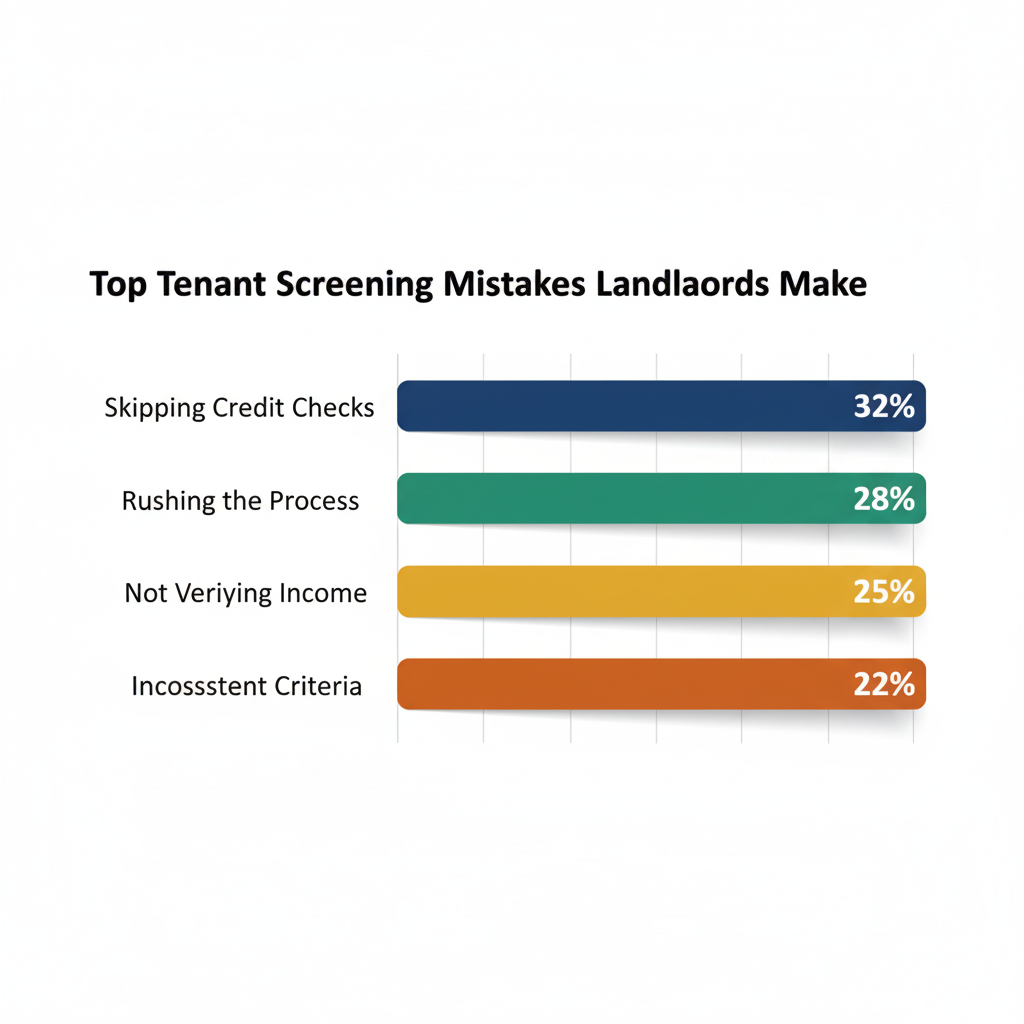
The Most Costly Tenant Screening Mistakes Landlords Make
Mistake #1: Skipping Comprehensive Credit Checks (32% Error Rate)
Skipping thorough credit checks represents the most common and costly tenant screening mistake, affecting 32% of landlords. Moreover, credit reports provide essential insights into financial responsibility, payment patterns, and debt management that directly predict rental payment reliability.
Furthermore, landlords who only glance at credit scores miss critical information, including collections accounts from previous landlords, utility companies, bankruptcies, and judgment patterns. Additionally, a comprehensive credit analysis should examine debt-to-income ratios, payment history trends, and credit utilization patterns to assess financial stability.
SmartScreen provides detailed credit analysis that goes beyond simple scores to evaluate complete financial profiles. Moreover, our soft credit inquiries don’t affect applicants’ credit scores while providing landlords with comprehensive financial assessments needed for informed decisions.
Mistake #2: Rushing the Screening Process (28% Error Rate)
Rushing tenant screening to fill vacancies quickly leads to costly mistakes for 28% of landlords. However, this pressure to maintain rental income often results in overlooking critical red flags, skipping essential verification steps, or accepting incomplete applications.
Additionally, hasty screening decisions often result in selecting unreliable tenants who cause significantly more problems than brief vacancy periods. Furthermore, the cost of evicting problematic tenants ($3,500-$10,000) far exceeds temporary rental income losses from thorough screening.
Therefore, SmartScreen’s efficient screening platform provides rapid results without compromising thoroughness. Moreover, our streamlined processes help landlords make quick but informed decisions by delivering comprehensive reports within 24-48 hours.
Mistake #3: Inadequate Employment and Income Verification (25% Error Rate)
Failing to properly verify employment and income affects 25% of landlords and leads to tenants who cannot sustain rental obligations. Moreover, with the rise of the gig economy and non-traditional employment, verification has become more complex yet increasingly important.
Additionally, landlords must verify all income sources, including employment wages, government assistance, disability benefits, and child support, equally under Fair Housing requirements. Furthermore, income verification should confirm not just current earnings but employment stability and the likelihood of continued income.
SmartScreen offers comprehensive employment verification services that accommodate traditional and non-traditional income sources. Additionally, our platform provides automated verification processes while ensuring compliance with source-of-income protection laws.
Mistake #4: Using Inconsistent Screening Criteria (22% Error Rate)
Applying different screening standards across applicants affects 22% of landlords and creates significant Fair Housing liability. Moreover, inconsistent practices can appear discriminatory, even when unintentional, leading to expensive legal challenges and penalties of $23,011 to $108,315 per violation.
Furthermore, subjective decision-making based on “gut feelings” rather than objective criteria increases the risk of discrimination while reducing screening effectiveness. Additionally, landlords need written screening policies with specific, measurable criteria applied uniformly to all applicants.
Therefore, SmartScreen helps landlords establish consistent screening criteria through standardized evaluation processes. Moreover, our platform documents decision rationales to demonstrate non-discriminatory practices.
Additional Critical Screening Mistakes to Avoid
Failing to Verify Rental History and References
Overlooking rental history verification represents another significant mistake that prevents landlords from identifying problematic tenant behaviors. Moreover, contacting previous landlords directly often reveals information about payment patterns, property care, and lease compliance not available through automated reports.
Additionally, reference checks should include employment, personal character, and professional references to provide a comprehensive tenant assessment. Furthermore, landlords should ask specific questions about reliability, responsibility, and any red flags observed during reference checks.
SmartScreen facilitates comprehensive rental history verification through automated reference checking and landlord contact services. Moreover, our platform guides landlords through practical reference verification questions while ensuring compliance with relevant requirements.
Using Outdated or Unreliable Screening Services
Relying on cheap, outdated, or unreliable screening services can provide inaccurate information, leading to poor tenant selections or unfair denials. Furthermore, quality screening requires current data sources, comprehensive database access, and FCRA compliance to ensure accurate results.
Additionally, screening services must comply with Fair Credit Reporting Act requirements, including proper consent procedures, accurate reporting, and adverse action notice provisions. Moreover, unreliable services expose landlords to legal liability for providing incorrect information or failing to follow proper procedures.
Therefore, SmartScreen maintains industry-leading data accuracy through comprehensive database access and rigorous verification procedures. Additionally, our FCRA compliance expertise ensures that proper legal procedures are followed throughout the screening process.
Ignoring Fair Housing and Legal Requirements
Failing to understand and comply with Fair Housing laws creates substantial legal risks for landlords. Moreover, discrimination based on protected characteristics can result in penalties ranging from $23,011 to $108,315 per violation.
Furthermore, evolving regulations, including criminal history guidelines, source-of-income protections, and requirements addressing AI bias, continue to change screening requirements. Additionally, state and local laws often impose additional restrictions beyond federal Fair Housing requirements.
For comprehensive Fair Housing guidance, landlords should regularly consult HUD’s Fair Housing Act resources and understand their obligations under federal law.
Best Practices for Avoiding Screening Mistakes
Establishing Written Screening Criteria
Developing clear, written screening policies helps ensure consistent, non-discriminatory tenant evaluation. Moreover, the criteria should include specific benchmarks, such as minimum credit scores, income-to-rent ratios (typically 3 times the monthly rent), and rental history requirements.
Additionally, screening policies must be directly related to tenancy qualifications and applied uniformly to all applicants. Furthermore, documented criteria provide legal protection by demonstrating objective, non-discriminatory decision-making processes.
SmartScreen assists landlords in developing compliant screening criteria through consultation services and best practice guidance. Moreover, our platform ensures consistent application of established criteria across all screening decisions.
Implementing Comprehensive Background Verification
Thorough background verification should include criminal history checks, eviction searches, employment confirmation, and credit analysis. However, criminal history evaluations must comply with Fair Housing guidelines by considering relevance, recency, and individual circumstances rather than relying on blanket exclusions.
Additionally, background checks should use national databases and multiple verification sources to ensure comprehensive coverage. Furthermore, landlords should provide applicants with opportunities to explain or dispute any negative findings before making a final decision.
SmartScreen offers comprehensive background verification services, utilizing Fair Housing-compliant evaluation procedures. Moreover, our platform guides landlords in considering criminal history and other sensitive information.
Real-World Examples of Screening Mistakes and Solutions
Case Study: Rushing to Fill Vacancy Leads to Problem Tenant
For instance, a landlord facing mortgage pressure quickly approved an applicant without proper income verification. Subsequently, the tenant stopped paying rent after three months, necessitating a costly eviction process that totaled $12,000 in legal fees and lost rent.
Moreover, proper income verification would have revealed the applicant’s unstable employment history and insufficient earnings. Therefore, taking additional time for comprehensive screening would have prevented this expensive mistake.
SmartScreen’s rapid screening capabilities enable thorough evaluation without extended delays. Furthermore, our platform helps landlords strike a balance between urgency and thoroughness by providing comprehensive results quickly.
Case Study: Inconsistent Criteria Creates Fair Housing Liability
Similarly, a property manager applied different credit score requirements based on subjective impressions, resulting in a $35,000 Fair Housing settlement. Additionally, the inconsistent practices created an appearance of discrimination despite a lack of intentional bias.
Moreover, establishing uniform written criteria would have prevented this costly legal challenge. Therefore, consistent application of objective standards protects landlords while ensuring fair treatment of all applicants.
SmartScreen helps prevent such issues by providing standardized evaluation criteria and consistent application procedures. Moreover, our platform documents objective decision-making processes that demonstrate compliance.
FAQ
What are the most common tenant screening mistakes landlords make?
The most costly tenant screening mistakes include skipping comprehensive credit checks (32%), rushing the screening process (28%), failing to verify employment and income properly (25%), and using inconsistent screening criteria (22%). Additionally, failing to check rental history, ignoring reference verification, and using unreliable screening services create significant risks.
How can rushing the screening process cost landlords money?
Rushing tenant screening to fill vacancies quickly leads to overlooking critical red flags and selecting unreliable tenants. Furthermore, the average eviction process costs $3,500-$10,000, including legal fees and lost rent, far exceeding temporary vacancy costs. Additionally, hasty decisions often result in tenants who cause property damage averaging $2,000-$10,000 per incident.
Why is inconsistent screening criteria a legal risk for landlords?
Using different screening standards for applicants creates Fair Housing liability, even when unintentional, leading to penalties of $23,011 to $108,315 per violation for discrimination. Moreover, subjective decision-making based on “gut feelings” rather than objective criteria increases legal risks while reducing the effectiveness of screening.
What happens when landlords skip credit checks during screening?
Skipping comprehensive credit checks, the most common mistake affecting 32% of landlords, prevents the identification of payment problems, debt issues, and financial instability. Moreover, credit reports reveal collections from previous landlords, utility companies, bankruptcies, and judgment patterns that predict rental payment reliability.
How do inadequate employment and income verification create problems?
Failing to properly verify employment and income affects 25% of landlords and leads to tenants unable to meet their rental obligations. Moreover, landlords must verify all income sources, including government assistance and disability benefits, equally under Fair Housing requirements.
What legal requirements must landlords follow during tenant screening?
Landlords must comply with the Fair Housing Act’s requirements prohibiting discrimination based on protected characteristics, with violations subject to penalties of up to $108,315 per case. Additionally, the Fair Credit Reporting Act requires written consent, proper disclosures, and adverse action notices when denying applications based on credit information.
How can technology help prevent tenant screening mistakes?
Modern screening platforms provide automated compliance features ensuring proper consent procedures, accurate reporting, and compliant adverse action notices. Moreover, automated systems reduce human error while maintaining consistent application of screening criteria. Additionally, comprehensive database access provides real-time updates and multiple verification sources for accurate assessments.
What documentation should landlords maintain to avoid legal problems?
Proper documentation should include application materials, screening reports, decision rationales, and all correspondence with applicants. Moreover, records must be maintained in accordance with Fair Housing requirements, typically for at least three years after the tenant selection process.
About the Author: David Chen is a Senior Tenant Screening Consultant at SmartScreen Tenant Screening Services with over 14 years of experience in property management and Fair Housing compliance. He has helped over 4,000 landlords avoid costly screening mistakes while maintaining legal compliance and has prevented an estimated $15 million in potential losses through proper screening guidance.
About SmartScreen: As the industry’s trusted leader in tenant screening for over two decades, SmartScreen helps landlords avoid costly screening mistakes through comprehensive, compliant evaluation processes. With over 500,000 successful screenings completed and a 99.4% accuracy rate, we help landlords make informed decisions that protect their investments.