


What Is Tenant Screening?
Core Definition and Purpose
Tenant screening involves assessing rental applicants to determine their reliability and trustworthiness through systematic evaluation of multiple factors. The process includes collecting rental applications, checking backgrounds, verifying employment, and speaking with references, with each step helping landlords make informed decisions.
Core Components of Tenant Screening:
Identity Verification: Government ID or Social Security number confirmation
Credit Report Analysis: Experian or TransUnion credit history and score evaluation
Criminal Background Checks: Federal, state, and local criminal records searches
Eviction History Review: Court filings and judgment verification (where legally permitted)
Income and Employment Verification: Pay stubs, W-2s, or direct employer contact
Rental References: Previous landlord interviews confirming payment history
According to Forbes, good tenant screening isn’t just about finding someone who can pay rent—it’s about choosing someone who will respect your property and lease terms.
Why Tenant Screening Matters in 2026
Financial and Legal Protection
Poor tenant selection increases eviction risk, which can cost landlords between $3,500 and $10,000 per incident, according to industry research. Additionally, 93.3% of property owners experience rental application fraud, with falsified documents carrying a 7 times higher risk of eviction.
Key Benefits:
Avoid Late Payments: 84% of landlords identify payment problems as their biggest concern
Reduce Turnover: Professional screening leads to longer tenant retention and lower vacancy losses
Ensure Legal Compliance: Fair Housing and FCRA adherence prevent costly violations
Protect Property Quality: Thorough screening reduces property damage risks
Minimize Legal Risks: Consistent criteria prevent discrimination claims
Real-World Example:
SmartScreen helped one Phoenix landlord avoid a repeat eviction by flagging a tenant with two prior judgments for nonpayment—data not shown on their self-reported application —preventing a potential $3,500- $10,000 loss.
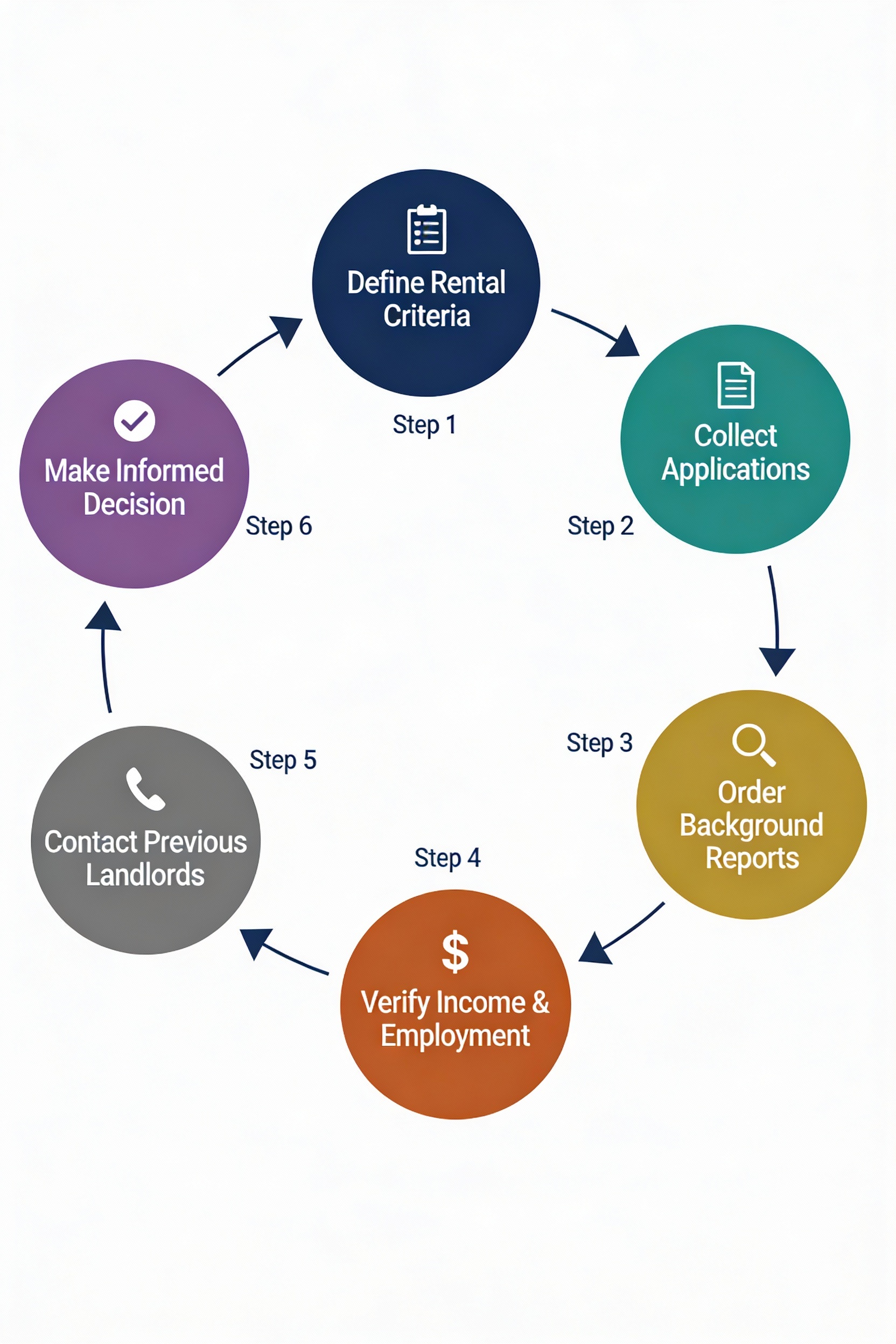
How to Screen Tenants: Complete Step-by-Step Process
1. Define Clear Rental Criteria
Set written standards—like a minimum 620 credit score, 3x rent income, no recent evictions, or violent crimes—ensuring consistency and protecting against Fair Housing claims. However, keep the criteria reasonable to attract a sufficient applicant pool.
Essential Criteria Elements:
Minimum Credit Score: Typically 620-650 for qualified tenants
Rent-to-Income Ratio: Monthly rent should not exceed 30% of gross income (3x multiplier)
Employment Verification: Stable employment history with minimal gaps
Rental History: No prior evictions or lease violations
Criminal Background Guidelines: Consistent with local laws and Fair Housing requirements
By using written criteria, landlords ensure all potential tenants are evaluated consistently and fairly.
2. Use a Digital Rental Application
Collect comprehensive information through standardized applications, ensuring legal compliance and efficient processing.
Required Application Information:
Full name and contact information
Social Security Number or government-issued ID
Current employment details and income
Complete rental history (minimum 3 years)
Previous landlord contact information
Personal and professional references
Written consent for background screening
Details about all occupants, including pets
In 2026, landlords must disclose what screening reports they’ll run and provide estimated costs upfront, with application fees capped in many states to actual costs only.
3. Order a Full Screening Report
Use a trusted FCRA-compliant provider like SmartScreen for comprehensive tenant evaluation:
SmartScreen Platform Features:
TransUnion-Powered Credit Data: FCRA-compliant credit reports with detailed payment history
National Criminal Searches: Comprehensive criminal background checks across 370+ million records
Eviction History: Court filing searches identifying prior evictions (where legally permitted)
ResidentScore® Technology: Predictive scoring reduces eviction risk by 15% compared to traditional credit scores
Risk Assessment Recommendations: Clear pass/fail guidance based on predefined criteria
The entire screening process typically takes 48-72 hours using integrated platforms, with some services delivering reports within minutes.
4. Verify Income and Employment
Ask for 2-3 months of pay stubs, W-2s, or bank statements to confirm income stability. Alternatively, contact the employer directly to verify salary, position, and employment status.
Income Verification Best Practices:
Seek tenants earning at least 3 times the monthly rent
Cross-check information by contacting employers
Review bank statements for income consistency
Use automated verification systems where available
Look for employment stability with minimal gaps
According to industry research, 45% of landlords consider unstable employment records a deal-breaker.
5. Contact Previous Landlords
Reach out to current and former landlords to verify a comprehensive rental history.
Critical Reference Questions:
Did they consistently pay rent on time?
Were there any late payments or NSF checks?
How was the property condition at move-out?
Were there damages beyond normal wear and tear?
Did they report maintenance issues promptly?
Were there any lease violations or complaints?
Would you rent to them again?
Industry data shows that 23% of landlords view negative references as decisive in their tenant selection process.
6. Make an Informed Decision
Compare the applicant’s results to your written criteria, applying standards consistently across all applicants. If denying an application, send an FCRA-compliant adverse action notice with explanation and credit bureau contact information.
For comprehensive Fair Housing guidance, visit HUD’s Fair Housing Act Guidelines.
Tenant Screening Red Flags in 2026
Top Warning Signs from Screening Reports
Understanding common red flags helps landlords identify problematic applicants before signing leases.
Most Common Red Flags:
Application Fraud (93.3% of property owners encounter): Unmatched fonts, fuzzy logos, math errors, PDF manipulation
Poor Credit History (84% of landlords’ top concern): Regular late payments, multiple collection accounts, high debt-to-income ratio
Prior Evictions: 3x higher risk of future evictions, costing $3,500-$10,000 each
Unstable Employment (45% deal-breaker): Job hopping, unexplained gaps, varying income
Criminal Records: 25% of rental applicants have criminal records requiring individualized assessment
Unverifiable Income: Cash sources, inconsistent documentation, pressure to skip verification
Communication Issues: Dodging questions, aggression, missing appointments (40% of property manager challenges)
Rush to Move In: High-pressure tactics often indicate fraudulent activity
Additional Warning Signs:
Incomplete or missing application information
All references are relatives
Over-denial of background check results
History of frequent moving
Offering advanced payment to skip screening
Lying about income or employment
Research indicates that 5% of tenants become problematic due to rushed screening, while consistent screening reduces issues by 60%.
Legal Compliance in Tenant Screening
Fair Housing and FCRA Requirements
Tenant screening must comply with Fair Housing Laws, which prevent discrimination based on race, religion, gender, disability, or family status. Additionally, landlords must handle tenant data carefully to comply with privacy laws and FCRA regulations.
Compliance Framework:
Follow the Fair Housing Act: Avoid discrimination against protected classes
Consistent Criteria: Apply identical evaluation standards to all applicants
FCRA Adverse Action Notices: Provide proper denial notices within 3-5 business days when required
Written Authorization: Obtain explicit consent before conducting background checks
Secure Data Disposal: Properly destroy consumer reports after decision completion
In 2026, compliance requirements include accepting all legal sources of income (housing vouchers, disability benefits, government assistance) and adhering to state-specific lookback limits for criminal and eviction records.
FCRA Penalty Structure:
Statutory damages: $100-$1,000 per violation
Actual damages for proven financial harm
Attorney fees and court costs
Punitive damages for willful violations
For comprehensive legal guidance, visit Nolo’s Fair Housing Legal Guide and HUD’s Fair Housing resources.
Why SmartScreen is Landlord-Trusted
Comprehensive Screening Platform
SmartScreen is a tenant screening platform built for landlords who want speed, compliance, and confidence in their tenant selection process.
Platform Features:
Instant Verification: Credit, eviction, and criminal checks delivered within minutes
Customizable Criteria: Set standards like “no evictions in 5 years” for automated evaluation
No Manual SSN Collection: Applicant-initiated screening protects sensitive data
Mobile-Ready Applications: Convenient digital tenant application process
Clear Recommendations: Pass/fail guidance based on predefined rental criteria
FCRA Compliance: Automated adverse action notices and proper authorization collection
Performance Results:
Used by landlords in over 40 states, SmartScreen reduces decision time by 70% on average while improving tenant quality through comprehensive verification.
Frequently Asked Questions
What is tenant screening?
Tenant screening is the process of evaluating rental applicants through comprehensive background checks—including credit reports, criminal history, eviction records, and income verification—to determine their reliability as tenants.
What do landlords look for in a background check?
Landlords examine credit scores (typically minimum 620-650), criminal records (25% of applicants have some history), eviction history (indicating 3x higher future risk), employment stability, income verification (3x rent minimum), and rental references.
How much income should a tenant have?
Industry standards recommend tenants earn at least 3 times the monthly rent, ensuring monthly rent does not exceed 30% of gross income, leaving sufficient funds for other expenses.
Can I reject a tenant with bad credit?
Yes, landlords can deny applications based on poor credit as long as the criteria are applied consistently to all applicants and proper FCRA adverse action notices are provided explaining the denial and credit bureau contact information.
Is SmartScreen safe and compliant?
Yes, SmartScreen is FCRA-compliant, utilizing TransUnion-powered data, end-to-end encryption, secure data handling, and automated compliance features ensuring legal adherence throughout the screening process.
What are the most common tenant screening red flags?
Top red flags include application fraud (93.3% of owners encounter it), poor credit history (84% of landlords’ primary concern), prior evictions (3x higher future risk), unstable employment (45% deal-breaker), and unverifiable income.
How long does tenant screening take?
The complete screening process typically takes 48-72 hours on integrated platforms, with some services, such as SmartScreen, delivering reports within minutes to expedite decision-making.
TL;DR: Essential Tenant Screening Framework
Set clear rental criteria and apply them consistently to all applicants
Use digital applications to collect comprehensive information with proper consent
Order FCRA-compliant background checks through trusted platforms like SmartScreen
Verify income and employment, ensuring 3x rent income minimum
Contact previous landlords for rental history confirmation
Stay Fair Housing-compliant by avoiding protected class discrimination
Watch for red flags, including fraud (93.3% encounter rate), poor credit (84% concern), and prior evictions (3x risk)
Use professional screening services to reduce decision time by 70% and prevent $3,500-$10,000 eviction costs
Conclusion:
Tenant screening is the landlord’s most critical defense against costly rental mistakes, with comprehensive background checks through platforms like SmartScreen preventing $3,500-$10,000 evictions, identifying the 93.3% fraud rate affecting property owners, and addressing the 84% of landlords concerned about payment problems. By implementing systematic screening procedures—including credit analysis, criminal background verification, eviction history searches, income verification requiring 3x rent minimum, and rental reference checks—landlords can reduce decision time by 70%, lower eviction risk by 15% through ResidentScore® technology, and maintain Fair Housing compliance while selecting reliable tenants in 2026’s challenging rental market.
Professional References: