


Why Tenant Screening is Critical for Rent Collection Success
Foundation of Reliable Payment Patterns
Tenant screening is essential for landlords because it verifies a potential tenant’s background, reliability, and financial stability. This comprehensive process helps landlords mitigate risks associated with rent defaults, property damage, and eviction hassles, ultimately ensuring consistent rental income.
How Tenant Screening Prevents Rent Collection Issues:
Credit History Analysis: Reviewing credit reports provides insight into financial responsibility and the ability to meet rent obligations
Payment Pattern Verification: Positive credit history indicates tenant reliability in making timely payments
Rental History Checks: Contacting previous landlords determines consistent rent payment and property maintenance habits
Income Verification: Ensuring stable employment and sufficient income (typically 3x monthly rent) reduces missed payment risks
Eviction History Screening: Identifying tenants with prior evictions (who are nearly 3 times more likely to be evicted again)
Real-Life Example:
Sarah, a landlord in Chicago, used SmartScreen’s comprehensive tenant screening to evaluate potential renters for her two-bedroom unit. By reviewing applicants’ credit history, rental references, and income stability, she found a tenant with a strong track record of timely payments, resulting in consistent rent collection without any issues over the past two years.
Effective Rent Collection Strategies for 2026
1. Set Clear Rent Collection Policies
Establishing transparent rent collection policies is vital for maintaining consistent cash flow and avoiding payment disputes. Clear policies outlined in lease agreements set expectations from the beginning and protect both landlords and tenants.
Essential Policy Components:
Payment Due Dates: Clearly specify when rent is due each month (typically the 1st) and acceptable grace periods (usually 3-5 days)
Accepted Payment Methods: List approved methods, including checks, bank transfers, ACH, or online platforms
Late Fee Structure: Define the late fee amount or percentage, and when fees will be applied
Consequences of Nonpayment: Outline steps for consistent late or unpaid rent, including eviction procedures
Grace Period Terms: Many landlords offer 3-5 day grace periods before applying late fees
Real-Life Example:
John, a landlord in Los Angeles, faced recurring issues with late rent payments. To address this, he established a clear rent collection policy including a five-day grace period and a $50 late fee. By communicating these expectations upfront and including them in the lease agreement, John saw a significant improvement in on-time payments.
According to legal experts, landlords who repeatedly accept late rent may give up the right to evict tenants who don’t pay on time, as continually accepting late payments effectively alters the lease terms.
2. Collect Rent Online with Automated Systems
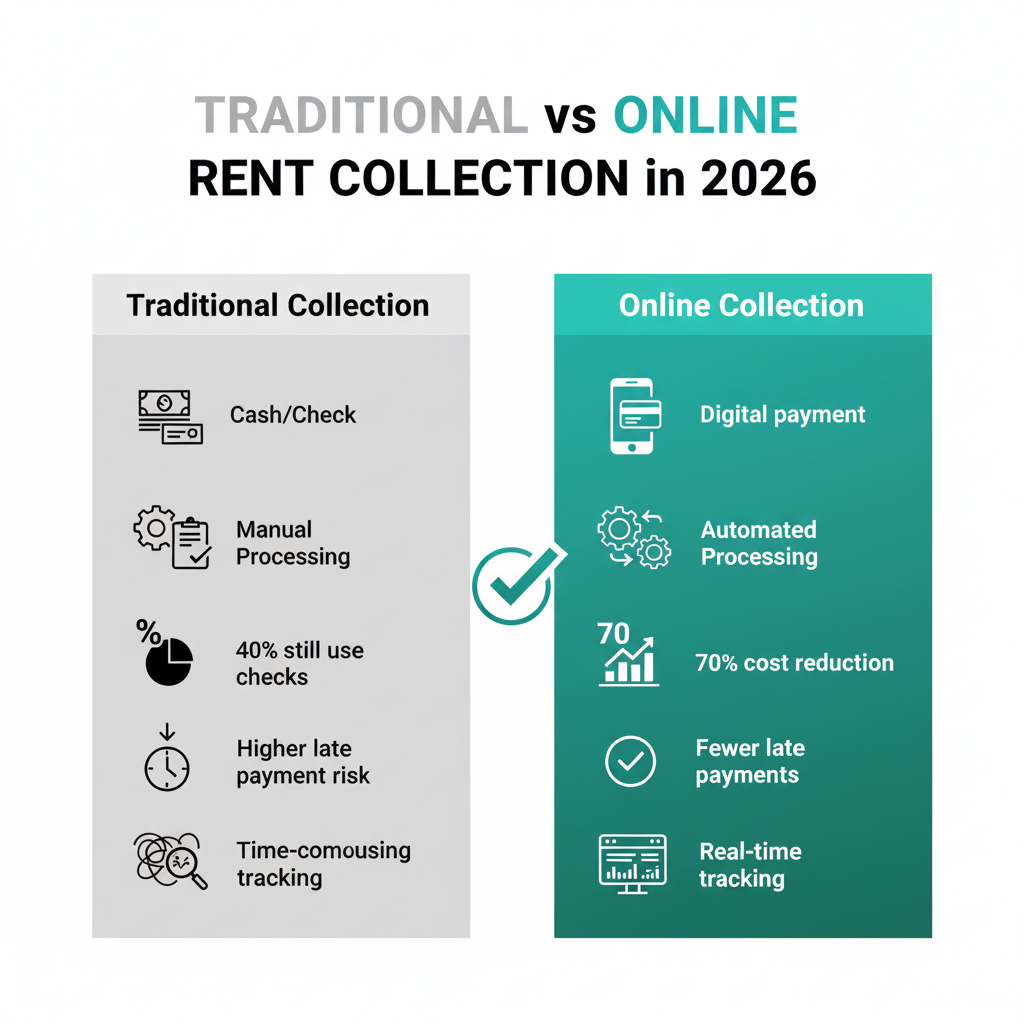
Online rent collection has become increasingly popular in 2026 due to its convenience, efficiency, and cost-effectiveness. Specialized rent collection platforms offer the most secure, reliable, and automated way to streamline rent collection.
Benefits of Online Rent Collection:
Administrative Cost Reduction: Online platforms cut administrative costs by up to 70%
Faster Processing: Direct transfers and automated deposits versus mail delays and manual processing
Reduced Late Payments: Automated reminders significantly reduce late payments
Enhanced Security: Encrypted transactions with lower risk of loss, theft, or misplaced items
Automated Record-Keeping: Digital records and reports versus manual logging and paperwork
Improved Cash Flow: Landlords receive payments as fast as two business days
Popular Online Payment Platforms:
ACH Bank Transfers: Secure direct bank-to-bank transfers with automated processing
Dedicated Rent Platforms: RIOO, Baselane, and TenantCloud offer specialized features
Mobile Payment Apps: Venmo for Business, Zelle, PayPal for convenient smartphone payments
Credit/Debit Cards: Flexible payment options with fast processing
Real-Life Example:
Emily, a landlord managing multiple properties, switched to online rent collection using Zelle Pay and automated ACH transfers. Her tenants appreciated the convenience, and Emily found that automating payments led to fewer delays while reducing her administrative workload.
According to industry research, properties that offer dedicated payment apps see much higher adoption rates despite 40% of renters still using checks.
3. Implement Automated Recurring Payments
Automatic recurring payments allow tenants to set up fixed rent amounts to be paid each month, helping eliminate late payments and streamline rent collection.
Recurring Payment Advantages:
Eliminates Late Payments: Automatic deductions ensure rent is paid on the agreed date every month
Predictable Cash Flow: Landlords receive reliable, consistent payments without chasing tenants
Hassle-Free for Tenants: No need to remember payment dates or write checks
Reduced Administrative Work: Automation minimizes manual processing and tracking
Win-Win Solution: Benefits both landlords and tenants through convenience and reliability
Platforms like RIOO allow tenants to set up recurring payments, ensuring rent is automatically deducted on the agreed date each month, eliminating late payment risk and providing landlords with predictable cash flow.
4. Offer Multiple Payment Options
To cater to tenant preferences, landlords should offer a variety of payment methods, including direct debit, mobile apps, ACH transfers, and online portals. Flexibility in payment options benefits both parties:
Payment Method Benefits:
Enhanced Convenience: Tenants are more likely to pay on time with preferred payment choices
Improved Tenant Satisfaction: Accommodating preferences shows consideration, leading to better retention
Increased On-Time Payment Rates: Multiple options significantly boost timely payment percentages
Broader Accessibility: Caters to different financial situations and technical capabilities
Recommended Payment Options:
Online payment portals for remote, quick transactions
Automatic bank transfers guarantee on-time payments
Mobile apps for smartphone-based payments
Traditional checks for tenants preferring conventional methods
ACH direct bank transfers for secure processing
Real-Life Example:
Lisa, a New York City landlord, offers tenants the choice to pay via Venmo for Business, Direct Debit, or checks. By accommodating diverse payment preferences, she has maintained a high on-time payment rate and improved overall tenant satisfaction.
5. Enforce Late Fees Consistently
Enforcing late fees for overdue rent payments incentivizes tenants to pay on time and discourages delays. A well-defined late fee policy should be included in the lease agreement and enforced consistently.
Late Fee Best Practices:
Set Reasonable Fees: Most landlords charge a percentage of rent or a flat fee (e.g., $50-$75), ensuring compliance with local laws
Establish Clear Consequences: Inform tenants upfront about penalties for late payments to promote accountability
Offer Grace Periods: Typically 3-5 days before late fees apply, allowing for minor delays
Consistent Enforcement: Apply fees uniformly to maintain fairness and avoid disputes
Legal Compliance: Verify late fees comply with state and local regulations, as some jurisdictions cap amounts
Real-Life Example:
Mark, an Austin landlord, introduced a $75 late fee after noticing repeated payment delays. Once tenants understood the financial consequences, they made concerted efforts to pay on time, resulting in fewer missed payments.
According to Georgia legal guidelines, if a lease states that a late fee will be charged, the landlord may charge a reasonable late fee if tenants fail to pay rent by the due date.
6. Provide Incentives for Early or On-Time Payments
Encouraging tenants to pay rent early through small discounts or rental credits creates a positive payment culture. For example, a 5% discount on next month’s rent for paying one week early can motivate tenants to prioritize rent payments.
Incentive Benefits:
Promotes Timely Payments: Rewards positive behavior and encourages consistent on-time payment habits
Fosters Goodwill: Creates positive landlord-tenant relationships and increases satisfaction
Reduces Late Payments: Motivates tenants to prioritize rent as their first monthly expense
Tenant Retention: Incentives demonstrate landlord appreciation, improving long-term retention
7. Communicate Effectively with Tenants
Effective communication with tenants is key to successful rent collection, building transparency, trust, and ensuring prompt issue resolution.
Communication Best Practices:
Automated Reminders: Send rent due notifications, reducing late payments significantly
Multiple Communication Channels: Use emails, texts, or written notices, ensuring tenants are informed
Friendly Initial Contact: Send friendly reminders when payments are late before formal notices
Formal Notice Escalation: Follow up with formal late rent notices indicating amounts owed and fees
Detailed Record-Keeping: Maintain thorough records of all communications for legal documentation
Real-Life Example:
Karen, a landlord managing a four-unit building, found that sending monthly payment reminders via text message helped her tenants stay on top of rent payments, reducing late payments while making it easier to resolve maintenance issues.
How SmartScreen Enhances Rent Collection Success
Comprehensive Tenant Screening for Payment Reliability
SmartScreen offers comprehensive tenant screening services that help landlords evaluate potential tenants through detailed background checks, credit reports, and verification processes.
SmartScreen Screening Components:
Credit and Financial History: Detailed credit reports offering insights into creditworthiness and payment behaviors
Criminal Background Checks: Thorough screening across 370+ million records for security assessment
Employment and Income Verification: Confirming stable financial sources to meet rental obligations
Rental History Verification: Insights into past rental behavior and landlord relationships
Eviction History Searches: Identifying tenants with prior evictions who are 3x more likely to be evicted again
ResidentScore® Technology: Proprietary scoring reduces eviction risk by 15% compared to traditional credit scores
By conducting thorough background checks, landlords can assess rental history, creditworthiness, employment status, and overall financial responsibility, ultimately selecting tenants more likely to pay rent consistently and on time.
Handling Late or Missed Rent Payments
Escalation Process and Legal Considerations
Landlords should follow systematic procedures when dealing with late or missed rent payments.
Late Payment Response Steps:
1. Send Friendly Reminder: Contact the tenant as soon as a late payment is noticed
2. Send Formal Notice: Provide a written late rent notice indicating amounts owed and fees
3. Enforce Late Fees: Apply fees consistently as outlined in the lease agreement
4. Open Communication: Discuss payment plans or hardship accommodations if appropriate
5. Send Final Demand: Provide a final demand letter outlining the past due amount and the deadline
6. Understand Eviction Laws: Familiarize yourself with local eviction procedures and requirements
7. File for Eviction: Follow the formal eviction process if the tenant continues missing payments
Legal Compliance:
Landlords must follow proper legal procedures and Fair Housing guidelines when addressing late payments to avoid discrimination claims. For comprehensive legal guidance, visit HUD’s Fair Housing resources.
Frequently Asked Questions
What are rent collection strategies?
Rent collection strategies refer to the methods landlords use to collect rent payments from tenants, including setting up payment schedules, choosing acceptable payment methods (online platforms, ACH, checks), and enforcing consequences for late or missed payments.
Why is it important to have effective rent collection strategies?
Effective rent collection strategies ensure steady cash flow for landlords, reduce late payments by up to 70% through automation, help avoid payment disputes, and maintain positive landlord-tenant relationships.
What are the benefits of online rent collection?
Online rent collection reduces administrative costs by 70%, decreases late payments through automated reminders, offers faster processing (as little as two business days), provides enhanced security, and simplifies record-keeping.
How do late fees improve rent collection?
Late fees incentivize tenants to pay on time by establishing clear financial consequences for late payments, typically $50- $75 or a percentage of monthly rent, while compensating landlords for the inconvenience caused by late payments.
What payment methods should landlords offer?
Landlords should offer multiple payment options, including online platforms (RIOO, Baselane), ACH bank transfers, mobile apps (Venmo, Zelle), credit/debit cards, and traditional checks, to accommodate tenant preferences and increase on-time payment rates.
How can SmartScreen assist with rent collection?
SmartScreen provides comprehensive tenant background checks, including credit analysis, rental history verification, income verification, and eviction history searches, helping landlords choose reliable tenants who minimize late-payment risk.
Can landlords change their rent collection strategies?
Yes, landlords can update rent collection strategies as needed, but they must communicate changes to tenants beforehand and provide alternative options to maintain transparency and consistency while complying with lease agreements.
What should landlords do if tenants fail to pay rent?
Landlords should follow lease agreement policies, including sending friendly reminders, formal notices, enforcing late fees, maintaining detailed records, and following proper legal eviction procedures if payment issues persist.
TL;DR: Essential Rent Collection Framework
Tenant screening is foundational: Use SmartScreen to identify reliable tenants with 3x rent income and positive payment history
Implement clear policies: Set transparent due dates, grace periods (3-5 days), and late fee structures ($50-$75)
Adopt online collection: Reduce administrative costs by 70% and decrease late payments through automation
Enable recurring payments: Automatic deductions eliminate late payments and provide a predictable cash flow
Offer multiple payment options: ACH, mobile apps, credit cards, and checks increase on-time payment rates
Enforce late fees consistently: Apply fees uniformly to promote accountability and timely payments
Provide payment incentives: Offer 5% discounts for early payments to foster positive tenant behavior
Communicate effectively: Send automated reminders and maintain open communication channels
Follow legal procedures: Comply with Fair Housing guidelines and local eviction laws
Conclusion:
Implementing effective rent collection strategies in 2026 requires combining comprehensive tenant screening through SmartScreen (identifying reliable tenants with 3x monthly rent income and positive payment history) with modern online collection platforms that reduce administrative costs by 70%, automated recurring payment systems that eliminate late payments, multiple payment options accommodating tenant preferences, and consistent late fee enforcement ($50-$75 or percentage-based) while maintaining clear communication and legal compliance. By utilizing SmartScreen’s comprehensive screening services, including credit checks, rental history verification, income verification, and eviction history searches, landlords can select tenants who are nearly 3 times less likely to default on rent, ultimately preventing $3,500-$10,000 eviction costs while ensuring consistent cash flow and positive landlord-tenant relationships.
Professional References: