


What Is Tenant Screening in Mississippi?
Tenant screening is the systematic process that Mississippi landlords use to assess potential tenants before approving lease agreements. It involves thorough background evaluations—including credit history, criminal records, eviction reports, employment verification, and rental references—to determine whether an applicant meets your written criteria.
This screening process is vital for reducing risks such as property damage, nonpayment, evictions, and legal disputes. By carefully reviewing rental applications through professional platforms like SmartScreen’s tenant screening services, landlords can identify reliable tenants who pay rent on time, maintain the property responsibly, and consistently follow lease terms.
Why Is Tenant Screening Important for Mississippi Landlords?
Tenant screening is an essential practice for landlords and property managers across Mississippi because it allows property owners to evaluate potential tenants’ financial stability, rental history, criminal backgrounds, and overall suitability before signing a lease. Through comprehensive screening, landlords safeguard their investments and comply with Fair Housing regulations.
Key benefits include:
Risk mitigation: Identifying applicants with eviction histories, poor credit, or criminal convictions that may threaten property safety or payment reliability.
Legal compliance: Ensuring screening practices align with the federal Fair Housing Act and FCRA requirements to avoid discrimination claims and costly penalties.
Better tenant selection: Using objective, consistent criteria helps landlords choose tenants who fulfill rental obligations and maintain positive landlord-tenant relationships.
By following proper screening procedures, Mississippi landlords also reduce the likelihood of encountering discrimination claims or legal issues under housing laws.
What Information Is Included in a Mississippi Tenant Screening Report?
A comprehensive tenant screening report in Mississippi typically includes detailed information on an applicant’s credit history, criminal background, eviction records, rental history, employment verification, and other screening criteria. This information helps landlords assess applicants’ suitability for the rental market and make defensible, data-driven decisions.
1. Credit History and Credit Reports
Examining a tenant’s credit history is a fundamental component of the screening process in Mississippi. Landlords commonly review credit reports from rental screening services such as SmartScreen’s tenant credit check platform, TransUnion SmartMove, or RentPrep.
Potential tenants may need to pay nonrefundable rental application fees at this stage, and the credit results directly impact the rental approval process.
A tenant’s credit history plays a crucial role in landlords’ assessments of financial reliability. By examining credit reports, landlords can evaluate an individual’s financial responsibility, including timely bill payments, outstanding debts, and overall debt management.
This information allows landlords to assess the risk level of renting their property to a specific applicant. Rental screening services provide comprehensive credit details, including credit scores, payment patterns, bankruptcies, and outstanding balances.
2. Criminal Background Check
Performing a criminal background check is an integral part of tenant screening in Mississippi. Landlords commonly hire rental screening companies like SmartScreen, RentPrep, or RentSpree to conduct thorough background checks, ensuring compliance with rental screening standards and Fair Housing regulations.
These checks are essential for evaluating the trustworthiness and safety of prospective tenants, providing landlords with valuable insights into an individual’s past conduct and criminal record.
Mississippi criminal background best practices:
Mississippi landlords should follow HUD’s guidance on criminal background checks to ensure fair screening. This includes:
Avoiding blanket policies that automatically deny all applicants with criminal convictions.
Assessing applicants and their criminal histories on a case-by-case basis.
Only denying an applicant when they demonstrate a direct risk to the safety of other residents or the property.
By collaborating with reputable screening companies, property owners can access comprehensive screening criteria, including credit history, eviction records, and employment verification.
3. Eviction History
Assessing an applicant’s eviction history is a crucial step in the tenant screening process in Mississippi. Landlords carefully examine past rental disputes, eviction incidents, and overall rental history reports to make well-informed decisions about potential tenants.
Examining eviction history provides landlords with valuable insights into an applicant’s past behavior as a tenant, helping them assess the risk of renting their property. Understanding how individuals have handled prior rental disputes and evictions provides a glimpse into their reliability and responsibility as renters, helping landlords assess their likelihood of fulfilling lease obligations.
This comprehensive vetting process is fundamental to protecting landlords from potential issues related to rental payments, property damage, or lease violations arising from problematic tenants.
4. Rental History and
Evaluating an applicant’s rental history is an essential component of the tenant screening process in Mississippi. Landlords analyze past rental experiences, application procedures, and property maintenance records to assess applicants’ suitability as tenants.
This assessment helps landlords determine how well prospective tenants have met their obligations in prior rental situations, indicating their reliability. By reviewing rental application processes, landlords can uncover valuable information about the applicant’s financial stability, employment history, and overall suitability as a tenant.
Reviewing property maintenance records enables landlords to assess the applicant’s ability to maintain a property in good condition, demonstrating their dedication to upkeep. These thorough evaluations enable landlords to make well-informed decisions that mitigate the risk of potential issues throughout the tenancy.
Laws and Regulations for Mississippi Tenant Screening
Mississippi tenant screening processes are regulated by specific federal and state housing laws that outline tenant rights, landlord obligations, and screening standards. Landlords need to follow these laws to ensure fair and legal tenant evaluations while protecting themselves from discrimination claims and regulatory penalties.
1. Fair Credit Reporting Act (FCRA)
The federal Fair Credit Reporting Act (FCRA) significantly impacts the regulation of tenant screening policies in Mississippi. Landlords are obligated to comply with FCRA guidelines regarding rental screening requirements, credit report verification, and applicant rights.
This federal law establishes criteria for how landlords should carry out tenant screenings, with a focus on accuracy and impartiality. During the evaluation of potential tenants, landlords must seek written permission to conduct credit checks and provide applicants with specific information if adverse actions are taken based on credit reports.
The FCRA mandates that landlords disclose to applicants their rights under the law, including the right to challenge incorrect information and receive a complimentary copy of their credit report if denied. Additionally, landlords must properly dispose of credit reports and tenant screening documents to protect sensitive personal information.
For detailed FCRA compliance guidance, review the Federal Trade Commission’s FCRA resources and SmartScreen’s tenant screening compliance overview.
2. Federal Fair Housing Act (FHA)
The Federal Fair Housing Act (FHA) prohibits discriminatory practices in tenant screening processes. Landlords in Mississippi must ensure that their screening reports, fees, and decision criteria comply with FHA regulations to promote fair and equal housing opportunities.
This act helps prevent landlords from discriminating against potential tenants based on factors such as race, religion, national origin, sex, familial status, or disability. By adhering to FHA guidelines, landlords must treat all applicants equally and evaluate them solely on their qualifications and rental history, not on any discriminatory criteria.
Federal Fair Housing protections in Mississippi include:
Race
Color
National origin
Religion
Sex (including sexual orientation and gender identity)
Familial status (families with children under 18)
Disability
Mississippi does not currently have additional statewide protected classes beyond these federal categories, though some local jurisdictions may provide broader protections.
For authoritative Fair Housing guidance, review HUD’s Fair Housing and Equal Opportunity resources and NARPM’s Fair Housing best practices.
3. Mississippi-Specific Tenant Screening Regulations
Mississippi is widely considered a landlord-friendly state with minimal state-level restrictions on tenant screening. Key Mississippi-specific rules include:
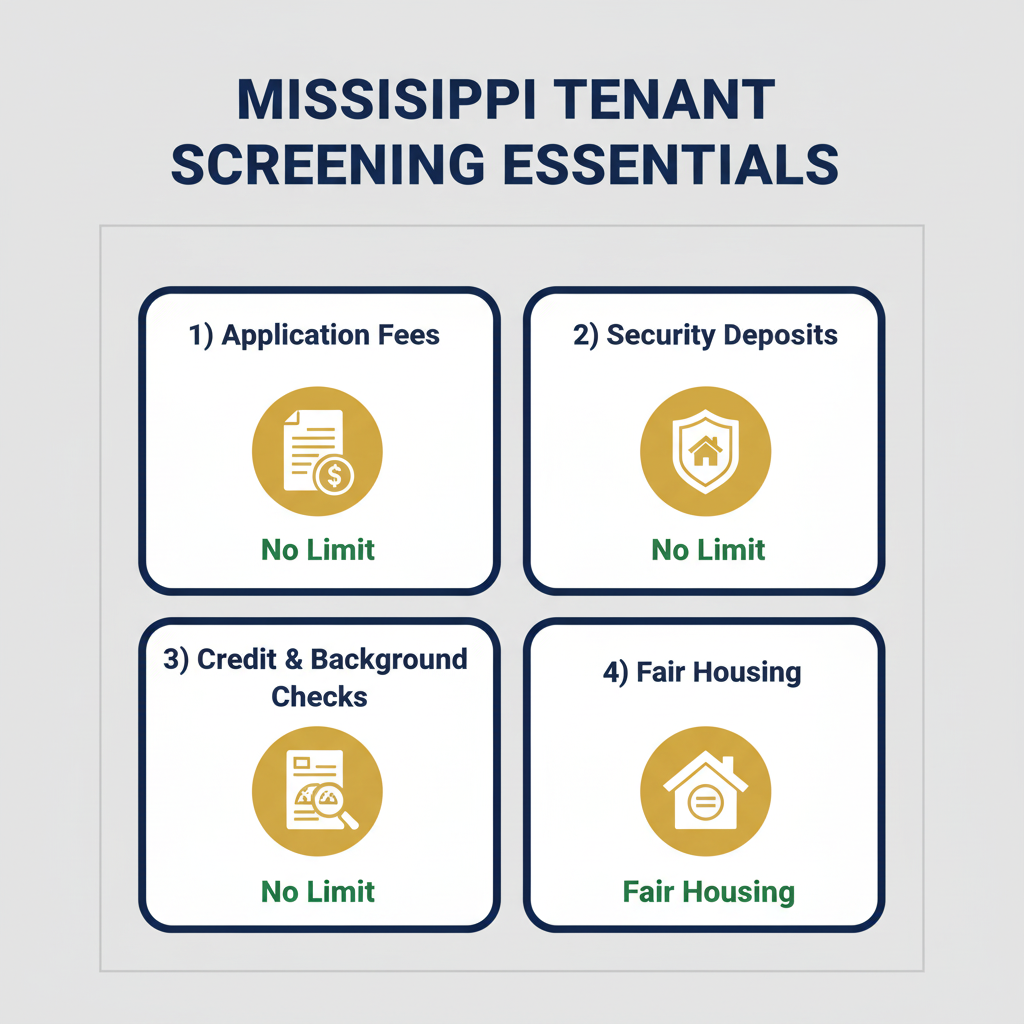
No application fee limits: Mississippi does not cap how much landlords can charge for rental application fees, though fees should be reasonable and related to actual screening costs.
No security deposit limits: Mississippi landlords can collect any reasonable security deposit amount, though deposits must be returned within 45 days of lease termination with itemized deductions.
Application fees are nonrefundable: Fees collected to cover screening costs are typically nonrefundable, even if the application is denied.
For complete Mississippi landlord-tenant law details, review the Mississippi Residential Landlord and Tenant Act and the Mississippi Landlord-Tenant Handbook.
How Can Mississippi Landlords Conduct Tenant Screening?
Landlords in Mississippi have various options for tenant screening, including online services, hiring professional screening companies, or using a do-it-yourself (DIY) approach. Each method offers different levels of convenience, thoroughness, and cost-effectiveness.
1. Online Tenant Screening Services
Online tenant screening services offer Mississippi landlords a convenient and efficient way to conduct screenings while ensuring compliance with rental screening standards and FCRA requirements. These digital platforms enable landlords to streamline the screening process, manage fees transparently, and access comprehensive reports quickly.
Popular online screening platforms include:
These services allow landlords to quickly verify potential tenants’ credit histories, criminal backgrounds, and rental histories in minutes, eliminating the need for manual paperwork and lengthy verification procedures. By using these platforms, landlords benefit from transparent fee structures, as many services provide upfront pricing with no hidden costs.
2. Professional Tenant Screening Companies
Tenant screening companies provide landlords in Mississippi with essential assistance by conducting thorough tenant evaluations. These professional services manage the entire screening process, produce detailed reports, and provide landlords with valuable insights to support well-informed decisions.
By engaging with tenant screening companies like SmartScreen or RentPrep, landlords can leverage professionals’ expertise to conduct comprehensive evaluations of potential tenants. This streamlined process not only saves time but also ensures that landlords receive precise screening reports that highlight critical information, including credit history, eviction records, and criminal background checks.
Armed with such detailed insights, landlords can make informed decisions when choosing tenants, thereby minimizing the risks of renting their properties. This level of professional support can significantly improve the overall rental experience and help landlords maintain high-quality tenants.
3. DIY Tenant Screening
Landlords in Mississippi may use a do-it-yourself (DIY) tenant screening approach to manage the screening process independently. This method allows landlords to customize their screening criteria, maintain control over the process, and potentially save on external screening fees.
By establishing specific requirements tailored to their preferences, landlords can ensure they attract tenants who meet their standards. DIY tenant screening offers flexibility and cost-effectiveness, particularly for landlords overseeing multiple properties or those with simpler screening needs.
However, DIY screening requires:
Thorough understanding of FCRA and Fair Housing compliance requirements.
Access to reliable credit bureaus, background check providers, and eviction databases.
Consistent documentation and record-keeping practices to defend decisions if challenged.
For most Mississippi landlords, partnering with professional screening services like SmartScreen provides stronger legal protection and more comprehensive data.
Red Flags to Look for in Mississippi Tenant Screening Reports
During tenant screening in Mississippi, landlords must be attentive to specific red flags in screening reports that indicate potential risks. These include poor credit history, criminal convictions, eviction records, and negative rental histories.
1. Poor Credit History
In Mississippi, a poor credit history can be a significant concern for landlords during the tenant screening process. It may impact rental decisions and suggest potential risks related to rental payment reliability and financial stability.
When assessing applicants, landlords commonly use credit reports to evaluate their ability to fulfill financial obligations. Instances of missed payments, outstanding debts, collection accounts, or past bankruptcies can raise concerns about a tenant’s dependability.
Landlords use credit evaluations to assess the risk of renting their property to a specific individual, considering factors such as credit score, debt-to-income ratio, and overall financial conduct. These evaluations help landlords make informed decisions to safeguard their investments and reduce the likelihood of future payment issues or evictions.
2. Criminal Convictions
Landlords conducting tenant screening in Mississippi should carefully review criminal convictions in screening reports while following HUD’s guidance for fair use of criminal history. Using rental screening companies like SmartScreen can help landlords assess the severity and relevance of criminal records while complying with screening standards.
Evaluating criminal convictions allows landlords to make informed decisions to ensure the safety and well-being of their properties and residents. Screening for criminal records is essential in maintaining a secure living environment and meeting the screening criteria outlined by federal regulations.
Best practices for criminal background evaluation:
Conduct individualized assessments rather than blanket denials.
Consider the nature, severity, and recency of the criminal activity.
Evaluate whether the conviction poses a direct threat to property safety or other tenants.
Rental screening companies have the expertise and resources to thoroughly analyze individual criminal backgrounds, providing landlords with detailed insights into potential risks associated with prospective tenants. This proactive approach not only protects properties but also improves overall tenant satisfaction and community safety.
3. Eviction History
Assessing an applicant’s eviction history is an essential aspect of the tenant screening process in Mississippi. Landlords analyze past rental disputes, evictions, and overall rental history to make well-informed decisions about potential tenants.
This comprehensive assessment enables landlords to evaluate the applicant’s financial responsibility, reliability as a tenant, and potential risks when renting to them. By examining eviction records in detail, landlords can determine whether the applicant has a history of breaching lease agreements or failing to meet rental obligations, providing valuable insights into the applicant’s rental conduct and dependability.
Understanding the underlying reasons for previous eviction incidents helps landlords assess the likelihood of similar issues arising in the future, aiding the evaluation of the applicant’s suitability as a tenant.
4. Negative Rental History
Evaluating an applicant’s negative rental history is an essential aspect of the tenant screening process in Mississippi. Landlords assess past rental experience, application procedures, and property maintenance records to determine applicants’ suitability as tenants.
Analyzing an applicant’s rental history provides landlords with valuable insights into how the potential tenant has handled previous living arrangements. Reviewing the rental application process provides landlords with insight into an applicant’s thoroughness and conscientiousness.
Examining property maintenance records helps landlords assess the individual’s dedication to maintaining the space and fulfilling responsibilities. This detailed evaluation enables landlords to make informed decisions and choose tenants who exhibit reliability and accountability in their rental history.
Frequently Asked Questions: Mississippi Tenant Screening
What is Mississippi tenant screening?
Mississippi tenant screening is the process of evaluating potential tenants for a rental property through credit checks, criminal background reports, eviction history, rental references, and employment verification to determine if they meet your written criteria.
Why is tenant screening important for Mississippi landlords?
Tenant screening helps landlords find reliable, responsible tenants while protecting properties from financial losses, property damage, and legal disputes caused by problematic tenants.
What information is typically included in a Mississippi tenant screening report?
A Mississippi tenant screening report typically includes the applicant’s credit score and history, criminal background check, eviction history, rental history with previous landlords, employment verification, and any other relevant information requested by the landlord.
Can a Mississippi landlord deny a tenant based on their screening report?
Yes, a landlord in Mississippi can deny a tenant based on their screening report, provided the denial is based on objective, consistent criteria and complies with Fair Housing laws and FCRA adverse action requirements.
How can Mississippi landlords conduct tenant screening?
Mississippi landlords can conduct tenant screening using online services like SmartScreen, TransUnion SmartMove, or RentPrep, hiring professional screening companies, or using DIY methods that comply with FCRA and Fair Housing requirements.
Are there laws or regulations regarding tenant screening in Mississippi?
Yes, Mississippi landlords must comply with federal Fair Housing laws, the Fair Credit Reporting Act (FCRA), and state regulations outlined in the Mississippi Residential Landlord and Tenant Act when conducting tenant screening.
TL;DR: Mississippi Tenant Screening for Landlords
Mississippi tenant screening for landlords involves using consistent, legally compliant methods—including credit checks, criminal background reports, eviction history, and rental references—to evaluate applicants and select financially responsible, reliable tenants. Mississippi offers landlords significant flexibility, with no caps on application fees or security deposits, but they must still comply with federal Fair Housing and FCRA requirements to avoid discrimination claims and legal penalties.
Professional screening services like SmartScreen, RentPrep, and TransUnion SmartMove streamline the process, ensure compliance, and provide comprehensive reports that support defensible, data-driven tenant selection decisions.
Author & Review Information
Written by: SmartScreen Legal & Compliance Team
Reviewed by: Real Estate Attorneys & Fair Housing Specialists