


Understanding Rental Returns: The Foundation of Profitability
What Are Rental Returns?
Rental returns represent the income landlords generate from rental properties after deducting all operating expenses, including property taxes, maintenance costs, insurance premiums, property management fees, and mortgage interest. This metric is the primary profitability indicator for real estate investments, indicating whether properties generate positive cash flow or require additional capital.
Understanding rental returns extends beyond simple rent collection. Comprehensive return analysis accounts for appreciation, tax benefits, and operating efficiency, providing landlords with complete visibility into investment performance. Consequently, successful landlords regularly calculate returns using multiple methods to assess property performance from different perspectives.
Essential ROI Calculation Methods
Landlords employ several calculation methods to evaluate rental property performance, each offering unique insights into investment returns:
Basic ROI Formula: The foundational calculation divides (net income plus appreciation) by total investment, then multiplies the result by 100 to produce a percentage. For example, if a $200,000 property investment generates $10,000 in annual net income plus $5,000 in appreciation, the ROI equals 7.5%.
Cash-on-Cash Return: This method measures annual cash flow relative to total cash invested, providing insights into yearly performance based on actual capital deployed. The formula—annual cash flow divided by total cash invested, then multiplied by 100—helps landlords assess whether properties meet income expectations.
Capitalization Rate (Cap Rate): The cap rate divides net operating income by the property’s purchase price, providing a standardized comparison metric across properties. Cap rates between 4% and 12% generally indicate sound investments, though acceptable ranges vary by property type and location.
Net Operating Income (NOI): NOI calculations subtract operating expenses and vacancy losses from rental income, excluding mortgage payments, to provide a pure operational profitability assessment. This method proves particularly valuable when comparing properties with different financing structures.
Gross Rent Multiplier (GRM): GRM divides the purchase price by the annual rental income, offering a quick comparative analysis. Lower GRM values indicate better investment opportunities, though this simplified metric should supplement, not replace, comprehensive analysis.
The 2% Rule: This screening tool indicates strong cash flow potential when the monthly rent is at least 2% of the purchase price. While useful for initial property evaluation, the 2% threshold proves difficult to achieve in high-demand markets with elevated property values.
| Method | Formula | Best Used For |
|---|---|---|
| Basic ROI | (Net Income + Appreciation / Total Investment) × 100 | Overall profitability assessment |
| Cash-on-Cash | Annual Cash Flow / Total Cash Invested × 100 | Evaluating annual performance |
| Cap Rate | (Net Operating Income / Purchase Price) × 100 | Comparing multiple properties |
| Gross Rent Multiplier | Purchase Price / Annual Rental Income | Quick property comparison |
| 2% Rule | Monthly Rent ≥ 2% of Purchase Price | Initial screening tool |
Cap rate expectations vary significantly based on property type, with different investment profiles commanding different return thresholds:
Single-Family Homes: Typically yield 4-8% cap rates, have lower risk profiles, and feature stable income characteristics. These properties appeal to families seeking long-term housing, leading to longer tenancies and more predictable cash flow.
Small Multifamily Properties (2-4 units): Generally produce 5-9% cap rates with moderate risk profiles. These investments balance risk and return, offering diversified income streams without requiring professional property management infrastructure.
Large Multifamily Properties (5+ units): Usually deliver 4-7% cap rates with lower risk profiles due to income diversification and professional management. Institutional investors favor these properties for stable, scalable returns.
Commercial Properties: Command 6-10% cap rates with higher risk profiles, dependent on tenant quality and lease structures. These properties require specialized knowledge but offer substantial returns for experienced investors.
Understanding these benchmarks enables landlords to evaluate whether specific opportunities meet market standards and justify allocating investment capital.
2026 Rental Market Trends and Pricing Strategies
Current Market Dynamics
The 2026 rental market reflects stabilization following previous volatility, with rent growth returning to sustainable levels. National rent increases averaged 4.8% in 2024, establishing momentum that continues into 2026 with projected growth of 2-5% in strong metropolitan areas. This measured growth indicates market maturation after periods of stagnation, creating opportunities for landlords who strategically position properties.
Moreover, vacancy rates show a gradual improvement as supply and demand converge in most markets. Landlords who understand local market dynamics can capitalize on seasonal patterns and tenant preferences to maximize occupancy and rental income.
Data-Driven Pricing Optimization
Successful 2026 pricing strategies rely on comprehensive market data rather than intuition or outdated comparables. Landlords must analyze real-time information specific to their neighborhoods and property types:
Comparative Market Analysis: Examine recently rented units—not just active listings—within the immediate area, adjusting for amenities such as in-unit laundry, parking availability, and smart-home features. Active listings reveal asking prices, but recently rented properties disclose actual market-clearing rates.
Days on Market Monitoring: Track how long comparable units remain vacant before securing tenants. Properties that have been vacant for 45+ days signal softening demand, suggesting that price adjustments may accelerate leasing. Importantly, one month of vacancy often costs more than a $50 monthly rent reduction over a year-long lease.
Seasonal Pricing Adjustments: Rental demand follows predictable seasonal patterns, with peak activity from April to August, when families prefer to move during school breaks. Conversely, demand typically declines from October through February as the weather worsens and holidays approach.
Strategic landlords align lease expirations with peak demand periods to maximize rental rates and minimize vacancy duration. For properties with off-season expirations, offering 6-month or 18-month lease terms can shift future renewals to more favorable periods.
Platforms such as Zillow Rental Data and Rentometer provide valuable market insights to inform competitive pricing decisions. Additionally, property management professionals use sophisticated software to analyze real-time rental data and pinpoint optimal pricing that maximizes revenue while minimizing vacancy.
The True Cost of Tenant Turnover: Why Retention Maximizes Returns
Understanding Turnover Economics
Tenant turnover represents one of the most significant threats to rental property profitability, yet many landlords underestimate its true financial impact. The average tenant turnover costs between $3,000 and $5,000, with premium markets experiencing expenses exceeding $10,000 per vacancy.
These costs extend far beyond lost rent, encompassing multiple expense categories that compound quickly:
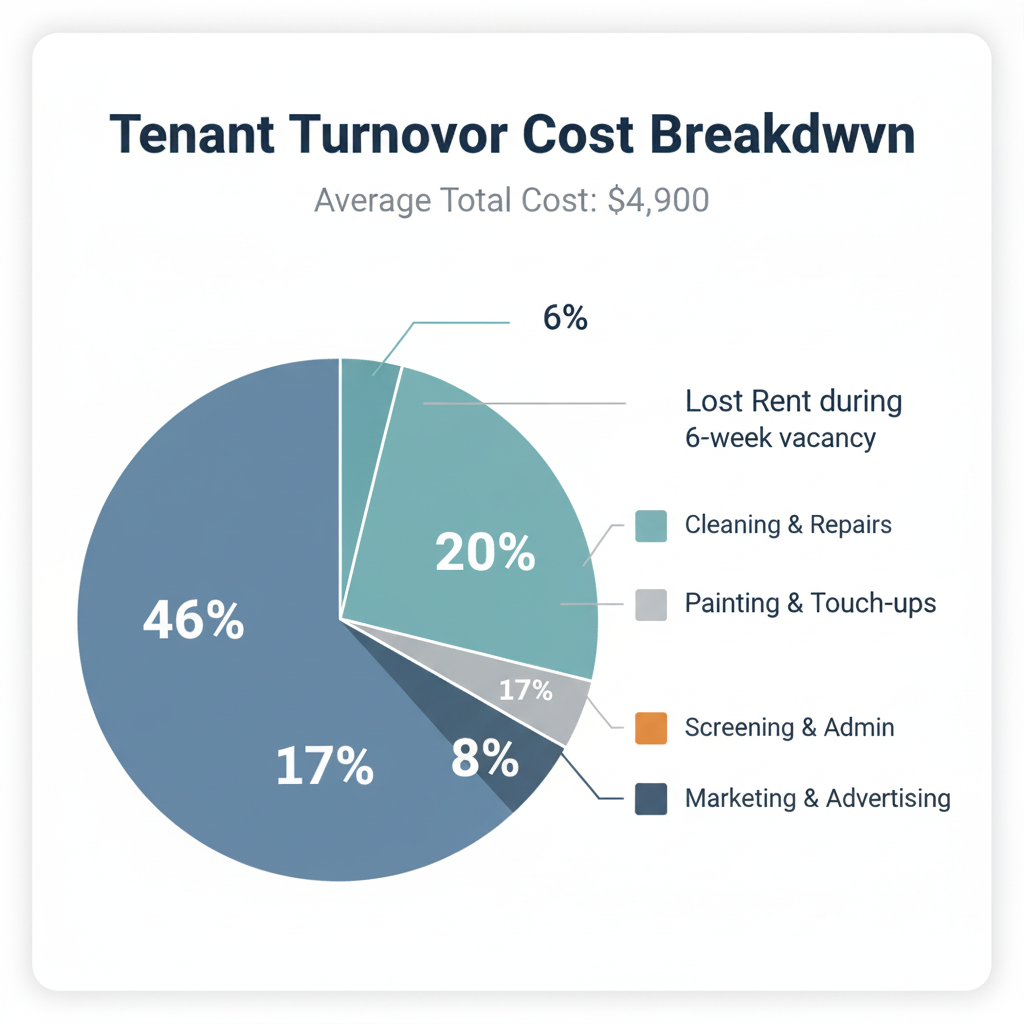
Lost Rent During Vacancy: The most significant cost component, averaging six weeks of vacancy, results in approximately $2,250 in lost income for properties with $1,500 monthly rent. During this period, landlords continue to pay mortgages, property taxes, and insurance without offsetting those costs with rental income.
Cleaning and Repairs: Professional cleaning, carpet shampooing, and deferred-maintenance corrections typically cost $750- $1,200 per turnover. Properties with longer tenancies often require more extensive refurbishment to meet current market standards.
Painting and Touch-Ups: Interior painting to refresh walls, repair drywall damage, and address normal wear and tear adds $800-$1,500 to turnover expenses. Premium properties, or those with extensive square footage, incur higher painting costs.
Marketing and Advertising: Online listing fees, professional photography, signage, and advertising across multiple platforms cost $300- $ 500 per vacancy. Competitive markets require enhanced marketing efforts to attract quality applicants quickly.
Screening and Administrative Costs: Background checks, credit reports, employment verification, and lease preparation consume 15-25 hours of landlord time plus $450 in direct expenses. Rushing this process to fill vacancies quickly increases the risk of selecting problematic tenants who generate even greater costs.
For landlords managing multiple properties, these expenses multiply rapidly. Three properties with annual turnover generate $9,000-$15,000 in turnover costs annually—capital that could fund property improvements, build emergency reserves, or accelerate portfolio expansion.
The Compounding Effect of Turnover
Beyond direct expenses, frequent turnover creates a destructive cycle that undermines long-term profitability:
Accelerated Property Deterioration: Move-ins and move-outs generate excessive wear beyond normal occupancy, requiring more frequent renovations
Administrative Time Diversion: Landlords spend time marketing, showing properties, and screening applicants rather than focusing on income-generating activities
Cash Flow Unpredictability: Frequent vacancies disrupt financial planning and investment strategies
Compromised Tenant Selection: Pressure to fill vacancies quickly leads to accepting marginal applicants, perpetuating the turnover cycle
Significantly, a single turnover in a property that nets $10,000-$12,000 annually can eliminate the entire year’s profit. This reality underscores why retention strategies deliver superior returns compared to accepting preventable tenant departures.
Proven Tenant Retention Strategies That Boost ROI
The Economics of Retention vs. Turnover
The financial case for tenant retention is compelling when costs are compared. Retaining a quality tenant through a modest rent discount—even $100 per month—costs $1,200 annually but saves $2,650- $3,800 in turnover expenses compared to average turnover costs. This favorable cost-benefit ratio explains why sophisticated landlords prioritize retention over maximizing short-term rent increases.
Furthermore, properties with strong retention achieve 22% annual turnover, compared with the industry average of 20-30%. This seemingly modest improvement generates substantial savings across multi-property portfolios.
| Scenario | Annual Cost | Net Impact vs Turnover |
|---|---|---|
| Retain Good Tenant (small discount) | $100 | Saves $2,750-$3,800 |
| Tenant Turnover (Low End) | $1,750 | Loss of 1.2-2 months’ profit |
| Tenant Turnover (Average) | $3,872 | Loss of 2-3 months’ profit |
| Tenant Turnover (High End) | $5,000+ | The entire year’s profit at risk |
Strategic Lease Renewal Programs
Effective renewal programs begin well before lease expiration, incorporating proactive outreach and compelling incentives:
Early Engagement: Contact tenants 90-120 days before lease expiration to discuss renewal options. This timeline demonstrates the landlord’s commitment to tenant satisfaction while providing sufficient time to address concerns before they motivate departures.
Market-Aligned Increases: Research suggests 55% of tenants cite rental costs as the primary reason for moving. Therefore, renewal rates should reflect market conditions rather than arbitrary percentages. Offering existing tenants slightly below-market rates—while still above current rent—creates “win-win” scenarios in which tenants perceive value in staying, while landlords avoid turnover costs.
Renewal Incentives: Studies indicate that 42% of renters would extend their leases if offered incentives. Effective incentives include:
One month rent discount for signing extended leases
Property upgrades like smart thermostats, new appliances, or fresh paint
Flexible lease terms accommodating tenant needs
Tenure bonuses, such as free professional carpet cleaning or HVAC servicing
Clear Communication: Explain any rent adjustments with market context, demonstrating how renewal rates compare favorably to current market conditions. Transparency builds trust and helps tenants recognize the value proposition.
Property Amenity Enhancements
Strategic property improvements significantly impact retention rates while justifying higher rents. Properties that upgrade amenities see a 20% increase in lease renewals, demonstrating the powerful retention effect of modernization.
Energy-Efficient Features: Sustainable properties command 8% rent premiums ($90-$144 additional monthly income on $1,800 properties) while generating 15-25% higher tenant satisfaction scores. Additionally, tenants in green properties renew leases at 10-15% higher rates, reducing turnover costs by $3,872 through longer tenancies. Key improvements include:
Energy Star appliances reduce tenant utility costs by 20-35%
LED lighting and smart thermostats
Low-flow fixtures and improved insulation
Solar panels with 5-7 year payback periods in high-sun states
Smart Home Technology: Modern amenities such as smart thermostats, keyless entry systems, and smart lighting differentiate properties while enhancing tenant convenience. These features justify premium rental rates, particularly for tech-savvy renters seeking a modern living experience.
Community Building: Properties that host regular community events—barbecues, holiday parties, or resident gatherings—achieve 50% higher renewal rates than properties without community engagement. Tenants who feel part of a community develop stronger emotional connections to properties, increasing stay duration.
Responsive Communication and Maintenance
Proactive communication beyond rent collection strengthens tenant relationships and demonstrates landlord commitment:
Send seasonal check-in emails asking whether everything functions properly
Respond promptly to maintenance requests, ideally within 24 hours
Implement automated maintenance tracking systems, ensuring nothing falls throughthe cracks
Provide easy online rent payment options and 24/7 emergency support
Moreover, 35% of satisfied renters stay in their rental units for at least five years, compared with much shorter average tenancies among dissatisfied renters. Therefore, small investments in tenant satisfaction generate substantial long-term returns through extended occupancy.
High-ROI Property Improvements for 2026
Kitchen and Bathroom Modernization
Kitchen and bathroom renovations consistently deliver the highest returns among property improvements, with ROI typically reaching 70-100% through higher rents and shorter vacancy periods. These spaces heavily influence tenant decisions, making them strategic investment priorities.
Kitchen Upgrades: Modern cabinets, energy-efficient appliances, and contemporary fixtures appeal strongly to prospective tenants. Additionally, durable countertops, improved lighting, and functional storage solutions enhance both aesthetics and practicality. Even modest upgrades, such as updated cabinet hardware, fresh backsplashes, and modern faucets, significantly improve property appeal at reasonable costs.
Bathroom Improvements: Updated vanities, modern lighting fixtures, water-efficient toilets and showerheads, and fresh tile or flooring create spa-like experiences that tenants value. These improvements command premium rents while reducing water consumption.
Energy Efficiency Investments
Energy-efficient improvements deliver dual benefits—attracting environmentally conscious tenants while reducing operating costs:
Operational Cost Reductions: Energy Star appliances, LED lighting, smart thermostats, and low-flow fixtures reduce landlords’ utility costs by 20-35% when they cover utilities. Solar panel installations can eliminate electricity costs entirely, with payback periods of 5-7 years in states with high solar exposure, such as California, Arizona, Texas, and Florida.
Rent Premiums: Genuine green features command 8% rent premiums, translating to $90- $144 in additional monthly income on properties with a $1,800 base rent. These premiums reflect tenants’ willingness to pay more for properties that offer 15-30% lower utility bills.
Enhanced Retention: Tenants in sustainable properties report 15-25% higher satisfaction levels and renew leases at 10-15% higher rates than comparable non-sustainable properties. This retention advantage saves thousands in annual turnover costs.
Regulatory Compliance: Local agencies are increasingly tightening water-use limits and appliance-efficiency standards, making energy-efficient upgrades essential to maintain rental eligibility. Proactive landlords who upgrade before mandates avoid rushed, expensive compliance retrofits.
Smart Technology Integration
Smart home technology distinguishes properties in competitive markets while providing quantifiable tenant benefits:
Smart thermostats reduce heating/cooling costs by 10-23% while allowing remote temperature control
Keyless entry systems eliminate lockout calls and enable secure remote access for maintenance and tours
Smart lighting enhances security and convenience through automated scheduling and remote control
Smart smoke/CO detectors improve safety while providing real-time alerts to landlords and tenants
These features justify higher rental rates, particularly when attracting professional tenants who value convenience and modern amenities.
Budget-Friendly High-Impact Upgrades
Landlords with limited renovation budgets can still achieve significant returns through strategic improvements:
Fresh Paint: The most affordable improvement with immediate visual impact, fresh neutral paint makes properties feel clean, spacious, and well-maintained. Professional painting costs $800-$1,500 but substantially improves tenant impressions.
Modern Lighting: Replacing outdated fixtures with contemporary, energy-efficient models brightens spaces and creates welcoming atmospheres. Strategic lighting upgrades cost only hundreds of dollars yet transform property appeal.
Flooring Updates: Durable, low-maintenance flooring like luxury vinyl plank withstands heavy tenant use while maintaining an attractive appearance. These materials justify higher rents while reducing long-term maintenance costs.
Pet-Friendly Features: With many renters owning pets, pet-friendly amenities such as dog parks, pet-washing stations, and pet-friendly flooring attract a broader tenant pool and increase occupancy rates. Additionally, pet deposits and monthly pet fees generate supplemental income.
Open Floor Plans: Removing non-structural walls creates open, airy spaces that appeal to modern tenants. Open floor plans make properties feel larger and accommodate flexible living arrangements, broadening market appeal.
The 30% Renovation Rule
When planning improvements, landlords should follow the 30% rule—never spending more than 30% of a property’s value on renovating a single space. This guideline ensures renovations deliver positive returns rather than over-improving properties beyond local market support. The goal remains making smart financial choices that attract quality tenants and increase property value without excessive capital deployment.
Comprehensive Tenant Screening: Protecting Your Investment
The Foundation of Profitability
Comprehensive tenant screening represents the most cost-effective investment landlords can make, preventing 60% of costly problems associated with problematic tenants. The screening investment—typically $35-$50 per applicant—generates exceptional returns relative to eviction costs averaging $3,500-$10,000.
Financial Protection: Thorough screening verifies the applicant’s ability to consistently pay rent, reducing the risk of payment defaults and evictions. Additionally, screening identifies candidates with histories of property damage, lease violations, or criminal activities that threaten property value.
Reduced Vacancy Rates: Professional screening services like SmartScreen deliver comprehensive reports within 30 minutes, enabling faster, more confident tenant selection decisions. This speed reduces vacancy duration while maintaining rigorous selection standards.
Legal Compliance: Professional screening helps ensure compliance with the Fair Credit Reporting Act (FCRA) and the Fair Housing Act, protecting landlords from discrimination claims and regulatory penalties. SmartScreen’s 22 years of screening expertise provides landlords with compliant, defensible tenant selection processes.
Essential Screening Components
Effective screening examines multiple data points to create comprehensive applicant profiles:
Credit Analysis: Credit reports reveal payment histories, outstanding debts, collections, and bankruptcies that predict rental payment reliability. Furthermore, TransUnion’s ResidentScore—used by SmartScreen—predicts evictions 15% more accurately than traditional credit scores and identifies 19% more payment skips.
Criminal Background Checks: In-depth criminal background checks assess tenant risk, focusing on offenses that impact property safety, such as violence, property crimes, and drug-related activities. These checks help landlords make informed decisions while remaining compliant with Fair Housing regulations.
Eviction History: Analyzing eviction records helps landlords avoid tenants with a history of nonpayment or frequent lease violations. A prior eviction is the strongest predictor of future eviction risk.
Employment and Income Verification: Confirming job stability and income helps ensure tenants meet the industry-standard 3x rent rule, which states that gross monthly income is at least 3 times monthly rent. For example, applicants for $1,500 in monthly rent should document a minimum monthly income of $4,500.
Reference Checks: Contacting previous landlords provides firsthand insights into tenant behavior, payment patterns, and property care that other screening components cannot reveal. SmartScreen’s reference verification process complements automated screening with human intelligence.
Screening Investment ROI
The ROI calculation for tenant screening proves compelling:
| Investment | Cost | Return |
|---|---|---|
| Professional Screening | $35-$50 | Prevents $3,500-$10,000 eviction |
| ROI Ratio | 1x | 70x – 200x |
This extraordinary return ratio explains why experienced landlords never compromise on screening quality, recognizing that accepting unqualified applicants to fill vacancies quickly inevitably generates far greater costs.
Moreover, SmartScreen’s soft inquiry credit checks don’t affect tenant credit scores, making screening tenant-friendly and encouraging applications without credit damage concerns. This approach enables landlords to screen multiple applicants for competitive properties without disadvantaging quality candidates.
Avoiding Common Landlord Mistakes That Reduce Returns
Neglecting Regular Property Inspections
Deferred maintenance and neglected property inspections lead to costly emergency repairs that devastate profitability. Regular inspections—ideally quarterly or semi-annually—identify minor issues before they escalate into expensive problems.
For instance, a small roof leak caught early might cost $300 to repair, whereas water damage from an undetected leak can require $3,000-$5,000 in structural repairs, mold remediation, and interior restoration. Systematic inspections protect property value while demonstrating professional management standards to tenants.
Insufficient Tenant Screening
Inadequate screening increases risks of payment defaults, property damage, evictions, and legal disputes. Landlords who skip comprehensive screening to fill vacancies quickly often face consequences far exceeding the time and money saved through shortcuts.
Professional screening services like SmartScreen provide thorough, FCRA-compliant verification at costs far below the potential losses from problematic tenants. With 22 years of industry expertise, SmartScreen offers landlords confidence that tenant selection decisions rest on accurate, comprehensive information.
Poor Communication Practices
Communication breakdowns result in tenant dissatisfaction, delayed rent payments, increased maintenance costs, and premature lease terminations. Conversely, transparent, responsive communication fosters trust, improves retention, and creates positive landlord-tenant relationships.
Effective communication strategies include:
Responding to tenant inquiries within 24 hours
Providing clear lease terms and property rules
Sending regular property updates and seasonal check-ins
Offering multiple communication channels (phone, email, text, portal)
Setting clear expectations for maintenance response times
Professional property management companies excel at maintaining consistent communication standards, handling after-hours emergencies, and implementing tenant satisfaction programs that boost retention.
Arbitrary Rent Increases
Raising rents without market research often backfires, as 55% of tenants cite rental costs as the primary reason for moving. Strategic landlords research comparable properties, assess market trends, and communicate rent adjustments with context explaining how increases align with market conditions.
Additionally, offering existing tenants renewal rates slightly below market—while still above current rent—frequently proves more profitable than pushing maximum increases that trigger turnover. A $50 monthly discount that retains a quality tenant saves thousands compared to turnover costs.
Maximizing Tax Benefits: Protecting Rental Returns
Understanding Rental Property Deductions
Strategic tax planning significantly enhances rental property returns by reducing taxable income through legitimate deductions. Landlords can deduct ordinary and necessary expenses associated with managing, conserving, and maintaining rental properties.
Major Deduction Categories:
Mortgage Interest: Interest paid on rental property mortgages represents one of the largest tax deductions for landlords. This deduction applies to both primary mortgages and refinancing loans used for property acquisition or improvement.
Property Taxes: State and local property taxes, including special assessments and municipal fees, qualify as tax-deductible expenses. Landlords should retain annual tax statements documenting these payments.
Property Depreciation: The most powerful tax strategy, depreciation allows landlords to deduct property value (excluding land) over 27.5 years for residential properties. For example, a $550,000 property purchase with $150,000 in land value yields approximately $14,545 in annual depreciation deductions ($400,000 ÷ 27.5 years). This non-cash expense reduces taxable income without incurring any cash expense.
Operating Expenses: Deductible operating costs include property management fees, insurance premiums, utilities paid by landlords, advertising expenses, cleaning and maintenance supplies, HOA fees, and professional fees for legal, accounting, or consulting services.
Repairs and Maintenance: Routine maintenance and repairs that maintain property condition qualify as immediate deductions. However, improvements that extend property life or increase value must be depreciated over time rather than deducted immediately.
Travel and Transportation: Mileage, vehicle expenses, parking fees, and travel costs for property inspections, tenant meetings, or maintenance supervision are deductible. Landlords should maintain detailed mileage logs documenting business-related travel.
Advanced Tax Strategies
Qualified Business Income (QBI) Deduction: Landlords whose rental activities qualify as trades or businesses under IRC §162 may claim up to 20% deductions on qualified rental income. Recent legislation makes this deduction permanent with raised income thresholds, enabling more landlords to benefit.
Accelerated Depreciation: Cost segregation studies identify property components with shorter depreciation periods (5-7 years) than the standard 27.5-year residential timeline. This strategy front-loads depreciation deductions, significantly reducing early-year tax liability and maximizing cash flow. Following the 2025 legislation, 100% bonus depreciation became permanent, making accelerated depreciation more powerful for portfolio growth.
1031 Exchanges: These tax-deferred exchanges allow investors to sell properties and reinvest the proceeds into similar assets, deferring capital gains taxes and depreciation recapture. Strategic use of 1031 exchanges enables portfolio growth without immediate tax consequences.
Schedule E Reporting
Landlords report rental income and expenses on Schedule E (Form 1040), which accompanies individual tax returns. This form documents property addresses, rental days, income received, and deductible expenses by category.
Importantly, rental activity reported on Schedule E qualifies as passive income and is not subject to the 15.3% self-employment tax, unlike Schedule C business income. This distinction provides significant tax advantages for landlords compared to active business operators.
Meticulous record-keeping is essential to maximize deductions and defend tax positions during audits. Property management software simplifying expense tracking and report generation helps landlords organize financial records efficiently.
Real-World Success: Applying These Strategies
Case Study: Strategic Retention vs. Turnover
Consider a landlord owning three single-family rental properties, each generating $1,800 monthly rent ($64,800 annual gross income across the portfolio). At the industry-average 25% annual turnover rate, the landlord experiences 0.75 turnovers per property per year, totaling 2.25 turnovers across the portfolio.
Turnover Scenario Costs:
2.25 turnovers × $3,872 average cost = $8,712 annual turnover expenses
Lost net income: $8,712 represents 13.4% of gross rental income
Time investment: 34-56 hours annually managing turnover processes
Retention Strategy Results:
By implementing strategic retention programs—proactive renewals with modest incentives, responsive maintenance, and periodic property upgrades—the landlord reduces turnover to 15% annually (industry-leading 22% minus further optimization).
0.45 turnovers annually across three properties
0.45 turnovers × $3,872 = $1,742 in turnover costs
Retention incentives: $300 per property × 3 = $900 annual cost
Net savings: $6,070 annually ($8,712 – $1,742 – $900)
Time savings: 20-34 hours annually redirected to income-generating activities
This $6,070 annual savings—nearly 10% of gross rental income—can fund property improvements, build emergency reserves, or accelerate portfolio expansion through additional property acquisitions.
2026 Market Positioning Example
A landlord with a rental property in a suburban market tracks comparable properties and discovers:
Current market rent: $2,000/month for similar properties
Current tenant paying: $1,850/month (lease expires in 60 days)
Turnover cost estimate: $4,200 (based on local market conditions)
Option 1: Maximize Short-Term Rent
Increase rent to $2,000/month (+$150/month = $1,800 annually)
Tenant declines renewal due to 8.1% increase
Experience $4,200 turnover cost
Net result: -$2,400 first year
Option 2: Strategic Retention Pricing
Offer renewal at $1,925/month (+$75/month = $900 annually)
Tenant accepts due to a reasonable 4.1% increase below market
Avoid $4,200 turnover cost
Net result: +$900 annually with continued occupancy
The retention strategy delivers $3,300 in year-one outcomes (a $900 gain vs. a $2,400 loss) while maintaining occupancy and tenant satisfaction. Over a three-year tenancy, this approach delivers substantially superior returns.
Frequently Asked Questions
What are the key methods to maximize rental returns?
Maximizing rental returns requires a multifaceted approach that combines several evidence-based strategies. First, conduct regular market analysis using platforms like Zillow Rental Data and Rentometer to ensure competitive, data-driven pricing that balances revenue maximization with vacancy minimization. Second, implement strategic rent pricing by monitoring comparable properties, adjusting for seasonal demand patterns, and timing lease renewals to peak rental seasons (April-August).
Third, invest in high-ROI property improvements, particularly kitchen and bathroom modernization, energy-efficient upgrades, and smart home technology that command premium rents and attract quality tenants. Fourth, prioritize comprehensive tenant screening with professional services like SmartScreen to prevent 60% of costly problems associated with inadequate vetting, recognizing that $35-$50 in screening investments can prevent $3,500-$10,000 in eviction costs.
Fifth, implement lease incentives and retention programs, including early renewal outreach (90-120 days before expiration), market-aligned rent adjustments, and modest upgrade incentives that cost less than turnover expenses. Finally, maintain proactive communication, responsive maintenance, and regular property inspections that build tenant satisfaction and extend tenancy duration.
How often should landlords review rental prices?
Landlords should conduct comprehensive rental price reviews at least annually, ideally 90-120 days before lease renewal dates, to inform renewal pricing decisions. However, successful landlords supplement annual reviews with quarterly market monitoring to track emerging trends, vacancy rates, and shifts in comparable property pricing.
Additionally, landlords should conduct immediate price reassessments when vacancies exceed 30 days, as this typically indicates misalignment with market conditions. Properties vacant for 45+ days in competitive markets often require price adjustments to accelerate leasing, since one month of vacancy can cost more than a $50- $100 monthly rent reduction over a year-long lease.
Market dynamics change throughout the year, with peak demand periods (April-August) supporting higher pricing and off-season months (October-February) requiring more competitive rates. Therefore, monitoring Days on Market for comparable properties provides real-time feedback on whether current pricing aligns with local market realities.
Why is tenant screening essential for maximizing returns?
Tenant screening is the most cost-effective investment landlords make, preventing 60% of costly problems and delivering extraordinary ROI of 70:1 to 200:1. Comprehensive screening protects rental returns through multiple mechanisms.
First, screening verifies financial capacity through credit checks, employment verification, and income documentation, ensuring tenants meet the 3x rent rule (gross monthly income ≥ 3 times monthly rent). This verification reduces payment defaults and late rent issues that disrupt cash flow.
Second, an analysis of eviction history identifies applicants with patterns of non-payment or lease violations, as prior eviction remains the strongest predictor of future eviction risk. Given that evictions cost $3,500-$10,000 on average—compared to $35-$50 screening expenses—thorough verification prevents catastrophic financial losses.
Third, criminal background checks evaluate tenant risk levels, identifying offenses involving violence, property damage, or illegal activities that threaten property value and neighbor safety. Fourth, reference checks, contacting previous landlords, reveal behavioral patterns, communication styles, and property care practices that other screening components cannot capture.
Professional screening services like SmartScreen combine TransUnion data, ResidentScore analytics (15% better eviction prediction than credit scores), and 22 years of expertise to deliver comprehensive reports within 30 minutes. This speed enables confident decision-making, reducing vacancy duration while maintaining rigorous selection standards.
Can property improvements significantly impact rental returns?
Yes, strategic property improvements deliver substantial returns through higher rents, shorter vacancy periods, and improved tenant retention. Kitchen and bathroom modernization consistently generates 70-100% ROI, justifying premium rental rates while attracting quality tenants seeking well-maintained properties.
Energy-efficient upgrades provide dual benefits: 8% rent premiums ($90-$144 additional monthly income on $1,800 properties) combined with 20-35% operational cost reductions when landlords cover utilities. Moreover, sustainable properties achieve 10-15% higher renewal rates, saving thousands in turnover costs through extended tenancies.
Smart home technology—including smart thermostats, keyless entry, and smart lighting—differentiates properties in competitive markets while delivering quantifiable tenant benefits, such as 10-23% reductions in heating/cooling costs. These features justify premium pricing, particularly for professional tenants who value convenience and modern amenities.
Importantly, properties with upgraded amenities experience 20% increases in lease renewals, demonstrating the powerful retention effect of strategic improvements. However, landlords should follow the 30% rule—never spending more than 30% of property value on single-space renovations—to ensure improvements deliver positive returns without over-improving beyond local market support.
Budget-conscious landlords can still achieve significant returns through affordable improvements such as fresh paint ($800-$1,500), modern lighting fixtures (hundreds of dollars), and durable flooring that substantially enhances property appeal without major capital investment.
What common mistakes reduce rental returns?
Several preventable mistakes significantly undermine the profitability of rental properties. First, neglecting regular property inspections allows minor issues to escalate into costly emergencies, such as small roof leaks that cause $3,000-$5,000 in water damage rather than $300 in early repairs. Quarterly or semi-annual inspections protect property value while demonstrating professional management.
Second, insufficient tenant screening to fill vacancies quickly generates far greater long-term costs than the time and money saved through shortcuts. Accepting unqualified applicants results in payment defaults, property damage, and $3,500- $10,000 in eviction expenses that exceed multiple months of rent.
Third, poor communication creates tenant dissatisfaction, delayed payments, and premature lease terminations. Conversely, responsive communication (24-hour inquiry response), clear expectations, and proactive maintenance build trust that improves retention.
Fourth, arbitrary rent increases without market research trigger unnecessary turnover, as 55% of tenants cite rental costs as their primary reason for moving. Strategic landlords offer renewal rates slightly below market while above current rent, creating win-win scenarios in which tenants perceive value and landlords avoid turnover costs.
Fifth, delaying necessary maintenance and property improvements allows properties to fall behind market standards, necessitating larger capital investments later and reducing rents and tenant quality. Sixth, inadequate financial record-keeping prevents landlords from maximizing tax deductions and accurately assessing property performance.
Finally, failing to implement retention strategies costs landlords $2,650-$3,800 per preventable turnover, compared with $100-$1,200 in annual retention investments through modest discounts or upgrade incentives.
TL;DR: Key Takeaways for Maximum Rental Returns
Maximizing rental returns in 2026 requires combining strategic pricing, tenant retention, property improvements, and comprehensive screening. Calculate returns using multiple methods—basic ROI, cash-on-cash, cap rate, and NOI—to assess property performance from different perspectives. Target cap rates of 4-12% depending on property type, with single-family homes (4-8%), small multifamily (5-9%), large multifamily (4-7%), and commercial properties (6-10%).
Understand that tenant turnover costs $3,000-$5,000 on average, with 46% attributed to lost rent, 20% to cleaning/repairs, 17% to painting, 8% to marketing, and 9% to screening/admin. Therefore, retention strategies that deliver $100-$1,200 in annual cost savings save $2,650-$3,800 in turnover expenses. Implement proactive lease renewals 90-120 days before expiration, offer market-aligned increases (not arbitrary percentage increases), and provide modest incentives such as rent discounts or property upgrades.
Invest in high-ROI improvements: kitchen/bathroom modernization (70-100% ROI), energy-efficient upgrades (8% rent premiums plus 20-35% cost reductions), and smart home technology that attracts modern tenants. Follow the 30% rule—never spend more than 30% of the property value on single-space renovations.
Prioritize comprehensive tenant screening with services like SmartScreen, recognizing that $35- $50 in screening investments can prevent $3,500- $10,000 in eviction costs (70:1-200:1 ROI). Screen for credit, criminal background, eviction history, employment/income verification, and references to prevent 60% of costly tenant problems.
Leverage tax strategies, including mortgage interest deductions, property depreciation (27.5 years for residential properties), operating expense deductions, and Qualified Business Income deductions (up to 20% of rental income). Monitor 2026 market trends showing 2-5% rent growth, align lease expirations with peak seasons (April-August), and use data-driven pricing through platforms like Zillow Rental Data and Rentometer.
Ready to maximize your rental returns through comprehensive tenant screening? Visit SmartScreen to access professional screening services, including credit checks, criminal background checks, eviction history, employment verification, and reference checks—all backed by 22 years of industry expertise and delivered within 30 minutes.