


The Rise of Independent Landlords in 2026
The independent landlord market has grown substantially, with 50.6% of current landlords starting their rental businesses in the past five years (2021-2025). This surge reflects increasing interest in real estate investment as a wealth-building strategy, particularly among individuals seeking control over their investments and direct relationships with tenants.
Independent landlords—property owners who manage rentals themselves without hiring a management company—retain full control over tenant selection, property maintenance, lease terms, and financial decisions. This hands-on approach offers cost savings by eliminating management fees typically ranging from 7-12% of monthly rent, resulting in $105-$180 in monthly savings on a $1,500 rental property.
Furthermore, direct tenant relationships enable independent landlords to build trust, respond quickly to concerns, and foster long-term tenancies that reduce turnover costs. Additionally, self-management provides valuable industry knowledge for landlords planning to expand their portfolios, as it gives them firsthand experience across all aspects of property operations.
However, the independent landlord path demands significant time investment, comprehensive legal knowledge, and sophisticated screening capabilities to mitigate risks that professional managers handle routinely. Understanding these trade-offs helps landlords make informed decisions about self-management versus professional assistance.
Critical Challenges Facing Independent Landlords in 2026
The Application Fraud Crisis
The most pressing challenge confronting independent landlords in 2026 is the alarming surge in rental application fraud. Recent data reveals that 93% of property owners now face fraudulent application attempts, with fraud incidents surging 40% in 2024 alone. This epidemic includes fake pay stubs, altered identification documents, fabricated employment letters, and professional reference-for-hire services designed to deceive landlords.
Moreover, 43% of people searching online for rentals encounter at least one fake listing, creating an environment of mutual distrust where legitimate landlords struggle to stand out from scammers. Bank fraud has escalated dramatically, with an 84% increase in check fraud between 2021 and 2022, directly impacting the reliability of rent collection.
Significantly, 24% of evictions are now linked to fraudulent applications that slipped through inadequate screening processes. For independent landlords without sophisticated fraud-detection tools, this threat poses an existential risk to profitability and sustainability.
Escalating Late Payment Rates
Late payment rates in independently owned rentals have risen from 8.8% in mid-2024 to 11.7% by June 2025, even as total rent collections remained stable. This troubling trend reflects the reality that traditional screening tools—simple credit score cutoffs and income multiples such as the 3x rent rule—no longer adequately capture applicants’ financial resilience.
Today’s renters face variable gig economy income, heavy consumer borrowing, elevated automotive debt, and high non-housing expenses that standard screening fails to assess. Consequently, an applicant who technically meets income requirements may still be financially stretched, living paycheck to paycheck with maxed-out credit cards and minimal cash reserves.
For independent landlords, late payments disrupt cash flow, forcing out-of-pocket payments for mortgages, property taxes, insurance, and maintenance while pursuing collection efforts. These situations frequently escalate to evictions, triggering the catastrophic cost cascades detailed below.
Regulatory Complexity and Compliance Burdens
Landlords in 2026 navigate an ever-changing landscape of local, state, and federal regulations that require continuous monitoring and adaptation. Tenant protection laws continue expanding, with new iterations of rent control measures, eviction moratorium guidelines, and fair housing requirements emerging regularly.
Rent control debates intensify in urban areas, with some jurisdictions implementing caps on annual rent increases or stringent requirements for justifying significant rate adjustments. Additionally, energy-efficiency mandates are becoming more stringent as environmental concerns intensify, potentially requiring costly upgrades to insulation, windows, heating/cooling systems, or renewable energy installations.
For independent landlords without dedicated legal teams, staying compliant with these shifting requirements demands substantial time and creates legal liability risks. Professional property managers specializing in regulatory compliance offer value precisely because they absorb this burden, though at the cost of management fees.
Maintenance Challenges and Cost Inflation
The skilled tradesperson shortage worsens annually, making it increasingly difficult for independent landlords to find reliable, qualified contractors. Service wait times have increased dramatically, creating potential habitability issues—particularly urgent in winter heating failures that may require landlords to pay for temporary tenant housing, depending on state laws.
Moreover, maintenance costs continue escalating, with projected 2026 increases of 5.8% for townhouses, 5.9% for single-family homes, and 3.8% for condominiums. These inflationary pressures compound broader cost increases affecting insurance premiums, materials, and labor.
Insurance costs have risen consistently from 2019 through 2024, with some high-risk areas, such as California and Florida, having difficulty obtaining coverage due to wildfire and hurricane risks. Without adequate insurance, maintaining rental property ownership becomes financially untenable, yet insurance premiums significantly impact profitability.
Evolving Tenant Expectations
Modern renters increasingly demand flexibility, with a growing preference for shorter lease terms accommodating the gig economy and remote work trends. Younger renters, in particular, exhibit higher turnover rates, creating costly and time-consuming tenant transitions for landlords.
Additionally, tenant expectations now include smart home technology (smart thermostats, keyless entry systems), pet-friendly policies, wellness amenities (fitness centers, green spaces), and community-building features. Properties lacking these modern conveniences face competitive disadvantages in attracting quality tenants.
For independent landlords with limited capital, meeting these evolving expectations requires strategic investment decisions that balance tenant attraction with ROI constraints.
| Challenge Category | Impact Level | 2026 Key Statistic |
|---|---|---|
| Application Fraud | Critical | 93% face fraud attempts |
| Late Payments | High | 11.7% rate in independent rentals |
| Regulatory Changes | Medium-High | Frequent law updates |
| Maintenance Costs | High | 5.8% annual increase |
| Insurance Premiums | High | Rising consistently 2019-2024 |
| Tenant Turnover | Medium | Shorter lease preferences |
The Devastating Cost of Bad Tenants
Understanding the True Financial Impact
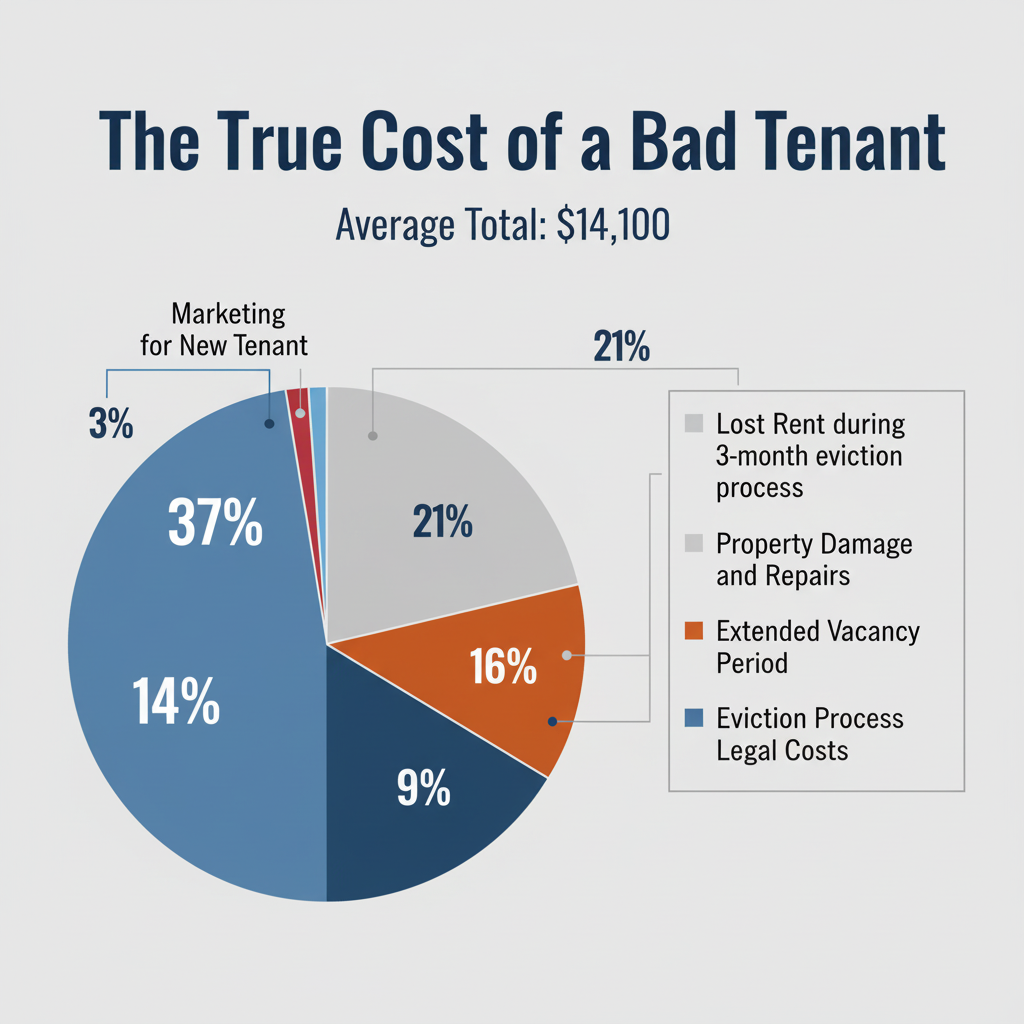
Bad tenants represent the single greatest financial threat to independent landlords, generating losses far exceeding the immediate inconvenience of unpaid rent. Comprehensive cost analyses reveal that inadequate tenant screening leading to problematic placements costs landlords between $20,000 and $25,000 per bad tenant. Even with moderately careful screening, bad-tenant situations typically result in total losses of $8,800 to $19,500, with an average cost of approximately $14,100.
Lost Rent During Eviction Process
The largest cost component—accounting for 37% of total bad-tenant expenses—is lost rent during the eviction process. Eviction proceedings typically span three months from initial non-payment through final court-ordered removal, during which landlords receive zero rental income while continuing to pay mortgages, property taxes, insurance, and utilities.
For a property renting at $1,750 per month, three months of lost rent equals $5,250 in foregone income, which directly impacts cash flow and financial planning. During this period, landlords must cover all ownership expenses out of pocket, creating severe financial strain, particularly for landlords with multiple properties experiencing simultaneous vacancies.
Property Damage and Repair Costs
Bad tenants frequently cause property damage exceeding the security deposit, accounting for 21% of total costs. This damage ranges from minor issues such as broken appliances and damaged fixtures to severe problems, including mold growth from unreported leaks, holes in walls, damaged flooring, and appliance misuse.
Repair costs typically range from $1,000 to $5,000, with an average of $3,000 required to restore properties to rentable condition. Moreover, extensive damage increases future maintenance costs and can decrease long-term property value through structural degradation and deferred maintenance consequences.
Eviction Process Expenses
The formal eviction process accounts for 14% of bad-tenant costs, including legal fees, court filing fees, sheriff’s fees, document processing charges, and attorney fees. A court filing alone costs $200-$300, while attorney fees for landlord representation can reach thousands of dollars, depending on case complexity and jurisdiction.
Total eviction process costs typically range from $1,000 to $3,000, averaging $2,000, though complex cases involving tenant legal representation or appeals can increase significantly. These expenses represent pure loss—money spent that yields no value beyond regaining possession of property.
Extended Vacancy Periods
After problematic tenants vacate, properties typically require extensive cleaning, repairs, and preparation before re-renting, resulting in extended vacancy periods that account for 16% of total costs. During these weeks or months, landlords lose additional rental income while paying ongoing ownership expenses.
An extended vacancy also requires increased marketing to attract replacement tenants, resulting in additional advertising costs, professional photography expenses, and listing fees across multiple platforms. For properties in poor condition following bad tenant occupancy, vacancy periods can extend significantly as repairs progress, compounding income losses.
Legal Fees and Court Costs
Beyond eviction-specific expenses, bad-tenant situations may incur additional legal costs, accounting for 9% of total expenses. These include consultations with attorneys specializing in landlord-tenant law, representation during disputes beyond eviction (such as property damage claims), and costs associated with collection efforts for unpaid rent and damages.
Legal processes are time-intensive and may require multiple court appearances, diverting landlords from income-generating activities and property management responsibilities. The stress and emotional toll of these legal battles, while not directly quantifiable, further compound the negative impact on landlords.
Finding Replacement Tenants
The final cost component—representing 3% of total expenses—covers the costs of finding, screening, and onboarding replacement tenants after bad-tenant situations are resolved. This includes marketing expenses, professional photography, online listing fees, showing coordination, screening services, and lease preparation.
For independent landlords self-managing these processes, the time investment alone proves substantial, consuming 20-30 hours per placement cycle. When properties remain damaged from previous tenants, marketing becomes more challenging, potentially requiring price reductions or longer vacancy acceptance to secure new renters.
| Cost Component | Low Range | High Range | Typical Average | % of Total |
|---|---|---|---|---|
| Lost Rent (3 months) | $4,500 | $6,000 | $5,250 | 37% |
| Property Damage/Repairs | $1,000 | $5,000 | $3,000 | 21% |
| Extended Vacancy | $1,500 | $3,000 | $2,250 | 16% |
| Eviction Process | $1,000 | $3,000 | $2,000 | 14% |
| Legal Fees | $500 | $2,000 | $1,200 | 9% |
| Marketing New Tenant | $300 | $500 | $400 | 3% |
| Total Cost | $8,800 | $19,500 | $14,100 | 100% |
The Compelling Case for Professional Tenant Screening
Extraordinary Return on Investment
Professional tenant screening delivers the most compelling ROI of any investment independent landlords can make, preventing losses that dwarf screening costs by orders of magnitude. Comprehensive screening services typically cost $30-$50 per applicant and include credit reports, criminal background checks, eviction history, employment verification, and reference validation.
By preventing just one problematic tenant placement, a $50 screening investment saves $14,100 in average bad tenant costs—a remarkable 282:1 return on investment. Even in best-case scenarios where bad tenants cause minimal damage, screening prevents $8,800 losses, delivering a 176:1 ROI.
This extraordinary return ratio explains why experienced landlords never compromise on screening quality, recognizing that shortcuts to fill vacancies quickly generate catastrophic long-term consequences. The screening investment pays for itself hundreds of times over through a single prevented bad placement.
Industry-Leading Background Checks: The Top Priority
Recent surveys demonstrate a fundamental shift in landlord screening priorities, with background checks now ranking as the single most important screening factor. Nearly 50% of landlords cite comprehensive background checks as their most critical evaluation factor, surpassing credit scores and income verification.
This prioritization reflects landlords’ increasing exposure to sophisticated application fraud, heightened financial risks from tight profit margins, and compressed leasing timelines that require confident decision-making. In today’s rental environment, landlords can no longer rely on a single data point—they need multi-layered verification that combines credit history, criminal records, eviction history, employment status, income documentation, and reference validation.
Significantly, 88% of landlords now run certified tenant screening reports, while 78% contact references and 61% review social media profiles. Over 60% of landlords verify all major data points—employment, income, references, credit, and rental history—before making leasing decisions, highlighting how rigorous modern screening has become.
However, a concerning 8% of landlords still don’t verify any tenant information, highlighting gaps in education and access to tools that leave these landlords vulnerable to the fraud epidemic and costly bad-tenant issues. For these landlords, adopting professional screening services represents urgent priority for business survival.
SmartScreen: Ranked Among Top 10 Tenant Screening Services
SmartScreen has earned recognition as one of the top 10 tenant screening services in the industry, distinguished by advanced technology, comprehensive reporting, and exceptional customer service tailored specifically for independent landlords. With 22 years of tenant screening expertise, SmartScreen provides the reliable results and user-friendly experience that independent landlords need to confidently select quality tenants.
Advanced Technology and Rapid Results
SmartScreen uses state-of-the-art algorithms and background-check software to process large volumes of verification data quickly, delivering comprehensive screening reports within hours or even minutes. This rapid turnaround enables independent landlords to make timely leasing decisions that reduce vacancy duration while maintaining rigorous selection standards.
The platform’s automated screening features eliminate the tedium of manual verification, allowing landlords to efficiently review multiple applicants during competitive leasing. Moreover, SmartScreen’s technology minimizes human error by validating data across multiple authoritative sources.
Comprehensive Screening Components
SmartScreen’s tenant screening encompasses all critical verification elements independent landlords need for confident decision-making:
Credit Checks: Detailed credit reports reveal payment histories, outstanding debts, collections, bankruptcies, and credit utilization patterns that predict rental payment reliability
Criminal Background Checks: In-depth criminal record searches evaluate tenant risk levels, focusing on offenses impacting property safety, including violence, property crimes, drug activities, and theft
Eviction History: Comprehensive eviction record analysis identifies applicants with patterns of non-payment or lease violations, as previous eviction remains the strongest predictor of future eviction risk
Employment Verification: Direct employer confirmation validates job stability, position details, hire dates, and salary information ensuring tenants meet income requirements
Rental History Checks: Contact with previous landlords provides firsthand insights into tenant behavior, payment patterns, property care, and lease compliance that other screening components cannot capture
TransUnion Partnership and ResidentScore
SmartScreen leverages partnerships with industry leaders such as TransUnion to access comprehensive credit and background data that independent landlords cannot obtain. Significantly, SmartScreen utilizes TransUnion’s ResidentScore—a proprietary scoring system specifically designed for rental applications that predicts evictions 15% better than traditional credit scores and identifies 19% more payment skips.
ResidentScore focuses on rental-specific performance indicators rather than general creditworthiness, providing landlords with more accurate tenant risk assessments. This rental-focused approach enables SmartScreen to score more applicants with minimal credit files, helping landlords evaluate candidates that traditional credit scoring systems would reject.
Tenant-Friendly Soft Inquiries
Unlike many screening services, SmartScreen uses soft inquiry credit checks that do not impact tenant credit scores. This tenant-friendly approach encourages quality applicants to apply without concerns about credit damage, while landlords still receive comprehensive financial information for evaluation.
Soft inquiries allow tenants to apply to multiple properties during housing searches without incurring credit score penalties, benefiting both applicants and landlords seeking a competitive leasing advantage.
Legal Compliance and Protection
All SmartScreen processes strictly adhere to the Fair Credit Reporting Act (FCRA), helping independent landlords maintain legal compliance with federal tenant-screening regulations. This includes proper applicant authorization procedures, accurate handling of information, adverse action notification protocols for denied applications, and dispute resolution support.
For independent landlords lacking legal expertise, SmartScreen’s compliance infrastructure provides essential protection against discrimination claims, regulatory penalties, and FCRA violation lawsuits.
Customer Testimonials and Recognition
Real landlord experiences consistently highlight SmartScreen’s value for independent property owners:
Dawn Parker of Birmingham Realty: “SmartScreen tenant screening is cost-effective and so easy to use! It gave me so much more information than I expected on a potential tenant.”
Mandy Campbell of Dorman Real Estate Management: “Very professional company and makes our job easier as a property manager! I highly recommend.”
Jim Adamek: “SmartScreen helped our clients for years with a very reliable and effective screening process. He is responsive when you have needs or questions.”
These testimonials reflect SmartScreen’s commitment to providing accurate, reliable screening services that foster trust and confidence in tenant selection decisions.
2026 Best Practices for Independent Landlord Tenant Screening
Implement Multi-Layered Verification
The most critical screening principle for 2026 is to reject reliance on a single data point in favor of comprehensive, multi-layered verification. Effective screening combines credit analysis, criminal background checks, eviction history, employment and income verification, reference checks, and increasingly, document authentication to detect fraud.
Each verification layer provides unique insights that others cannot capture. For example, credit reports reveal financial responsibility patterns; criminal background checks assess safety risks; eviction records predict the likelihood of lease compliance; employment verification confirms income stability; and reference checks uncover behavioral patterns.
Independent landlords should establish written minimum standards across all verification categories and apply these criteria consistently to every applicant. This standardization ensures fairness, demonstrates objective evaluation processes, and protects against discrimination claims.
Focus on Financial Resilience, Not Just Income
The traditional 3x rent income rule—while still valuable as a baseline—no longer adequately predicts tenant payment reliability in the complex financial landscape of 2026. Independent landlords must assess financial resilience by examining total financial obligations relative to income, not just gross earnings.
Specifically, landlords should verify recent pay stubs and bank statements to confirm actual cash flow patterns. Additionally, evaluate total debt obligations including credit card balances, automotive loans, student debt, and other consumer credit that consumes disposable income.
A renter with modest debt loads and a small cash reserve ($1,000-$2,000) often proves safer than a significantly higher earner living paycheck-to-paycheck with maxed-out credit cards and no emergency savings. The former demonstrates financial discipline and resilience, while the latter faces high default risk despite meeting income multiples.
Deploy Advanced Fraud Detection
With 93% of landlords facing fraudulent applications and rental fraud surging by 40% in 2024, independent landlords must implement sophisticated fraud-detection measures. Document-scanning platforms like Snappt scan uploaded documents for signs of tampering, identifying altered pay stubs, fake bank statements, and modified identification documents.
Additionally, conduct independent employment verification using phone numbers obtained independently of applicant-provided contacts. Ask specific questions about job titles, compensation details, hire dates, and current employment status directly with HR departments or supervisors rather than general company lines.
Real-time bank verification technology—where applicants authorize direct connection to bank accounts—provides exponentially harder-to-fake income and balance confirmation than PDF statements. These direct verification methods dramatically reduce the risk of fraud that simple document review cannot catch.
Furthermore, verify landlord references by cross-checking property ownership through county tax records or online property databases. Fake references often fail basic ownership verification, revealing fraud attempts before they result in lease signings.
Maintain Consistent Documentation
Independent landlords must meticulously document every screening decision, maintaining records of applications, screening reports, reference check notes, and approval/denial rationales. This documentation serves multiple purposes: legal protection during discrimination disputes, support for consistent criteria application, and evidence during potential eviction proceedings.
Before running any credit or background check, obtain the applicant’s electronic authorization through screening platforms and retain dated authorization records. This FCRA compliance protects landlords from legal liability and provides dispute-resolution documentation.
When to Seek Professional Assistance
While many aspects of independent landlord operations are suitable for DIY management, tenant screening is an area where professional services deliver exceptional value. Independent landlords should strongly consider professional screening services like SmartScreen when:
Managing multiple properties where bad tenant costs multiply across the portfolio
Lacking time for thorough verification across credit, criminal, eviction, employment, and reference categories
Facing competitive leasing situations requiring rapid yet confident decisions
Operating in jurisdictions with complex fair housing regulations demanding compliance expertise
Encountering borderline applicants where professional risk assessment provides clarity
The $30-$50 investment in professional screening proves trivial compared to the $14,100 average bad tenant costs, making this decision financially straightforward for prudent landlords.
Essential Self-Management Best Practices
Property Preparation and Proactive Maintenance
Successful independent landlords minimize tenant complaints and maintenance requests by thoroughly preparing the property before tenant move-in. When units become vacant, conduct comprehensive inspections addressing every minor issue—dripping faucets, malfunctioning light fixtures, non-working electrical outlets, and any visible leaks or damage.
This proactive approach reduces likelihood of post-occupancy repair requests while demonstrating professional management standards that attract quality tenants. Additionally, implement regular six-month maintenance visits (calling them “maintenance visits” rather than “inspections” to foster a collaborative tone), checking for damp spots, mold, appliance function, and general property condition.
Early issue detection during routine visits prevents minor problems from escalating into expensive emergencies. For example, identifying small roof leaks during inspections costs $300 to repair, whereas undetected leaks can generate $3,000-$5,000 in water damage, mold remediation, and interior restoration.
Importantly, don’t penny-pinch on necessary repairs—complete proper repairs promptly rather than delaying or implementing inadequate temporary fixes. Properties maintained to high standards command premium rents, attract quality tenants, and preserve long-term property values.
Establish Clear Communication Systems
Effective tenant communication significantly impacts satisfaction, retention, and rental property success. Independent landlords should establish communication channels at lease signing, clearly explaining how tenants should submit maintenance requests, ask questions, or report concerns.
Many successful independent landlords use WhatsApp groups for each property, enabling quick photo sharing of maintenance issues and a transparent communication archive. Others implement property management software portals that provide online rent payments, maintenance request submission, and document access.
Regardless of specific platform, respond to tenant inquiries within 24 hours, even if complete resolution requires additional time. Prompt acknowledgment demonstrates professionalism and builds trust, reducing tenant frustration and improving retention.
Leverage Technology and Automation
Independent landlords in 2026 access sophisticated online tools for virtually every property management process—listing creation, tenant screening, rent collection, maintenance coordination, accounting, and financial reporting. These tools often match or exceed capabilities of professional property managers while costing significantly less than management fees.
Specifically, independent landlords should automate repetitive tasks whenever possible:
Online listing distribution to multiple rental platforms simultaneously
Pre-screening questionnaires qualify applicants before showing coordination
Digital lease signing and document execution
Automated monthly rent payment requests and reminders
Maintenance request tracking with contractor coordination
Expense categorization and financial reporting for tax preparation
Additionally, consider making properties “smart” through remotely operated digital locks, security cameras, and motion sensors. These devices provide flexibility for remote showings, enhanced security monitoring, and simplified access management during maintenance visits.
Build Reliable Contractor Networks
While independent landlords often handle many tasks themselves, building relationships with reliable, licensed, and insured contractors is essential for major repairs, emergency situations, and specialized work. Develop a preferred vendor list, including plumbers, electricians, HVAC technicians, roofers, and general contractors, before emergencies arise.
Quality contractors often book weeks in advance, making emergency availability challenging without established relationships. Landlords with vendor networks can coordinate repairs in days rather than weeks, reducing vacancy duration and tenant dissatisfaction.
For landlords managing five or more properties, consider building a small part-time team including leasing support, operations management, and administrative assistance. Virtual assistants can handle many administrative burdens at low cost, freeing landlords to focus on strategic decisions and income-generating activities.
Know When to Self-Manage vs. Hire Professionals
Independent landlord self-management works best under specific conditions:
Owning 1-3 properties located near landlord’s residence for easy access
Having available time for tenant communication, maintenance coordination, and property management
Possessing skills or willingness to learn landlord-tenant law, fair housing compliance, and property maintenance
Wanting maximum profit retention by avoiding 7-12% management fees
Enjoying hands-on involvement in investment properties and tenant relationships
Conversely, professional property management makes sense when:
Owning multiple properties or properties located far from residence
Lacking time for management responsibilities due to career or personal commitments
Prioritizing passive income over active involvement
Needing legal compliance expertise for complex jurisdictions
Valuing professional contractor networks and tenant placement systems
Many independent landlords successfully blend approaches—self-managing most operations while outsourcing specific functions, such as tenant screening, to specialized services like SmartScreen. This hybrid model captures cost savings from self-management while accessing professional expertise for high-stakes decisions.
Getting Started with SmartScreen
Simple Registration Process
Independent landlords can begin using SmartScreen through a straightforward registration process designed for ease and accessibility. Visit SmartScreen to create an account and provide basic information, including your name, contact details, and property addresses.
The platform’s user-friendly interface ensures that landlords of all experience levels—from first-time property owners to seasoned investors—can navigate registration and screening processes efficiently.
Select Customized Screening Packages
After account creation, independent landlords can choose from SmartScreen’s customizable screening packages, tailored to their verification needs and property types. Basic packages typically include credit checks and criminal background reports, while enhanced packages add eviction history, employment verification, and comprehensive reference checks.
Premier packages provide the most thorough analysis, incorporating detailed financial assessments, multi-jurisdiction criminal searches, and in-depth rental history verification. Landlords should select packages matching their specific risk tolerance, property values, and local market conditions.
This flexibility ensures that independent landlords with varying budgets can access professional screening without overpaying for unnecessary services while maintaining the option to upgrade for premium properties or competitive markets.
Enter Applicant Information and Authorize Screening
Once registered and package-selected, landlords enter tenant applicant information into SmartScreen’s system to initiate screening. Required information typically includes full legal name, current address, contact information, Social Security number, date of birth, employment details, and contact information for previous landlords.
Applicants must provide electronic authorization for background and credit checks to ensure FCRA compliance and legal protection for landlords. SmartScreen’s platform facilitates this authorization process through secure digital consent forms completed online by applicants.
Accurate data entry is critical, as discrepancies can lead to misleading screening results or delays. SmartScreen’s interface guides landlords through information entry, highlighting required fields and validating data formats to minimize errors.
Review Comprehensive Reports and Make Confident Decisions
SmartScreen delivers detailed screening reports typically within hours, providing independent landlords with comprehensive insights across all verification categories. Reports present information in user-friendly formats, highlighting key risk factors, red flags, and approval recommendation guidance.
Independent landlords review credit histories, analyze payment patterns and financial responsibility, review criminal background results, assess safety concerns, evaluate eviction records, predict lease compliance likelihood, verify employment, confirm income stability, and review reference feedback, revealing behavioral patterns.
Armed with SmartScreen’s thorough analysis, independent landlords can make confident, informed tenant selection decisions that protect their investments while complying with fair housing regulations. The peace of mind from knowing potential tenants have been rigorously screened allows landlords to focus on property improvements, portfolio growth, and long-term strategy rather than worrying about problematic placements.
Frequently Asked Questions
Why is tenant screening essential for independent landlords?
Tenant screening is the most critical investment independent landlords can make, preventing 60% of costly problems while delivering an extraordinary 282:1 return on investment. Comprehensive screening protects landlords through multiple mechanisms, which justify the modest $30-$50 per-applicant fee.
First, screening verifies financial capacity through credit analysis, employment confirmation, and income documentation, ensuring tenants can afford rent obligations. Second, eviction history examination identifies applicants with non-payment patterns or lease violation histories, as previous eviction remains the strongest predictor of future eviction risk.
Third, criminal background checks evaluate safety threats from violence, property crimes, or illegal activities that endanger property value and neighbor well-being. Fourth, reference checks contacting previous landlords reveal behavioral patterns, property care practices, and communication styles that other screening cannot capture.
Given that bad tenants cost independent landlords an average of $14,100 through lost rent, property damage, eviction expenses, legal fees, extended vacancies, and replacement tenant costs, a $50 screening investment prevents losses 282 times greater. Furthermore, 93% of landlords now face fraudulent applications, making professional screening with fraud-detection capabilities essential to protect against the 24% of evictions linked to fraud.
For independent landlords lacking institutional screening infrastructure, services like SmartScreen provide access to verification tools, legal compliance frameworks, and fraud-detection technologies that would be prohibitively costly to develop in-house.
What makes SmartScreen different from other tenant screening services?
SmartScreen distinguishes itself among tenant screening services through several key differentiators that specifically benefit independent landlords. First, 22 years of specialized tenant screening expertise enable SmartScreen to deliver reliable, accurate results backed by deep industry knowledge.
Second, SmartScreen’s advanced technology and algorithms rapidly process comprehensive verification data, delivering screening reports within minutes or hours rather than days. This speed enables independent landlords to make timely decisions in competitive leasing situations without compromising thoroughness.
Third, SmartScreen partners with industry leaders like TransUnion to access premium data sources, including ResidentScore—a rental-specific scoring system that predicts evictions 15% better than traditional credit scores and identifies 19% more payment skips. This rental-focused approach provides a more accurate tenant risk assessment than generic credit scoring.
Fourth, SmartScreen uses tenant-friendly soft inquiry credit checks that don’t impact applicant credit scores, encouraging quality tenants to apply without credit damage concerns. This approach benefits both tenants and landlords seeking a competitive advantage.
Fifth, SmartScreen’s commitment to FCRA compliance and fair housing adherence protects independent landlords from legal liability through proper authorization procedures, accurate data handling, and adverse action support.
Finally, SmartScreen’s user-friendly platform and exceptional customer service make professional screening accessible to independent landlords of all experience levels. Real customer testimonials consistently highlight SmartScreen’s reliability, responsiveness, and value.
How much does a bad tenant really cost independent landlords?
Bad tenants cause catastrophic financial losses for independent landlords, with comprehensive analyses showing an average cost of $14,100 per problematic placement. In worst-case scenarios involving extensive property damage or prolonged eviction battles, costs can reach $20,000 to $25,000.
This financial devastation stems from multiple compounding cost categories. Lost rent during the typical three-month eviction process averages $4,500- $6,000 ($5,250), representing 37% of total bad-tenant costs. Property damage and necessary repairs add $1,000- $5,000 (average $3,000), representing 21% of costs.
Extended vacancy periods while repairing damage and marketing to replacement tenants result in $1,500- $3,000 in additional lost income (averaging $2,250), accounting for 16% of costs. Eviction process expenses including filing fees, attorney representation, and court costs total $1,000-$3,000 (averaging $2,000), representing 14% of total costs.
Additional legal fees for disputes beyond eviction proceedings range from $500 to $2,000 (average $1,200), representing 9% of costs. Finally, marketing and onboarding replacement tenants adds $300-$500 (averaging $400), representing 3% of total costs.
Significantly, these figures exclude the substantial time investment (30-50 hours) and emotional stress that bad tenant situations impose on independent landlords. Moreover, for landlords managing multiple properties, simultaneous bad-tenant situations can multiply these costs exponentially, potentially threatening entire rental businesses.
This reality explains why experienced independent landlords prioritize comprehensive screening over virtually all other business expenses, recognizing that $30-$50 in screening investments prevent $14,100 in losses—a 282:1 ROI that no other property management expense can match.
What are the biggest challenges independent landlords face in 2026?
Independent landlords in 2026 navigate a complex landscape of interconnected challenges that demand strategic responses. The most critical challenge is the rental application fraud epidemic, with 93% of landlords facing fraudulent attempts and fraud incidents surging 40% in 2024. This includes fake pay stubs, altered identification, fabricated employment verification, and professional reference-for-hire services designed to deceive landlords.
Late payment rates have escalated from 8.8% in mid-2024 to 11.7% by June 2025 in independently owned rentals, even as total collections remained stable. This trend reflects that traditional screening tools no longer adequately capture applicant financial resilience in today’s environment of variable gig income, heavy consumer debt, and elevated non-housing expenses.
Regulatory complexity continues to increase, with evolving tenant protection laws, rent control measures, energy efficiency mandates, and fair housing requirements demanding continuous monitoring. For independent landlords lacking legal teams, compliance burdens create significant time investments and legal liability risks.
Maintenance challenges intensify as shortages of skilled tradespeople worsen, service wait times increase, and costs rise 5.8-5.9% annually. Insurance premiums have continued to rise from 2019 through 2024, with some high-risk areas experiencing difficulty obtaining coverage.
Finally, evolving tenant expectations for shorter lease terms, smart home technology, pet-friendly policies, and modern amenities require strategic capital allocation to maintain competitive positioning. Independent landlords must balance these investments against profitability constraints while managing all other operational demands.
Successful independent landlords address these challenges through professional tenant screening services, technology adoption, contractor network development, and continuous education on regulatory changes.
How can independent landlords detect rental application fraud?
Detecting rental application fraud requires multi-layered verification strategies combining document authentication, independent verification, and professional screening tools. First, utilize document-scanning platforms like Snappt that analyze uploaded documents for signs of digital manipulation, identifying altered pay stubs, fake bank statements, and modified identification.
Second, implement independent employment verification by researching company contact information separately from applicant-provided phone numbers. Contact HR departments or direct supervisors asking specific questions about job titles, compensation, hire dates, and current employment status. Be wary of vague answers or contacts unwilling to verify employment details.
Third, deploy real-time bank verification technology that allows applicants to authorize a direct connection to their bank accounts (with permission), providing current balances and deposit patterns that are exponentially harder to fake than PDF statements. This direct verification eliminates opportunities for document manipulation.
Fourth, verify landlord references by cross-checking property ownership through county tax records or online property databases before conducting reference interviews. Fake references often fail basic ownership verification, revealing fraud attempts immediately. Additionally, use reverse phone lookups to confirm that the reference contact information matches the property records.
Fifth, watch for common fraud red flags, including matching last names between applicants and references, overly enthusiastic praise without specific details, inability to answer property-specific questions (unit numbers, lease dates, exact rent amounts), personal email addresses instead of business domains, and no online presence for alleged property management companies.
Finally, partner with professional screening services like SmartScreen that incorporate AI-powered fraud detection, biometric identity verification, automated reference checks, and predictive scoring to identify high-risk applicants before they become non-paying tenants. The $30-$50 screening investment provides fraud-detection capabilities that independent landlords cannot replicate.
When should independent landlords consider professional property management?
Independent landlords should evaluate professional property management when self-management demands exceed available time, expertise, or emotional capacity to maintain operations effectively. Specific situations warranting professional management consideration include owning multiple properties (typically 5+) where self-management tasks become unmanageable.
Properties located far from landlord residences create logistical challenges for showing coordination, maintenance supervision, and emergency response that professional local management resolves. Landlords with demanding careers, family obligations, or health concerns often find that management responsibilities compromise other life priorities, making professional assistance valuable.
Complex regulatory jurisdictions with frequent changes in law, stringent rent control, or aggressive enforcement of tenant protections benefit from professional managers specializing in compliance. Similarly, landlords uncomfortable with tenant confrontations, eviction proceedings, or legal disputes may find professional management provides essential buffer and expertise.
Importantly, landlords can adopt hybrid approaches—self-managing most operations while outsourcing specific functions where professional expertise delivers exceptional value. For example, many independent landlords handle daily operations personally but partner with SmartScreen for professional tenant screening, capturing self-management cost savings while accessing specialized screening tools and fraud detection.
The decision calculus weighs professional management fees (7-12% of monthly rent) against time savings, stress reduction, legal protection, and improved tenant quality that professional services provide. For landlords prioritizing passive income and hands-off investment approaches, professional management proves worth the expense. For those who enjoy hands-on involvement and have sufficient time and skills, self-management through selective professional screening partnerships often delivers optimal outcomes.
TL;DR: Essential Takeaways for Independent Landlords
Independent landlords in 2026 face unprecedented challenges including a 40% surge in rental application fraud affecting 93% of property owners, late payment rates escalating to 11.7% in independent rentals, and bad tenants costing an average of $14,100 per problematic placement. These threats make comprehensive tenant screening the single most important investment independent landlords can make.
Professional screening services like SmartScreen—ranked among the top 10 tenant screening providers—deliver an extraordinary 282:1 ROI by preventing $14,100 in bad-tenant losses with $50 in screening investments. SmartScreen’s 22 years of expertise, TransUnion partnership, ResidentScore technology (15% better eviction prediction than credit scores), and soft-inquiry credit checks provide independent landlords with institutional-grade verification through user-friendly platforms.
Background checks now rank as the top screening priority for 2026, with 88% of landlords running certified screening reports and 60%+ verifying all major data points—credit, criminal history, evictions, employment, income, and references—before leasing. However, a concerning 8% of landlords still don’t verify any information, leaving them vulnerable to fraud and bad tenant costs.
Effective 2026 screening requires multi-layered verification combining credit analysis, criminal checks, eviction history, employment confirmation, reference validation, and fraud detection through document authentication and independent verification. Focus on financial resilience beyond simple income multiples, assessing total debt obligations and cash reserves.
Independent landlord success also requires proactive maintenance, clear communication systems, technology adoption for automation, reliable contractor networks, and knowing when to seek professional assistance for high-stakes decisions such as tenant screening. Visit SmartScreen to access comprehensive tenant screening that protects your investment and provides the peace of mind every independent landlord deserves.
Ready to protect your rental investment with professional tenant screening? Visit SmartScreen today to access comprehensive background checks, credit reports, eviction history, employment verification, and fraud detection—all backed by 22 years of expertise and delivered within hours for confident tenant selection decisions.