


TL;DR Summary
Criminal record screening for rentals in 2026 requires landlords to conduct comprehensive background checks reviewing past convictions, sex offender registry listings, arrest records (with Fair Housing limitations), pending criminal cases, and outstanding warrants through professional services like SmartScreen providing multi-database searches, data cross-referencing for accuracy, and automated Fair Housing compliance following November 2025 HUD guidance—which rescinded prior restrictive recommendations but still requires individualized assessments considering offense nature, severity, recency, and rehabilitation rather than blanket conviction bans that cause disparate impact discrimination and penalties reaching $115,054 for repeat violations, while reducing eviction rates up to 50% and problem tenant rates from 28% to 6%.
Why Tenant Screening with Criminal Record Checks Matters for Landlords
Tenant screening is one of the most critical steps landlords can take to secure long-term property safety, financial stability, and positive landlord-tenant relationships. Evaluating a tenant’s rental history, financial stability through credit reports, and criminal background provides essential reliability insights that protect both properties and communities.
A thorough screening process delivers measurable benefits:
Minimizes financial risk: Identifies tenants prone to nonpayment (45% of disputes), property damage (25% of disputes), and lease violations (15% of disputes).
Ensures property security: Screens out individuals with histories of violent crimes, drug offenses, property crimes, or other illegal activities that threaten resident safety.
Promotes positive relationships: Transparency and trust reduce late payments, disputes, and turnover costs, averaging $3,872 per unit.
Protects legal compliance: Adheres to Fair Housing laws, avoiding discrimination penalties ranging from $23,011 to $115,054.
According to TransUnion SmartMove and industry data, thorough criminal record screening can reduce eviction rates by up to 50% and problem-tenant rates from 28% to just 6%, delivering a 285% ROI through extended tenancies (from 8–14 months to 24+ months) and reduced turnover expenses.
What Is Criminal Record Screening for Rentals?
Criminal record screening involves reviewing a potential tenant’s criminal history to determine if they pose safety, financial, or legal risks to the property, other residents, or the landlord’s business. This screening checks county, state, and federal databases for past convictions, arrests, pending cases, outstanding warrants, and sex offender registry listings, providing landlords with a comprehensive picture of the applicant’s background.
Criminal record screening serves multiple critical functions:
Protects property and residents: Maintains safe communities by screening for violent, property, and drug offenses.
Prevents future issues: Identifies high-risk patterns, such as multiple convictions, recent offenses, or active criminal proceedings, that indicate ongoing legal jeopardy.
Supports legal compliance: Ensures decisions adhere to Fair Housing Act requirements, November 2025 HUD guidance, FCRA consumer reporting standards, and state/local screening laws.
SmartScreen’s criminal record screening helps landlords avoid high-risk tenants while supporting a compliant, fair, and defensible rental process backed by 22+ years of expertise and 1.8 million checks processed with zero record-keeping failures.
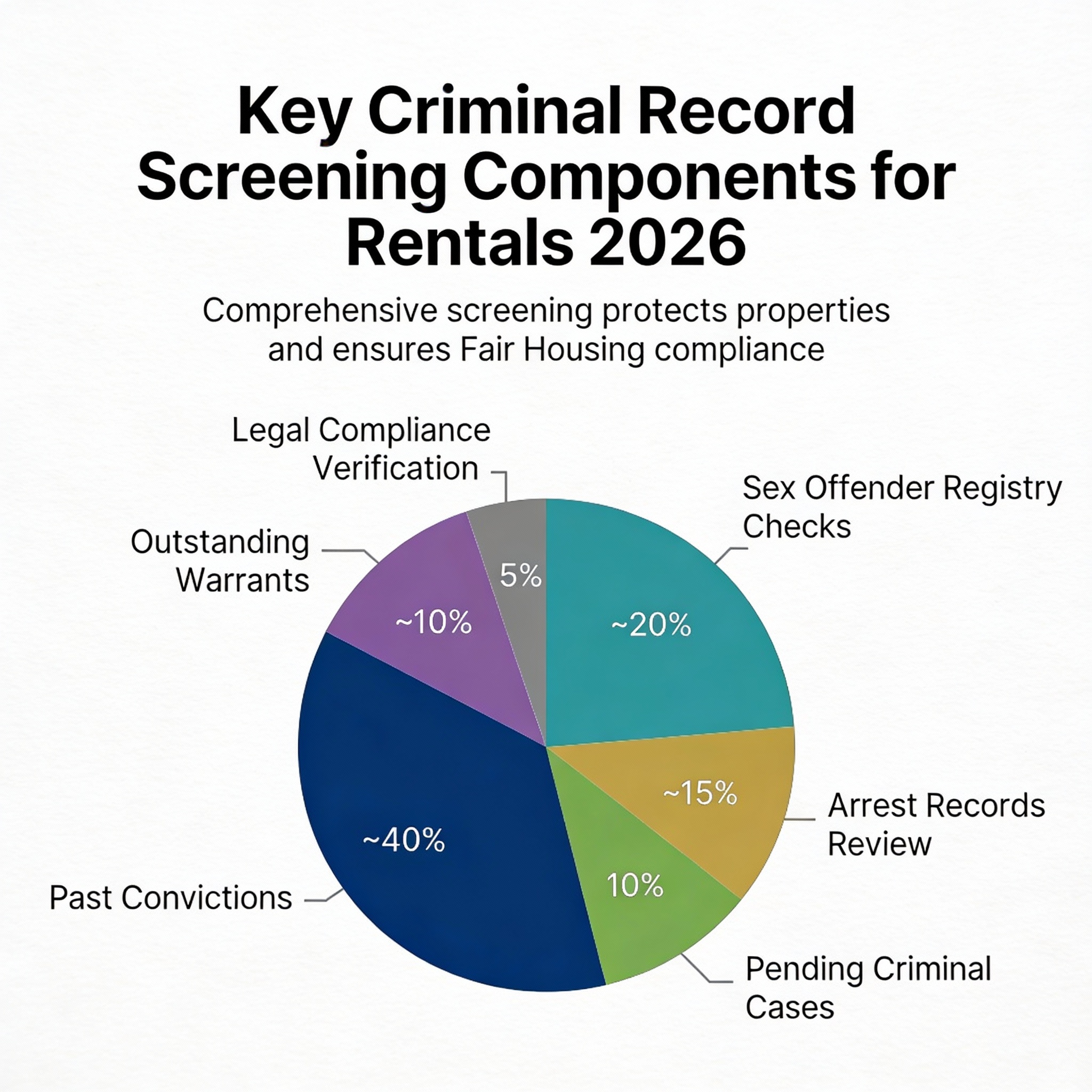
This pie chart illustrates the key components of criminal record screening for rental properties in 2026, with past convictions representing approximately 40% of evaluation focus, followed by sex offender registry checks (20%), arrest records review (15%), pending cases (10%), outstanding warrants (10%), and legal compliance verification (5%).
Why Criminal Record Screening Is Essential for Rental Property Protection
Criminal record screening is vital for landlords seeking to identify tenants with criminal histories that may threaten property security, resident safety, or lease compliance.
Enhanced Property and Resident Security
Screening for violent crimes (assault, battery, domestic violence, weapons offenses), property crimes (burglary, theft, arson, vandalism), and drug offenses (manufacturing, distribution, trafficking) ensures a secure environment for all residents living on the property. With HUD regulations requiring mandatory denial for lifetime sex offender list registration and drug-related activity in federally-assisted housing within 3 years, landlords have clear authority to screen for safety-related criminal histories.
Preventing Illegal Activities and Lease Violations
Criminal record screening prevents individuals with histories of illegal activity from renting, reducing the likelihood of on-site criminal behavior, drug activity, property damage, or lease violations that trigger costly eviction proceedings averaging $3,500–$10,000 per case.
Maintaining Fair Housing Compliance
Adhering to Fair Housing Act requirements, November 2025 HUD guidance, and state/local housing laws ensures fair treatment of all applicants and protects landlords against discrimination lawsuits and penalties that can reach $115,054 for repeat violations. Professional screening through SmartScreen automates compliance, documents individualized assessments, and creates defensible audit trails.
How SmartScreen Conducts Comprehensive Criminal Record Screening
SmartScreen uses advanced technology and multi-database searches for thorough, accurate, and compliant criminal record screenings:
Multi-Database Cross-Referencing
SmartScreen compares applicant data against county, state, and federal criminal justice databases, national sex offender registries, and public court records using multiple identifiers (name variations, date of birth, Social Security Number) to catch records that single-source checks miss. This comprehensive approach delivers 96–99% accuracy compared to approximately 80% for manual checks.
Comprehensive Reports with Verified Data
Reports include detailed information on:
Past convictions: Felonies and misdemeanors with case details, offense types, sentencing, and disposition dates.
Arrests: Records when the individual was taken into custody (with Fair Housing limitations on using arrests without convictions).
Sex offender registry listings: Flags applicants on national and state registered offender lists—one of HUD’s mandatory denial categories.
Pending criminal cases: Identifies active proceedings or outstanding arrest warrants indicating current legal jeopardy.
Relevant legal details: Court jurisdictions, case numbers, and disposition information for verification.
Speed and Efficiency
SmartScreen retrieves and verifies data quickly, providing landlords with accurate, actionable reports in 2–5 minutes, rather than hours or days for manual checks. This rapid turnaround allows landlords to make informed decisions without delaying the leasing process or losing qualified applicants to competitors.
For more on SmartScreen’s screening technology, visit SmartScreen’s background check services.
What Information Is Included in a Criminal Record Check?
A comprehensive criminal record check typically includes:
1. Past Convictions (Highest Evaluation Weight)
Past guilty verdicts for criminal activities, including felonies (serious crimes punishable by more than one year in prison, such as violent crimes, drug trafficking, burglary, fraud) and misdemeanors (less serious offenses punishable by less than one year, such as petty theft, disorderly conduct, minor drug possession). Conviction records provide the strongest legal basis for tenant screening decisions because they represent proven criminal conduct rather than allegations.
2. Sex Offender Registry Listings
National and state sex offender registry searches flag applicants on registered offender lists—one of HUD’s mandatory denial categories requiring automatic rejection for lifetime sex offender list registration. This screening protects vulnerable residents and ensures compliance with federal housing regulations.
3. Arrest Records (with Fair Housing Limitations)
Records documenting when individuals were taken into custody by law enforcement. Critical compliance note: HUD’s November 2025 guidance rescinded prior arrest-only restrictions, but using arrests without convictions still raises Fair Housing concerns because arrest rates show substantial racial disparities, potentially causing disparate impact discrimination. Best practice: Do not deny housing solely on the basis of arrests without convictions; arrests may justify further investigation into behavior, but an arrest alone cannot serve as the basis for denial.
4. Pending Criminal Cases
Information on active criminal proceedings where charges have been filed but not yet resolved. Pending cases may indicate current legal jeopardy affecting a tenant’s ability to fulfill lease obligations or remain in the community, warranting individualized assessment.
5. Outstanding Warrants
Active arrest warrants are issued by courts for failure to appear, unpaid fines, or other legal violations. Outstanding warrants suggest ongoing legal problems and potential flight risk, both of which are relevant to tenant reliability.
6. Legal Compliance Verification
Automated checks ensuring screening procedures comply with Fair Housing Act requirements, November 2025 HUD guidance, FCRA consumer reporting standards, and state/local laws, including “ban the box” restrictions and conviction look-back period limits. SmartScreen’s platform automatically adjusts for all 50 states, ensuring compliance regardless of jurisdiction.
How SmartScreen Verifies Criminal Record Information Accuracy
SmartScreen employs rigorous validation processes to ensure report accuracy and reliability:
Cross-Checking Multiple Independent Sources
SmartScreen checks data across county court records, state criminal justice databases, federal databases (FBI National Crime Information Center, where available), and sex offender registries for consistency and reliability. This multi-source validation catches errors, outdated records, and identity mismatches that single-database checks miss.
Advanced Validation Standards
Biometric identity verification, document fraud detection, and cross-database matching using multiple identifiers prevent misreporting and errors, ensuring reports are reliable and defensible if challenged. With 96–99% accuracy and zero record-keeping failures across 1.8 million checks, SmartScreen’s validation standards exceed industry norms.
Benefits of Using SmartScreen for Criminal Record Screening
SmartScreen delivers landlords measurable advantages over DIY manual checks or basic screening services:
Fast and Efficient Results
Get detailed criminal background reports within 2–5 minutes, instead of hours or days, so landlords can make timely decisions without losing qualified applicants to competitors who move faster.
Comprehensive Multi-Component Results
Review criminal history, rental history, credit history, employment verification, eviction records, and identity authentication for a complete view of the applicant’s reliability—reducing eviction rates up to 50% and problem tenant rates from 28% to 6%.
Automated Legal Compliance
All checks adhere to Fair Housing Act requirements, November 2025 HUD guidance, FCRA consumer reporting standards, and state/local screening laws through automated consent management, individualized assessment documentation, and jurisdiction-specific adjustments—avoiding discrimination penalties that can reach $115,054 for repeat violations.
For comprehensive tenant screening, visit SmartScreen’s tenant screening tips for landlords.
Using Criminal Record Screening Results to Make Informed Decisions
Landlords can use criminal record screening results strategically to identify high-risk tenants and select reliable renters:
Identifying High-Risk Tenants
Criminal record screening highlights warning signs, including:
Recent violent crimes: Convictions for assault, battery, domestic violence, weapons offenses, or other violent behavior within the past 3–7 years pose direct threats to resident safety.
Drug-related offenses: Manufacturing, distribution, or trafficking convictions trigger HUD mandatory denial standards for federally-assisted housing and indicate high risk for private market rentals.
Property crimes: Burglary, theft, arson, or vandalism convictions suggest threats to the landlord’s property and other residents’ belongings.
Multiple recent convictions: Patterns of ongoing criminal activity indicate unreliability and a lack of willingness to comply with legal obligations, including lease terms.
Active legal problems: Pending cases, outstanding warrants, or probation/parole status affect a tenant’s ability to fulfill lease obligations and remain in the community.
Concrete example: An applicant’s criminal record shows three theft convictions within the past 5 years, including one from 8 months ago. Additionally, the applicant has an outstanding warrant for failure to appear in court. This pattern of recent, ongoing property crimes, combined with active legal jeopardy, justifies denial based on documented safety and reliability concerns—provided the landlord applies consistent criteria to all applicants and documents the rationale for the individualized assessment.
Making Informed Decisions on Tenant Selection
Landlords should evaluate the complete applicant profile rather than relying solely on criminal records:
Holistic assessment framework:
Criminal history: Nature, severity, recency, and patterns of offenses.
Financial stability: Credit scores, debt-to-income ratios, income verification showing ability to pay rent (3x monthly rent minimum).
Rental history: Previous landlord references, payment patterns, lease compliance, and eviction records.
Employment verification: Stable employment history confirming reliable income sources.
Rehabilitation evidence: Clean records since conviction, stable employment, positive references, completion of treatment programs.
Example of proper Fair Housing–compliant assessment: An applicant’s criminal record reveals a single non-violent misdemeanor conviction (shoplifting) from 9 years ago. The applicant has been employed with the same company for 6 years, has an excellent credit score (750+ FICO), and provides positive references from previous landlords documenting 8 years of on-time rent payments and no lease violations. The landlord conducts an individualized assessment, documents the offense’s age and non-violent nature, notes the strong positive factors, and approves the application—resulting in a reliable 4-year tenancy with zero issues.
Fair Housing Compliance: Avoiding Discrimination in Criminal Record Screening
Despite November 2025 HUD guidance rescinding prior restrictive recommendations, Fair Housing Act protections against disparate impact discrimination remain fully intact, requiring landlords to use individualized assessments rather than blanket bans.
Legal Requirements for Criminal Record Screening
1. No arrest-only denials: Using arrests without convictions to deny housing raises Fair Housing concerns because arrest rates show substantial racial disparities, potentially causing disparate impact discrimination even after HUD’s November 2025 guidance rescission.
2. No blanket conviction bans: Resident selection criteria should not include automatic exclusions for all convictions or all felonies because such policies are likely to be challenged via disparate impact claims under the Fair Housing Act. Screening based on convictions remains permissible, but policies must be narrowly tailored and include individualized assessment.
3. Individualized assessment required: Consider offense nature and severity (violent vs. non-violent, property crimes vs. minor misdemeanors), time since conviction (recent vs. 7+ years ago), recency and patterns (single old incident vs. multiple recent violations), and rehabilitation evidence (stable employment, positive references, clean record since conviction).
4. Consistent criteria applied uniformly: Use standardized, written screening policies applied to all applicants regardless of race, color, religion, sex, national origin, disability, or familial status. Inconsistency is primary evidence in discrimination claims.
For comprehensive Fair Housing guidance, review HUD’s Fair Housing rights and obligations and SmartScreen’s tenant screening laws overview.
Frequently Asked Questions
What is criminal record screening for rentals?
Criminal record screening for rentals is the process of checking a potential tenant’s criminal history through county, state, and federal databases to evaluate past convictions, sex offender registry status, arrest records (with Fair Housing limitations), pending cases, and outstanding warrants—ensuring the safety of properties and communities while maintaining Fair Housing compliance through individualized assessments rather than blanket bans.
Why is criminal record screening important for landlords?
Criminal record screening informs tenant selection decisions by identifying high-risk patterns including violent crimes, drug offenses, property crimes, and ongoing legal problems that threaten resident safety, property security, and lease compliance—reducing eviction rates up to 50%, cutting problem tenant rates from 28% to 6%, and protecting landlords from liability while ensuring Fair Housing compliance and avoiding discrimination penalties reaching $115,054 for repeat violations.
What information is included in a criminal record screening for rentals?
Comprehensive criminal record screening includes past convictions (felonies and misdemeanors with case details), sex offender registry listings (mandatory denial category under HUD regulations), arrest records reviewed within Fair Housing limitations, pending criminal cases and active proceedings, outstanding arrest warrants, and legal compliance verification ensuring adherence to Fair Housing Act, November 2025 HUD guidance, FCRA standards, and state/local screening laws.
How does SmartScreen conduct criminal record screenings for rentals?
SmartScreen searches national and state criminal justice databases, county court records, federal databases, and sex offender registries using multi-database cross-referencing, biometric identity verification, and fraud detection to deliver 96–99% accuracy in 2–5 minutes with automated Fair Housing compliance, individualized assessment documentation, and jurisdiction-specific adjustments for all 50 states—backed by 22+ years of expertise and zero record-keeping failures across 1.8 million checks.
Can a landlord legally reject a tenant based on their criminal record?
Yes—landlords can legally reject tenants based on criminal records if decisions are non-discriminatory, follow Fair Housing Act requirements, use consistent written criteria applied uniformly to all applicants, conduct individualized assessments considering offense nature/severity/recency/rehabilitation rather than blanket bans, and document decision rationales—with professional screening through SmartScreen automating compliance and creating defensible audit trails that protect against discrimination penalties reaching $115,054 for repeat violations.
Are there laws protecting tenants with criminal records from discrimination?
Yes—the Fair Housing Act requires landlords to evaluate applicants individually rather than using blanket bans on all convictions or all felonies, because such policies cause disparate impact discrimination disproportionately excluding protected classes, particularly regarding arrest-only records showing substantial racial disparities, with November 2025 HUD guidance rescinding prior federal recommendations but not changing Fair Housing Act protections that remain fully intact and enforceable through HUD complaints, state agencies, and federal court lawsuits recovering compensatory damages, punitive damages, and attorney fees.
Conclusion: Trust SmartScreen for Comprehensive Criminal Record Screening
SmartScreen is a trusted partner for landlords seeking reliable, comprehensive, and compliant criminal record screening in 2026. Its platform delivers multi-database criminal background checks, credit reports, rental history verification, employment authentication, eviction record searches, and identity verification—empowering landlords to make safer and more informed tenant selection decisions that reduce eviction rates up to 50%, cut problem tenant rates from 28% to 6%, and extend average tenancies from 8–14 months to 24+ months, delivering 285% ROI.
With an easy-to-use platform, 2–5 minute results achieving 96–99% accuracy, strict Fair Housing and FCRA compliance through automated consent management and individualized assessment documentation, and 22+ years of expertise with zero record-keeping failures across 1.8 million checks, SmartScreen is the landlord’s choice for accuracy, efficiency, legal protection, and peace of mind in today’s complex regulatory environment.
For comprehensive tenant screening tools and expert support, visit SmartScreen’s tenant screening platform.